I am headed somewhere other than our sense of things,
where I am supposed to believe in notions I do not believe—
that our mad wrack of engines and enterprise will end in disaster;
or that after centuries of darkness, we have awakened to the darkness.
The irregular pocks of the moon in their regular circles, the one
time one will ever hear that song in the park, walking along
after too long of a day, much too long; when, for a moment,
all ambition and sense of self fades into a fascination
with the texture of paint on a wall—this is my testimony,
my uncool punkly trudge of hope. I am on a city bus,
I am walking alone through the woods, the mushrooms
gather the fallen limbs into the humus, and someone else
gets on, and someone else gets off, and the driver reads a page
of The Andromeda Strain at a long stop, and through the window
of the nearby deli someone drinks from a cream soda and rubs
their hair back—the day has been long, the evening has been long,
the respites in the long evening strange and sudden. A soft fall
of a cup onto a table, and someone has put their head
in their hands, cradling it as if cradling their migraine
(and isn’t the whole damn day sometimes a migraine?).
In spite of the facts (and in spite of those who spite them),
I am moved to pat the shoulder of the driver as I leave
to fall into the unmade bed alone, and look him in the eye—
it’s been too long since I’ve looked anyone in the eye—and I say
“Thanks, man.” And he says, “No worries, man. Got far to walk?”
And I say No, although I suppose I do. You know how that goes.
Let’s do it this way.
Let’s turn and sashay
just off the beat,

making it up as we go,
like a tree twenty years on
still sways from a storm,

but manages to have wriggled
its caddy-corned way
above the winter hill crest

with its web of winter light. &
let’s not try to name the light,
or the feeling of the light.

Let’s not say what we’ve said before;
or, if we must, just bring in the mistletoe
and the old jazz records and let’s try

to make everything a little
like it was before, but only
a little before,

for a little bit more, before
the entropy, before the key change,
before the new buds blossom at the door.
The sky is drab, and then you learn how that backdrop
crystalizes the blue of the hills on the day of the first snow,
and then the sky becomes misty and darkly luminous. Everything
comes closer. Hellish faces of spiders soften into the rainbows
of the Phiddippus.  In repetition, the knowing scatters. In repetition,
knowing scatters. In repetition, something happens—a nail loosens,
or a thread unspools in the dark room, and un-stitch by un-stick
or board minus board the house makes itself in the tree’s undoing.
Gold, in the age of cell phones, is losing its valuable, gaining its value.
The well-to-do long for interesting notions—trips to Mars, the search
for an engineered unicorn, sex with someone who actually likes them,
despite their hideous backstory or hideous stream of capital investment.
Between my depressions, I like to frequent minds beyond paradigm
and piss-ass: the moral exactitude of bell hooks, the forbearance
of Lao Tzu, Buckminster Fuller’s optimistic spits into the wind
of seventeen apocalypses. What a great privilege it is to scribble
and make puns when women and men have literally died
for the right to learn what they would need to play Scrabble.
Some days, we must act on this fact, or lose our souls. On others,
pot-bellied pigs in bow ties wink at us from the two remaining
wholesome ends of the internet, absurd synchronous blessings,
like those passages in Mark where Jesus mysteriously retreats up a hill.
I think I love myself, and then I send myself mixed messages. I feed myself
coffee and cholesterol and 3am for a week, but then find myself smiling,
in the midst of a stringy addle, at the audition tape of an aspiring oboist.
Be careful out there, people tell you. But you must be careful inside, too—
not only are there the dangers of stainless-steel pans, but the steel wool ego
with its desire to compete for the EGOT. It only makes middle-brow white-
bred tear jerkers, and although its sense of editing is impeccable (it can flip
the script on almost anything), never once has anyone walked away from it
overjoyed or edified. Beauty is the music of escape from all of that—the pain
of the tortured artist? Horseshit. Consider the territory inhabited by Rumi
and Bach—their immaculate genius of daily vegetables and daily kneeling.
Rejoice, for today, at the blank grey sky. Sufficient are the evils thereof.
Matt Prater is a writer from Saltville, Virginia. His work has appeared in Spillway, Hampden-Sydney Poetry Review, Poet Lore, and The Hollins Critic, among other locations.
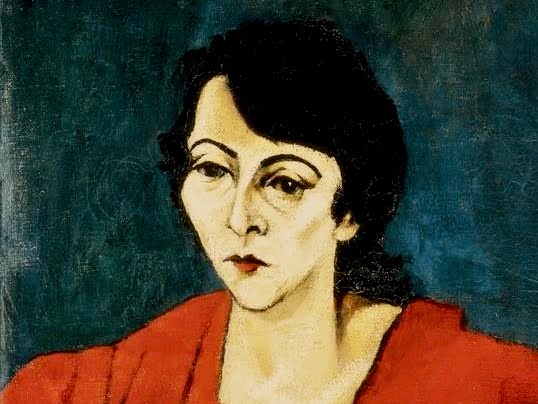
Three painting by Lajos Tihanyi.
The Critic, Self portrait, and Woman in Red, 1916-1918.
A self-taught artist, Tihanyi combined the fragmentation of Analytical Cubism and the psychological intensity of Expressionism in his portraits. The Critic figure has been identified as a particular individual—Andor Halasi, a literary critic Tihanyi knew well—yet the sitter’s sharply rendered features almost suggest a physical type for the profession, with a high, intellectual forehead, alert eyes, long nose, and pinched mouth. From the collections of the Brooklyn Museum.