Put scalpel to skin, electrocautery to tissue, saw to
middle sternum. Incise pericardium, then aorta.
Place one finger to plug the hole that you have made.
Cannulate, stop the heart.
Years later, my father would confess, as a boy,
you moved in such a way that I found feminine.

Suture grafts to coronary vessels.
Tie seven knots per stitch.
Dr. Nicolosi, in his office, said, I have patients
happily married to women, men who went to bathhouses.
Lower the head, return volume to the heart.
My mother would say, the saddest thing is
to die alone.

Control the heart’s new rhythm,
control the bleeding that is there, yes, men who go to bathhouses
and wire the halves of the sternum shut.
Half-sedated in the fridge’s cold,
piled in brown paper bags like broccoli,
swaying their long antennae,
their rubber-banded pincers, alive,
far from the crags of marine ground
and the taste of dark salty water.
I remember seven lobsters
at a dinner party of seven friends:
how we put pots onto the stovetop,
brought water to a boil,
held each to our faces, inspecting
the ugly carapace of bodies,
the black fish-eggs of eyes,
liquid passing into steam, their
hundred thousand neurons electric.
I remember one lobster splaying its claws,
some benthic insect or angel
surprised by its own wing span
exceeding a pot’s diameter,
how I hid my face,
happier to commit cruelties
without knowing,
until we dropped lobsters one by one
and I watched through a glass lid
when two kept moving
longer than seemed humane,
except what is humanity
when it comes to lobsters becoming
more beautiful when they are boiled.
And we marveled at that deep red
their speckled brown shells became,
salivated in thickening kitchen air,
twisted tails from thoraxes,
hungry for white meat drenched
in butter and brine, our hands
covered in both. Is it
erotic or monstrous
that I picture you
sucking my flesh off of bone?
Except I am not a lobster,
and I would eat them
again and again, for the taste.
One resident
   teaching two students
      means three swaying

black stethoscopes
   like the gentle trunks of elephants
      sniffing at a woman’s chest,

hollow rubber sending
   her electric charges
      into the coils of my ear,

into the blue spark
   of recognition that I am
      lonely, very lonely,

as the doctor mimics
    this specific heart’s
      systolic murmur

with the same mouth
   he uses to kiss his wife
      and deliver bad news,

as our patient’s eyes
   fix themselves onto
      the window’s elsewhere

and try to crack the glass:
   I am learning today
      how a mother elephant

lies down
   beside her child’s body,
     stops eating, drinking,

suffers a broken heart,
   another animal that is
      capable of grief.
Joe Tobias is a surgeon and poet in Portland, Oregon. His recent work has been published in Alaska Quarterly Review and elsewhere. He is a graduate of the Bennington Writing Seminars.
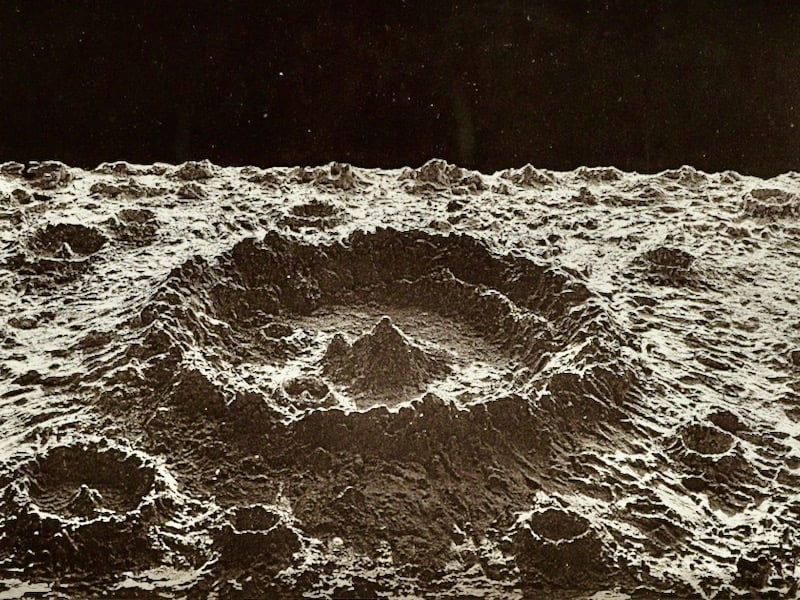
At first glance these intricate depictions of the moon might seem like photographs from the Apollo space program of 1961–75. In fact they were captured a century earlier by an ingenious and wholly land-based Scottish astronomer. Peering through a self-made telescope, James Nasmyth sketched the moon’s scarred, cratered and mountainous surface. Aiming to “faithfully reproduce the lunar effects of light and shadow” he then built plaster models based on the drawings, and photographed these against black backgrounds in the full glare of the sun. As the technology for taking photographs directly through a telescope was still in its infancy, the drawing and modeling stages of the process were essential for attaining the moonly detail he wanted. From the Public Domain Review