Les Chemins de Saint-Jacques de Compostelle


In the shop Maison Necty, I buy alfalfa
honey and the necklace I was meant
to find on my village retreat: iron scallop
shell looped on a black cord, sign of hope

and strength guiding the faithful,
the penitent along the Way of St. James
since the Middle Ages. Call it protection
or symbol of rebirth, lined like the routes

pilgrims traveled leading to one point:
the tomb in Santiago de Compostela.
Saint James’ unearthed remains were said
to be covered with scallop shells. Scallops

in every corner of my village, embedded
in plaster, on door lintels—milestones
from France to Spain for the weary, the lost—
not that I’m either, but I’ve returned

to the particular light of this place, tapping
the ground forward without knapsack
or clocked miles. I think I would like to
join them on the Camino and know

the relief of cold cider and unlaced shoes
at day’s end. For now, it’s enough to wear
the necklace strung across my cobbled heart,
making the way as I go, ever closer
to what saves me.
I may belt out lyrics on Falcon Radio driving to the co-op for coffee and pesto, but I’m no singer. Not like the three songbirds chopping shallots for risotto, arranging chèvre and apricots in the centuries-old farmhouse for our poetry residency in the south of France. In the kitchen, in our studios, poplar beams tune to Dolly, Piaf, rounds of “Frère Jacques,” fluted as the doves’ refrain in the wispy cottonwoods. Voices alight in the rafters, plaintive and feathery, belying the thorns we’ve tufted with imagery and elegy, each one still the daughter who stepped on a crack and broke her mother’s back, each singing on despite the breakage. I never knew why my mother didn’t join her three sisters in their trio at Lockeland Baptist, each washed in postwar blood, lambs on the pyre of their father’s drunkenness. June, the alto, sewed her own dress of black tulle and formed The Charmers with two friends, dubbed Nashville’s Andrews Sisters on WLAC. My mother, the lone mate, clipped her own wings to spite whatever threesome meant home, whatever harmony eluded her, flinging herself against one impossible glass house after another. I, the missed note, the minor key, the afterthought, except these French evenings when bridge lights spangle the Garonne and the light itself sheds whatever remains of grief, when my poetry sisters, charmers of rosé and camembert, raise glasses and lilt over village and river in one unbroken hymn.
                        Without thinking,
I nearly bought the bottled inks
in the museum shop at Moissac Abbey,
an 11th century monastery, imagining
his flourishes on ivory vellum like
the monastic scribes at their religious texts
by guttering candle just before or after
matins or vespers, in constant
vigilance.

                        His favorite inks
oxblood, jade, South Seas blue, I imagined
monks at their barrels of boiled onion skins,
walnut hulls, plums—hours stirring,
poring over holy manuscripts. His poetry
no less holy, a distillation of sound,
memory, color awakening
on the furrowed page.

                        Then I left the inks
for others in love with a sleek nib
and rivered flow on parchment. I left
the years of our parting, his exhausted heart
tired of me, tiring of life itself—his prayers
likely unanswered, vain search for just the right
something to bloom in topaz or aubergine.
In the light of day, my own script brightens,
shed of the moldering past,
my pen a wash of petals.
At seventy, I keep moving—warrior pose,
on my knees in the garden, hefting brush
over the fence—but here in a village in France

I stand at the line, still as the girl who once
held clothespins for Mrs. Jones draping sheets
and shirttails buoyant in the backyard,

the girl who counted hours until her mother
stepped off the 5:15 bus and they walked
to their attic apartment on Stratton.

I haven’t seen a clothesline in years,
much less unpinned tea towels and aprons,
stiff and fragrant with sun and late spring,

folding each as I would for my own kitchen.
Something inside me flutters and sails
with the reverence of this act, lost to time,

something still waiting, still counting—tuned
to the pins like little ears clasped at the neck
and shoulders of life as it keeps moving.
Poet, playwright, essayist, and editor, Linda Parsons is the poetry editor for Madville Publishing and copy editor for Chapter 16, the literary website of Humanities Tennessee. She is a poetry mentor in the MTSU Write certificate program and has published in such journals as The Georgia Review, Iowa Review, Prairie Schooner, Southern Poetry Review, The Chattahoochee Review, Baltimore Review, and Shenandoah. Five of her plays have been produced, and her fifth poetry collection is Candescent (Iris Press, 2019).
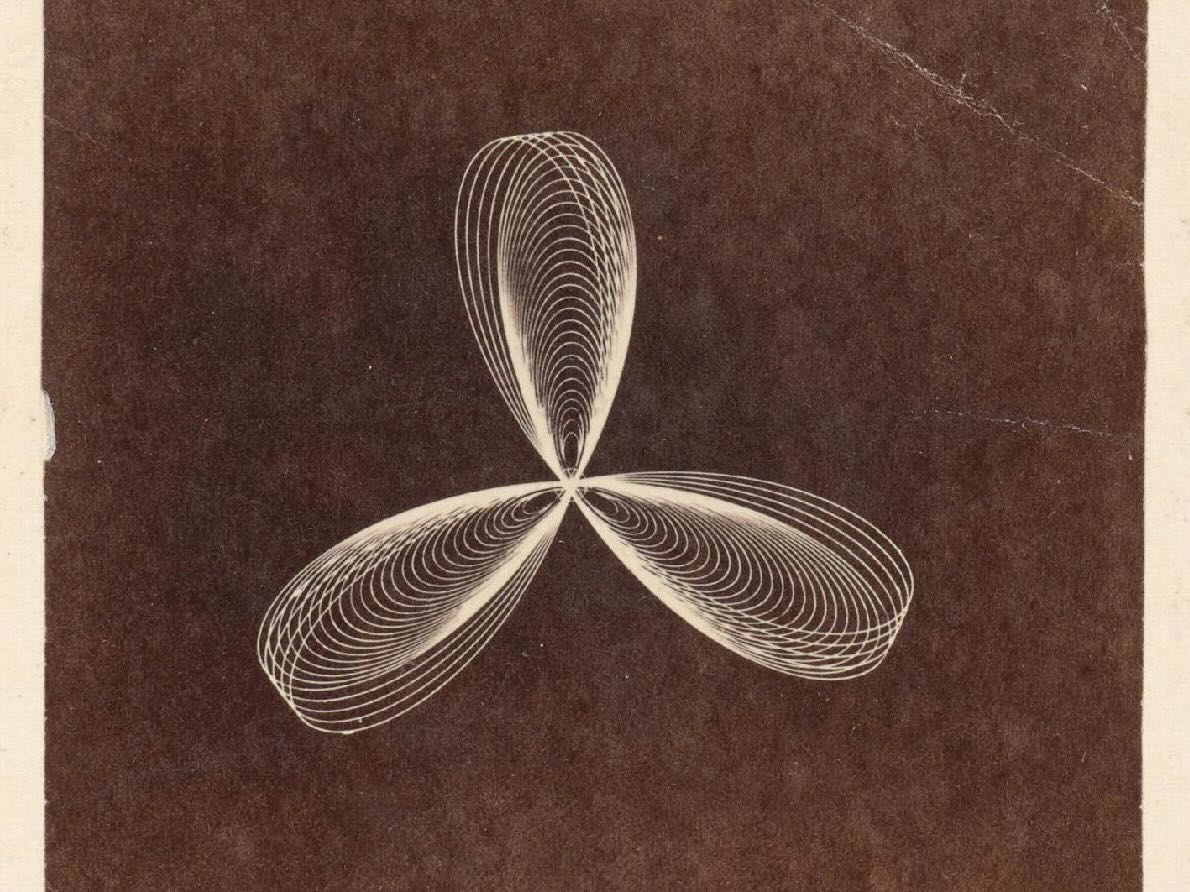
This early photography book, titled Specimens of Fancy Turning, features thirty tipped-in albumen silver prints of geometric designs created on “the hand or foot lathe”. Resembling something between spirograph drawings and textbook diagrams of orbiting electrons, the figures were created using geometric, oval, and eccentric chucks and an elliptical cutting frame. Attributed to “an amateur” on its title page, the book is the work of Edward J. Woolsey (1803–1872), an heir of the mercantile Woolsey family and partner in the New York Patent Sugar Refinery. From Public Domain Review.