I know the reason a snake sheds its skin
know the reason the crab forsakes
its lonely shell on forgotten beaches along the coastline
to fill with water and float away like storm-wracked boats
I know the feeling of the carapace grown too tight
the world within grown larger than the world beyond
And when the skin grows thin to tearing with
all that you contain and all that you must hold
I know the feeling of looking up at the night sky
of counting all the stars your eyes can discern
knowing that if you multiplied them a hundred fold
only then might they begin to contain
the maddening clamor of your thoughts
I know that if you could reach out just one hand
and pluck a single bright jewel down to wish on
the only thing your heart could imagine wanting
is to break free of this chrysalis and fly away.
Each year, the placard tells us,
     Ho-Chunk Indians
         burned this prairie to ash,
      rooting out invasive species –
           the buckthorn and the honeysuckle,
                  so eager to conquer
                      and upend precarious order.

Still, when settlers came,
   with their muskets, beaver traps, plagued blankets,
larceny disguised as
            gratitude
                       no cleansing burn laid clean the land
                       no prairie fires
  released the seeds of a new spring
                   and the ancestors’ ghosts wept.

Today, trudging up sage-drab
     hillside snaked by waterways,
        lined in desiccated grasses,
   looking down on fields of
oxtail, purple coneflower, silky aster
     cleaving mightily to the
embattled substrate,
             clamoring their defiance
                in gaudy hues,
     I am thinking of how
           the Ho-Chunk know a secret:
that to destroy something so
                 very precious to you,
          some part of what you call home,
 is to let it return to you
     filled only with
             the essence of all
it was ever meant to be,
      black and bare,
                 seeded
                        and ready for spring.
And if you tried to look me up
in a dictionary, searched every page,
scoured old manuscripts, unrolled papyrus
back to the ages of the disciples and fishes and loaves,
crawled through dusty low-scraping grottos
towards the innards of ancient pyramids to
scry the hieroglyphs of ages, never would you
see my likes, find any tongue or translation,
to describe me, for I am untranslatable,
my body the unutterable truth of the generations
of queens turned to slaves, of shamans and
seers turned dime-store hustlers, yet who
in the glimmering nights held one another
like diamonds, unwilling to relinquish
what they knew was priceless.

The language of your ancestors
cannot hold my own. Fraught with
Freudian slips and poor transcriptions,
the sing song lilt, the cheeky click and
clack of my greatest grandparents is
beyond your limited vowel roundness,
and if something was caught
in the final translation, it is that
which warned you that a caged soul
doesn’t remain caged forever,
and that finding our own tongue again is
the sweetest form of vengeance.
R. B. Simon is a queer artist and writer of African- and European-American descent. She has been writing poetry since teenage angst first hit at age eleven, but sincerely hopes it has improved with age. She loves the expansive capacity of words, from the hunt for specificity of language, to the opportunity to evoke visceral responses in an audience and aspires to transport the reader into a crystallized moment in time or state of emotion that can be felt beyond the words. She has been published in the Terra Preta Review, The Green Light Literary Journal, Anti-Heroin Chic, Blue Literary Journal, Electric Moon, Bramble Literary Magazine, and Literary Mama. She is currently living in Madison, Wisconsin, with her partner, teenage daughter, and four unruly little dogs.
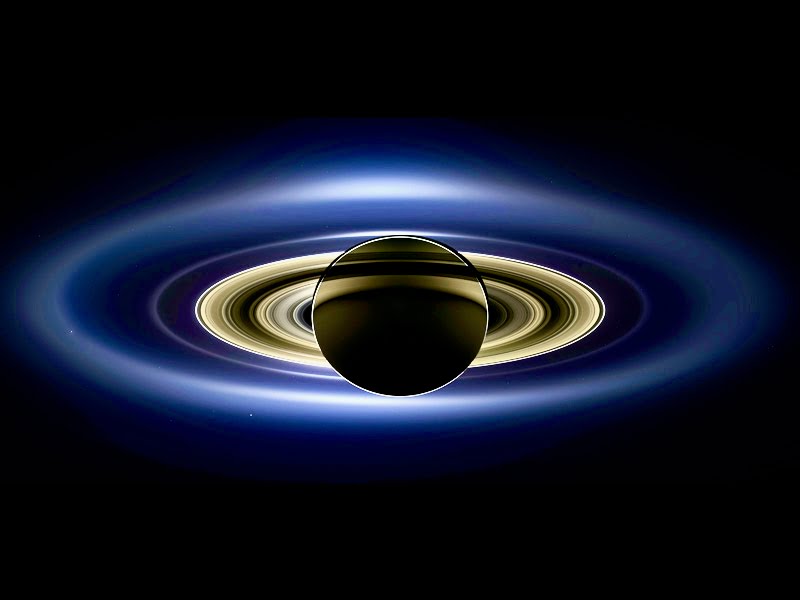
Multiple images of Saturn were taken by the Cassini spacecraft.
In the first image, Cassini slipped into Saturn’s shadow July 19, 2013, and turned to image the planet, seven of its moons, and its inner rings. Image credit: NASA/JPL-Caltech/SSI
The second image is a false color reconstruction of the vortex of Saturn’s north polar storm. Measurements have sized the eye at 1,250 miles across with cloud speeds as fast as 330 miles per hour. Image credit: NASA/JPL-Caltech/SSI.
Finally, a false-color composite image, constructed from data obtained by Cassini shows Saturn’s rings and southern hemisphere. The composite image was made from 65 individual observations by Cassini’s visual and infrared mapping spectrometer in the near-infrared portion of the light spectrum on Nov. 1, 2008. The observations were each six minutes long. Image credit: NASA/JPL/ASI/University of Arizona