He’s been looking for something simple
like hydrochloric acid or magnesium
for the past half hour, but he’s been caught up
by other things: the mummified cat on the top shelf,

the model of a human brain
still tucked away in the model of a human head,
Copernicus, Galileo, Einstein,
bauxite, obsidian, and gypsum.

Passing by the window, there are more
distractions, the varsity football players scuffing each other
in practice, all the weepy-eyed girls
staring astonished as though

these young men could defy physics, like wishes,
to give them anything they want.  This will never happen,
but they don’t need to know that.  A few steps farther,
the clear upside-down

bell of the vacuum chamber waits
for its once a year feeding of balloons and marshmallows,
ready to feast on the air,
drawing it out in one mortifying extended breath.

There is one teacher for all these sections,
a balding minister of a Baptist church,
who tells the boy, quoting a thousand sermons,
he is going to Hell

unless he accepts God into his life.
For a few moments there is a presence
in everything, something blue in the flame
of Bunsen burners, something waiting

in the mongrel pup stored in a jar of formaldehyde,
something in the atoms of helium
that pushes it to float upward toward its own
dispersion.  Nothing that holy could exist

on earth.  So he resigns himself
to tarsus and metatarsus, tibia and fibula.
The quivering skeleton in the back room
all the kids guess is real,

wondering who it was, and if it suffered,
and, if there are souls in heaven, is it there?
But that is another problem, a test
with no observable evidence other than these bones

hanging from a metal pole in the darkness of a storage closet,
ready for its numbered parts to be labeled
and displayed and reassembled.
He could search all afternoon, tomorrow,

and the day after that for whatever it is
he has been sent to find.  Outside this room,
he knows the stars are moving farther away.
The light they send is so fleeting and old.
Sirius, the dog star, and Procyon, the little dog,
I’m in the spill of streetlight

trying to find the brightest stars.  Really,
I should know better, here

in the midst of town where the aura of buildings
and roadways is stronger

than constellations.  Growing up in the country,
I could see every pinpoint

in the sky, the dancing arm of the galaxy aglow
across the night.  Arcturus,

bear watcher, in the last stages of its life, and
Vega, the vulture, there are

so many animals in the sky, so many dead heroes
to keep them company.

I’ve often dreamed myself among them, a few
barely blinking lights

in a cluster somewhere near Orion’s heel.
Which is called Rigel,

the place where Scorpio stung him in fiercest
battle.  But I’ve done

my research—Orion was a giant and the worst
sort of man, the kind

we should all reach up and tear from the sky,
all those stars falling

in fire upon the world.  Canopus is a supergiant,
and Capella is actually

four stars.  I have a hard time orienting myself at this
confluence of rivers bordering

town, the way they snake and change direction.
Betelgeuse is a lion

waiting on the other shore, and Achernar is the end
of this river, which is an ocean,

which is another place too wide to see all at once,
at least from here.  Eventually,

I will go back inside to lamplight, watch a movie
I’ve seen a dozen times

before, maybe something science fiction.
Something that allows me

to weave in and out of stars, and all the fabled
creatures that live among them.
                                                 —no thanks to Shakespeare


My lover’s eyes are nothing like what you’re thinking,
and when I use the word my, I don’t mean to denote
ownership or dominion.  I intend a certain intimacy—
sitting at dinner, our knees touching—or later, asleep,
our arms, our hips, our hands fallen where they may.
May what, I couldn’t say.  And when I say lover,
I don’t mean to imply a strictly physical relationship,
a constant passion ravaging the body.  We walk
along grocery aisles comparing prices.  We sing
and talk and answer tv gameshow questions.  Yes,

I said ravaging.  Sometimes passion shakes your bones
brittle, deprives the body of oxygen, snaps the junctions
in the brain.  My lover’s temperament is earthquake
and typhoon, tornado and lightning.  I wouldn’t have it
any other way.  And when I drown in the deepest
oceanic trench or suffocate in the exosphere, my lover
is my metamorphosis pulling me back to land, restarting
my heart, blessing air back into my eager, ravaged lungs.
David B. Prather is the author of WE WERE BIRDS from Main Street Rag Publishing (2019). His work has appeared or is forthcoming in Prairie Schooner, Cutthroat: A Journal of the Arts, Poet Lore, Colorado Review, The Literary Review, and many others. He studied acting at the National Shakespeare Conservatory in New York, and he studied writing at Warren Wilson College in North Carolina. He lives in Parkersburg, West Virginia.
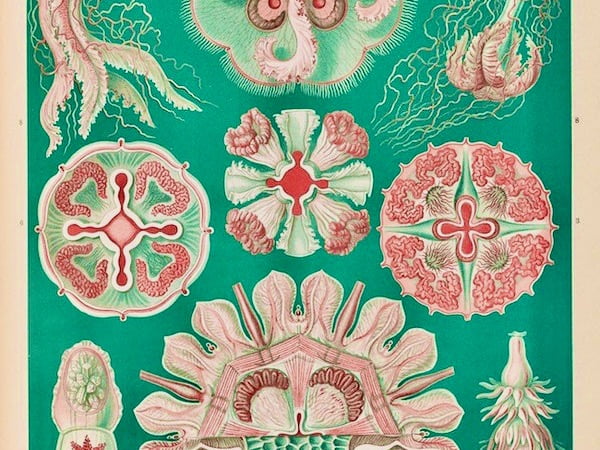
The German biologist Ernst Haeckel was fascinated by medusae, the umbrella-shaped animals commonly called jellyfish. For Haeckel, whose imagination was shaped in the Romantic era, medusae expressed the exuberant yet fragile beauty of Nature. And in their ethereal forms he glimpsed a reflection of his great love Anna Sethe, who died tragically at the age of twenty-nine. As part of his efforts to demonstrate that all living things are interconnected through evolution, he produced monographs on Siphonophorae (1869–88), Calcareous Sponges (1872), Arabian Corals (1876) and Medusae (1879–81). A year after completing the medusae book, a mighty two-volume work describing 600 species, Haeckel had a house built in Jena. He named it Villa Medusa and decorated the ceilings with frescoes of medusae that would later appear as lithographs in his classic book Art Forms in Nature (1899–1904). From Public Domain Review