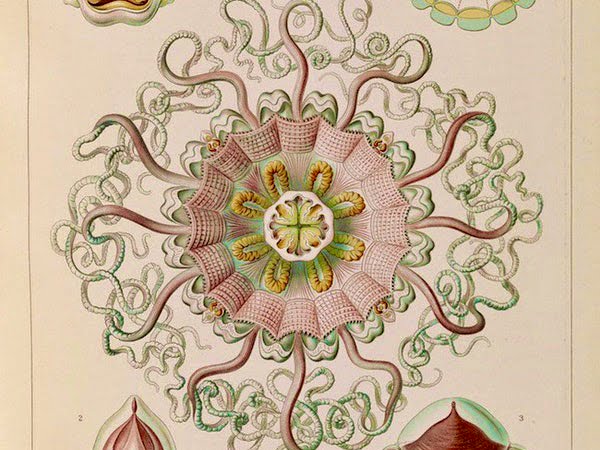
The German biologist Ernst Haeckel was fascinated by medusae, the umbrella-shaped animals commonly called jellyfish. For Haeckel, whose imagination was shaped in the Romantic era, medusae expressed the exuberant yet fragile beauty of Nature. And in their ethereal forms he glimpsed a reflection of his great love Anna Sethe, who died tragically at the age of twenty-nine. As part of his efforts to demonstrate that all living things are interconnected through evolution, he produced monographs on Siphonophorae (1869–88), Calcareous Sponges (1872), Arabian Corals (1876) and Medusae (1879–81). A year after completing the medusae book, a mighty two-volume work describing 600 species, Haeckel had a house built in Jena. He named it Villa Medusa and decorated the ceilings with frescoes of medusae that would later appear as lithographs in his classic book Art Forms in Nature (1899–1904). From Public Domain Review