You won’t admit it. The names alive are like the names/ In graves.
– Terrance Hayes

My brother is lead-chipped metal,
pimp walk in blue prison jumpsuit.
He is dead black skin.

I am the smell of salt
on his neck. I peel the dead skin
from his body like a sunburn.

Brother unearths us from the grave
our father dug for our mothers. We are the soil
formed from their murdered bodies.

When we breathe again
our names are different than the ones given to us.
We speak for the first time.

No one in the prison is awake
to see us turn to seed in the palm
of each other’s hands.
for Carl

During my third visit to prison we play cards:
Skipbo, Uno, Rummy, Spades, Phase Ten.
My brother says, “Somebody took the instructions
out the boxes a long time ago. Ain’t nothin’ here sacred.”

We make the rules up the way we did as children.
We shuffle the decades old decks, so soft they surrender
without a sound.

I’ve run out of dog-eared memories to reference in conversation,
so, I’m thankful for the aging cards in need of shuffling,
for our clumsy memory of the stated rules,
for your homeboy and his old lady sliding into the seats next to us,
for a commissary line so long, it skims the concrete walls
with twenty bodies before our turn, when I say,
“Order anything you want.”

This is the visit you tell me about the twenty years
you kept our father’s name on your waiting list, excluding
the names of others, before acknowledging
he would never show up.

Five hours later, I hunch over my phone in the prison parking lot
to look up the instructions to every game we played.
On the back of the commissary receipt I write the scripture
we’ll follow during all future visits:

Use a standard deck of cards (no Jokers).
Make a tally of the running score.
Put down your sets and runs.
The game continues until a player lays down
all the cards in his hand.
When I visit my brother in prison
every body is black or brown except
the men with guns.

I read once in an article on color theory
black is not a color, it absorbs
the visible spectrum and reflects nothing.
A black object may look black,
but still reflect light.

Black is the absence of color.

In the workshop the white men ask me,
What’s the point of all the references
to race in your poems? Aren’t you more
than just black?

Black’s existence as a color depends
on the object it is transmitted through.

Black is a color dependent on how the receiver
takes in information about color.

Black is only a color when the color agents
are tangible objects.

Like the weight of a boy’s body
against asphalt, left in the street to burn
his blackness into white light.

Like the body of the author of this poem.

Like the smell of metal on my brother’s hands
as he reaches to touch my face
for the first time in twenty-five-years.
I.
That day the hurricane’s breath licked Florida’s
thick back, the wind as hard as our father’s
hands against our swollen legs as we lied
to save us. Did you take it? Tell the truth.
I didn’t know yet that no apology
could fix not having said the right words
to begin with. I was five. Should we have
understood already which objects belonged
to us and which did not? My brother and I
sat in our father’s studio for hours after
watching him sleep off the whiskey, lacing
our small bodies into a tapestry of shame
the color of a fresh bruise. Remember this
he said to me as the lights shuttered off.

II.
He said to me when the lights shuttered off,
Stay quiet. Lightening flickered and sparked
against the ash gray sky. In the narrow hallway
we lit and re-lit the shrinking wick
of a dozen small candles long enough
to see before losing sight again.
Did I know this would be the last time
I’d see my brother as himself before our father
took him away? Would I remember this?
I was thirteen. For hours, alone
together in the dark we appeared
and disappeared to each other.
I finally understood what objects
belonged to me and which did not.


III.
I learned my children belonged to me and they did not
the day the shutters split and shattered against the house
until the wind slowed to nothing but breath.
Will the lights come back on? I’m scared.
Wind had skinned the curtains back to window
and bones. Are you listening to me
anymore? The air was a wet blanket of ash
through the window’s broken teeth. I was afraid
to open the hallway door to see the damage.
My children asked me again,
Will the lights come back on? I was thirty-three.
I didn’t know. I tried to remember
what my brother had taught me.
I told them, I’ll open the door
knowing if the roof had caved in I would dig
a hole through the earth big enough to save them.
Tiffany Melanson is a poet and arts educator with an MFA from the Bennington Writing Seminars. She is the author of the audio chapbook What Happens (EAT Poems), and her work has recently appeared in POETRY Magazine, Bridge Eight, and Compose Journal, among others. She teaches poetry and oral interpretation at Douglas Anderson School of the Arts in Jacksonville, Florida, where she is faculty sponsor of Élan, a student literary magazine, and co-director of the Douglas Anderson Writers’ Festival.
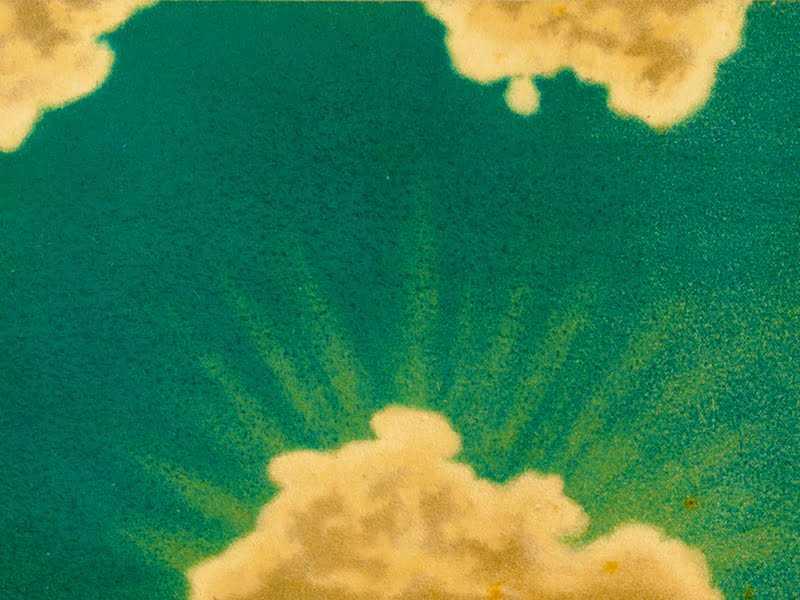
Images from a book published in 1888 — Untersuchungen über Dämmerungserscheinungen: zur Erklärung der nach dem Krakatau-Ausbruch beobachteten atmosphärisch-optischen Störung, which roughly translates as “Studies on twilight phenomena: to explain the atmospheric-optical disturbance observed after the Krakatau eruption.” While most of the book is an exploration via text, by the German physicist Johann Kiessling, the final pages are given over to a wonderful series of chromolithographs from watercolour images by Eduard Pechuël-Loesche, a few of which are selected here. From Public Domain Review.