A flurry today and I think of all the lies sweeping through the air, each one wilder than the last. This snow won’t last. This is the weekend of setting the clocks back, but you are beyond time now. Is that why fear sits on my chest at night and won’t let me sleep. Each flake stern and overbearing, spikey and cold. Each face I see holds the same features, but none of them yours. I stare at photographs and can see even forty years ago how bags began forming under your eyes. A sign of heart disease. That first attack when I was working on a Sunday and your son came banging at the school window and the news sent me to the hospital. They worked on you— oxygen mask, IVs, blood drawn and tested, your blood pressure—too low, too low. If you died then, how would my life be different? If you died then, the river would have rushed through me, plummeting me over rocks. Is it harder now after all these years? What happens to those flakes of snow when they meld into drifts, each one having lost its shape, hardened to ice now, beyond moving, waiting for spring melt.
What you don’t see: my cheeks sharp ridged, my hands islands in the sea of exhaustion. When you ask I say: fine. What I mean is that I am alive, I can walk to the end of the driveway. Out the window all the yellow has leaked away. Only taupe, brown, a dark sludge of snow. When you ask sometimes I say: I’m holding. Though I don’t mention the crumbled earth beneath, the way thoughts of the dead burn away hours of my sleep. Do you ever wake like that after a dream where you remind someone they are dead and they smile? All the tiles in my scrabble board spell his name. Each morning I play games: Wordle and Spelling Bee and Strands, just to check my sanity, to burn up some time. I hope you don’t judge me by how many times I cry, how many sweets I consume, how I feel embarrassed talking to the teller at the bank. Telling her to remove my husband’s name from the account. Five months he’s already been dead. How am I holding up? Or better: What’s holding me up? It’s nearly time to turn the bare earth, to stake the tomatoes. I’ve learned one thing. Nothing I eat fills the emptiness in me. It’s not that kind of hunger, yet still I eat and eat. If I don’t, I’m afraid of what will happen. If I don’t, words like grief and trauma will bury me and I will have to weep.
I don’t believe in ghosts. The haze over the stream is not my dead
husband, but a million infinitely small drops of what once was
water, what once was air. He died in a truck on November
twenty-second while shoals of fish skittered above mud, lips
thrusting. His death hangs on me like dry leaves.
In the ground a cardboard box sags around his ashes. I don’t
believe in ghosts, because I never hear him cursing in the other
room, bent over wires from the electronic ballast of the fluorescent
light, trying to get it to work again. His absence afflicts me,
fills me with guilt. Right now I’m memorizing a poem
by Millay, saying the lines over and over, piece by piece,
digging out the mix of sadness and joy. We used to watch the
osprey sometimes, the one with the nest by the railroad tracks,
watch it glide over the stream, the roof, the drive—worry about
our cats so unfishlike and unlikely. There are so many things I
don’t believe in. We were alike in that. Yesterday I saw two
mergansers out on the stream, the male's white body so plump it
could have been cotton, could have been smoke, blank paper,
the cry of a loon. I don’t believe in ghosts, but I wouldn’t mind finding
a note from him—a yellow post-it in one of the boxes saying he loved
me. Or even a list of all the things we needed that day.
Judy Kaber’s poems have appeared in journals such as Pleiades, Poet Lore, and Prairie Schooner. She won the 2023 Maine Poetry Contest, the 2024 Maine Literary Short Works Poetry Award, and the 2024 Naugatuck River Review Narrative Poetry Contest. She is a past poet laureate of Belfast, Maine (2021-2023).
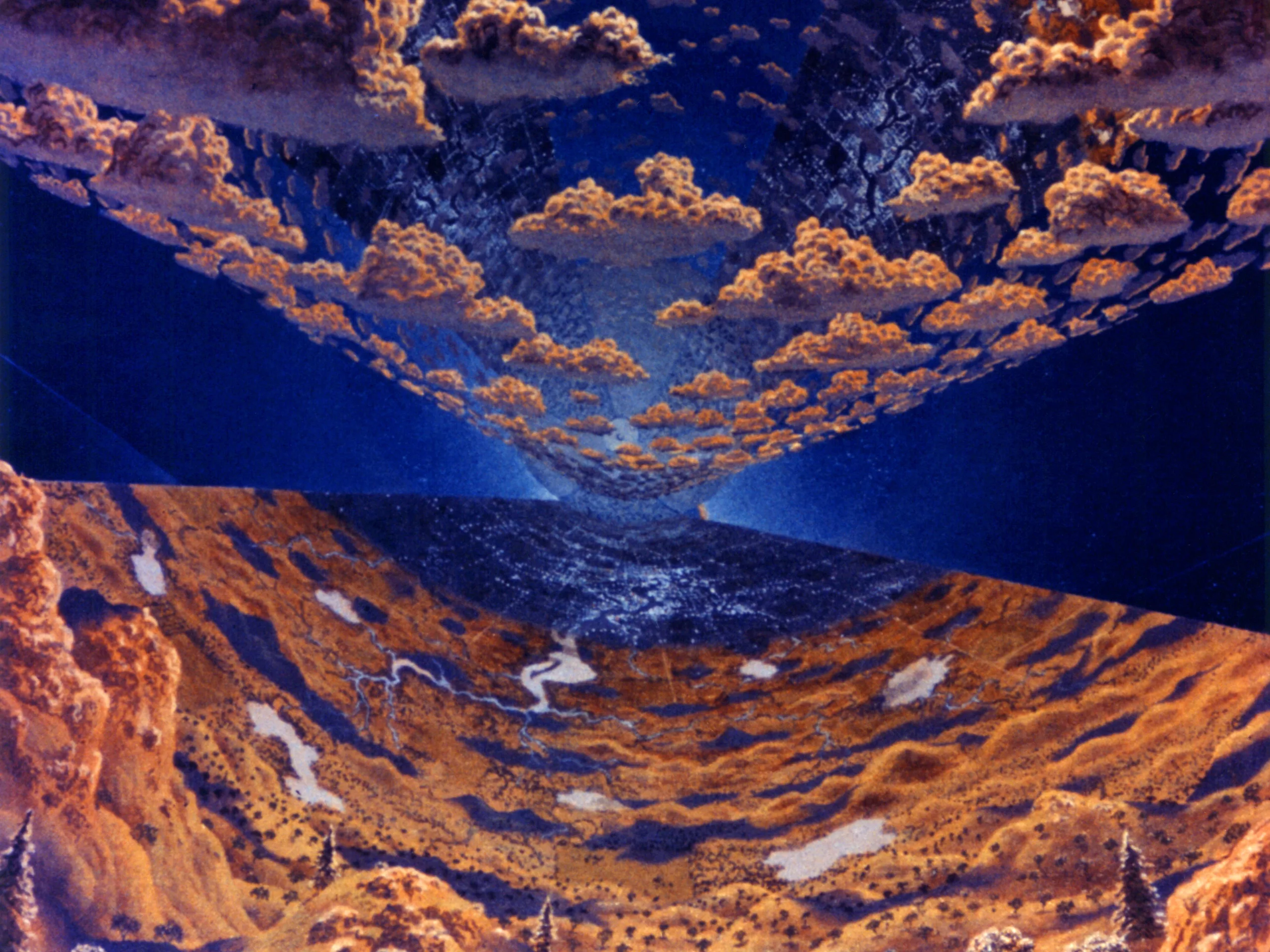
The images gathered below were created in the mid-1970s during O’Neill’s summer research programs on space colonization held at NASA’s Ames Research Center. The artists include Don Davis, who would later help design the visuals for Carl Sagan’s Cosmos series, and Rick Guidice, who illustrated space projects for NASA across fifteen years. In an interview about the project, Davis discusses how his images of O’Neill’s ideas still have a “freshness”, for they continue to embody “the aspirations people have had ever since the space age began”. While this is certainly true — and the artists’ visions of artificial cylindrical worlds have had an outsized influence on science fiction — these psychedelic vistas populated by high-tech homes and cocktail-sipping residents were also a product of their cultural climate.
Image sourced from the Public Domain Image Archive / NASA