“You need to come home for the funeral,” my mom said for what had to be the fourth or fifth time. My mind wouldn’t wrap itself around the other part, though. “Did you hear me, honey? Tiffany’s dead.”
It was August 1995, and I had just moved to Roanoke the week before. I had just put Tyler, my little hometown, in the rearview mirror. There was nothing that could make me go back that soon. I wanted to tell my mother that. I wanted to explain that Tiffany died a long time ago, as far as I was concerned, before we graduated from high school in 1989. How could I say that, though? Even worse, how could I think it?
Mom kept talking about the car accident. Tiffany had been going back to Tyler from Roanoke from a concert, “probably one of those old heavy metal concerts,” she uttered with great disdain. “She was with that old Sterling boy,” Mom went on, as though there was only one Sterling boy in Tyler, but I knew which one she was talking about. She continued, “He was driving, and they must have been flying through Grapefield.” I stopped listening then. I didn’t want to hear the gory details. Wasn’t it enough that she was dead? I lied to my mom and told her someone was on the other line, that I’d call her back later. The truth was, my childhood was on the other line, and I couldn’t put it on hold.
***
Tiffany and I had been best friends before we ever went to school, both of our mothers working together in a factory and both busy being single moms in a time when that was still taboo. My father deserted us when I was six months old. Hers had never been in the picture. We both lived with our grandparents, too. Hers cussed, and mine fussed. I found hers intriguing. We weren’t allowed to cuss at our house. But everyone at Tiffany’s did, even Tiffany from a very young age. I was insanely jealous.
My earliest memories of Tiffany and me involve taking off our swimsuits and streaking from the house to her front yard, where the kiddie pool sat, splashing around naked and our moms running us down to put our clothes back on. After we played in the pool and were toweled off, Tiffany always went back down by the pool, near the carport where her granddad parked the police cruiser he drove as a town officer. I remember watching her lean into the honeysuckle bramble, even with all the bees buzzing around it, inhaling as deeply as she could, her eyes closed, and the smell of honeysuckle permeating the scene. Then she picked a single blossom, raised it to her mouth, and sucked all the nectar out, lifting her face with a smile. She glowed like the sun and turned to offer me a flower. I always said no, afraid of getting stung by a bee. She laughed at my folly, like I didn’t know what I was missing. And maybe I didn’t, but I didn’t want to get stung.
As time passed, we grew apart. By middle school, we didn’t have the same teachers anymore. My mom was on marriage number three, and her mother had chosen to remain single. They no longer worked together. Some bonds aren’t meant to last forever. We still said hello in the halls. Occasionally we got dragged to each other’s birthday parties. But any semblance of “friendship” ended when we were still elementary-aged schoolgirls.
My next memory of Tiffany involved the girls’ bathroom in high school. It was the late-80s, the era of big hair, dark eyeliner, and multiple pierced earrings, the piercings probably not done professionally at a kiosk in the mall. Unlike the boys’ bathroom, the girls’ bathroom had a door on it. And in-between classes, the “bad girls” filled it up with cigarette smoke, clouds of hairspray, and foul language. Tiffany was almost always in the middle of that Aqua-Net cloud, sucking down cigarettes as fast as she could before the next bell rang.
This one time, though, class had already started. I had a hall pass to go to the restroom. I walked in to find her crying, black eyeliner and mascara streaming down her pretty face. Taken aback, I stopped just inside the door. I didn’t know what to say or do. She was crying hard. Until she saw me. Then she wiped those black streaks with the back of her hand, smudging her makeup even more.
“What the hell are you looking at?” she demanded, getting up in my face.
I stammered, “N-nothing.”
“Damn straight!” she answered.
I found my voice, though it quivered. “Do you need help?”
She instantly puffed up. “You got any cigarettes?”
I had asthma. Everyone knew I didn’t have cigarettes. “No,” and I started to explain about my asthma.
“Then you don’t have shit that I need!” She looked in the mirror, wiping the makeup streaks from her face and paused only a moment to instruct me of one other thing. “You better not tell anyone you saw me crying, you understand?” And she strutted out the door, letting it slam behind her, not even waiting for my answer.
I stood there in shock. I wondered what was wrong, what had made her cry. No, I wouldn’t tell anyone, but I sure did worry about her. She and her boyfriend were always fighting. There were rumors he beat her up. I didn’t know if they were true. But he seemed like a punk, so I didn’t doubt the possibility. How could anyone be with someone like that? I never ventured into a relationship. You can’t get stung if you don’t pull the blossoms from the honeysuckle bramble.
I never talked to Tiffany after that day in the bathroom. Sometimes our paths crossed. It was a small high school. She gave me the side-eye, I guess because I caught her in a vulnerable moment. She didn’t have to worry, though. Her secret was safe with me. I wasn’t afraid of her, but I was terrified of what the boyfriend – who wasn’t that old Sterling boy – might do if she got mad at me. So, I left it alone. I left her alone. We graduated from high school. I went to college, and she married the boyfriend sometime while I was gone. I moved back to Tyler for two years, around which time the boyfriend – no, husband – ended up in prison for forging checks, embezzlement, or something like that. And then she took up with that old Sterling boy.
I never ran into Tiffany, despite it being a small town. We ran in different circles, two worlds apart. Mom updated me regularly on all the town gossip about her, though. “I just can’t believe that pretty little girl has made such a mess out of her life.” I wanted to tell her I believed it because I’d witnessed it happening firsthand in high school. But that wasn’t what Mom wanted to hear. I remained silent. After all, there was nothing I could say now to change anything.
***
Around 2:00 a.m. the morning of the funeral, I awoke to the sound of “Drive” by The Cars playing on the all-80s radio station I played 24/7. It jarred another memory of Tiffany and me. One from middle school I had shoved way to the back of my memory. It was one of those birthday parties our moms had dragged us to. One of hers. A crisp April afternoon. Held out in her playhouse, a full-sized outbuilding crammed with sparkling unicorns and Care Bears, a huge boom box and cassettes galore. It was everything a sixth grader could possibly want. And more.
Except for the wasp’s nest way up in the back corner that immediately drew my attention. Her granddad said, “Aw, you’re not gonna let a damned thing like a wasper’s nest keep you from having a good time, are you?”
In fact, I was. Tiffany knew it. She made a face that said I was being a baby, and this was a grown-up girl birthday party. I fought the tears that stung my eyes and took my cake outside to her tire swing strung up in an oak tree about halfway between the playhouse and her real house. I heard soft footsteps in the grass and looked up. It was Tiffany. She had left her party to eat with me. “You don’t have to,” I started.
“I know.” She paused. “I don’t like waspers, either, but don’t tell Granddad. He calls me a baby. Says I’ve gotta be a hell of a lot tougher than that. If I’m not tough about things, the world will eat me up.” She looked sad. “I am afraid. I have to pretend to be tough. Or Granddad makes fun of me.” She took a bite of cake, and so did I. “But don’t tell anyone, okay? Especially not Granddad.”
I nodded my head.
And in that moment, as the dream faded and I woke up in my new apartment, alive and well in Roanoke, I relented. I would drive back for the funeral. I would sit with my mom. I would awkwardly hug Tiffany’s mom who kissed my forehead and told me how beautiful I was, while I wondered if she was wishing Tiffany was standing there instead of me. Part of me felt guilty for not telling a teacher about her crying in the bathroom that day in high school. Maybe if someone had intervened, she wouldn’t have ended up marrying the boyfriend, wouldn’t have ended up associating with that old Sterling boy, would still be alive. I pictured her, then, as that small child I went streaking with across the yard, sucking the nectar from the honeysuckle blossom, still looking at me like I didn’t know what I was missing. And I thanked God I was afraid of bees.
Chrissie Anderson Peters lives in Bristol, Tennessee. She holds degrees from Emory & Henry College and the University of Tennessee. She has been published in Still: The Journal, Women of Appalachia Project, Red Branch Review, Untelling, Salvation South, Chicken Soup for the Soul, and others.
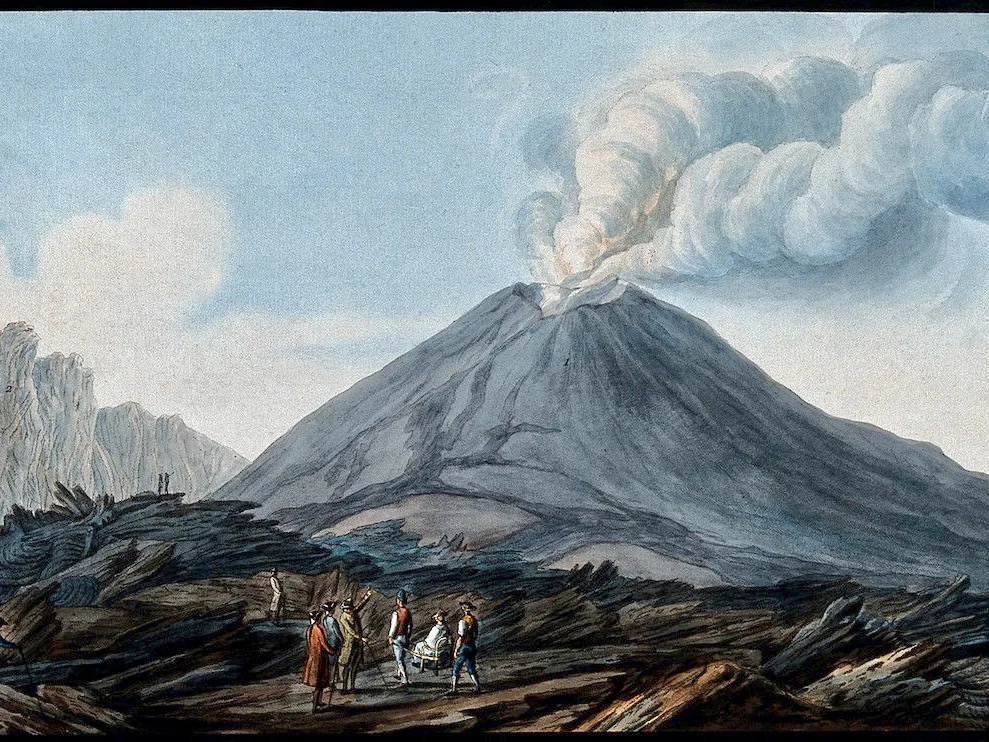
A British diplomat serving as Envoy Extraordinary to the Kingdom of the Two Sicilies, William Hamilton (1730–1803) was present for the eruptions of Mount Vesuvius during the mid-to-late eighteenth century, and wrote Observations on Mount Vesuvius (1772) for the Royal Society. To illustrate these volumes in a manner true to his approach, Hamilton recruited the English-born Neapolitan artist Peter Fabris, otherwise known for his paintings of the city’s “pulsating street life — with sellers of melons, cooked apples, corn, truffles and fried pastries”, writes Robert Holland. Hamilton charged Fabris to paint with “the utmost fidelity”, making sure “each stratum is presented in its proper colours”, and fifty-nine of the resultant gouaches were engraved and hand-colored to accompany Campi Phlegraei (literally, the flaming or fiery fields, named after the area west of Naples). In curator and writer James Hamilton’s assessment, Fabris “revolutionized the art of the volcano, and changed our ways of seeing them”.
Images sourced from the Public Domain Image Archive / Wellcome Collection