Fear of Bees
|


Clayton Adam Clark survives the recurring flooding of many rivers in three excerpts from his long poem, Before Me Is Always Fled. An aspiring writer navigates social circumstances at a writers’ conference in Daniel Abiva Hunt’s “Before Our Time on this Earth Ends.” Chrissie Anderson Peters examines the usefulness of some fears, in Fear of Bees.
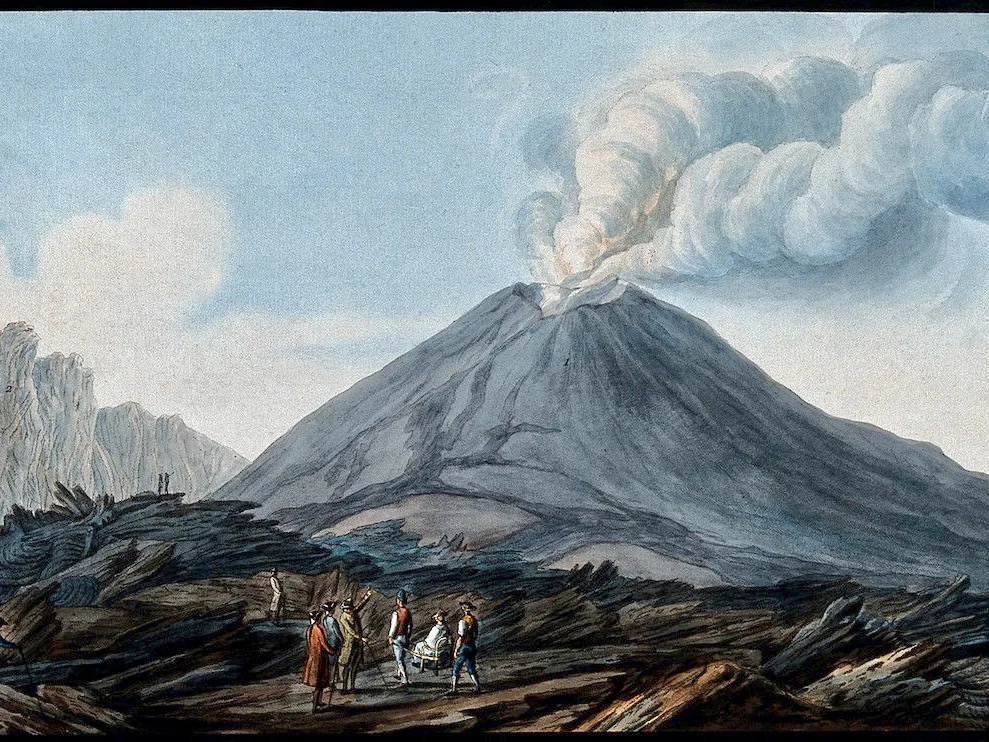
A British diplomat serving as Envoy Extraordinary to the Kingdom of the Two Sicilies, William Hamilton (1730–1803) was present for the eruptions of Mount Vesuvius during the mid-to-late eighteenth century, and wrote Observations on Mount Vesuvius (1772) for the Royal Society. To illustrate these volumes in a manner true to his approach, Hamilton recruited the English-born Neapolitan artist Peter Fabris, otherwise known for his paintings of the city’s “pulsating street life — with sellers of melons, cooked apples, corn, truffles and fried pastries”, writes Robert Holland. Hamilton charged Fabris to paint with “the utmost fidelity”, making sure “each stratum is presented in its proper colours”, and fifty-nine of the resultant gouaches were engraved and hand-colored to accompany Campi Phlegraei (literally, the flaming or fiery fields, named after the area west of Naples). In curator and writer James Hamilton’s assessment, Fabris “revolutionized the art of the volcano, and changed our ways of seeing them”.
Images sourced from the Public Domain Image Archive / Wellcome Collection