I am he as you are he, as you are me, and we are all together.
– “I Am the Walrus” by The Beatles
Going to Walmart un-caffeinated is not a good idea. Here I am, arriving before morning has won the fight against night. I put the truck in park, kill the engine and hop out, eager to get my shopping over with and get on with my day.
Ahead of me in the grocery store parking lot, a white Honda Civic approaches blasting “Walk This Way” by Aerosmith. The windows are all at half-mast. A little boy in the backseat flashes a peace sign at me as they breeze by. The little boy is singing along to the song’s namesake chorus, singing and giggling, extending his tiny hand out the window.
Smiling back, I return the greeting. I can’t help but laugh.
And in a flash, I find myself trading places with the boy. It’s not quite seven a.m. on a Sunday morning at Walmart, but, simultaneously, I am elsewhere, in two places at once, in two space-time continua. The overhead radio bleats some tired Beatles tune. “Hard Day’s Night”—the title comes to me only milliseconds before Lennon and McCartney harmonize the words.
Just like that, I’m a kid again, half-asleep in the passenger seat of my dad’s old Chevy, hearing “Hard Day’s Night” for the very first time, the radio turned way up, the windows down. It is summertime and I can feel the sunshine on my skin, the warm breeze on my face, and all the years that are not. However, the trip down memory lane comes to a grinding halt as I start to question whether or not the lyrics were censored just now on the Walmart radio. Incredulous, I toss the bag of carrots I’m holding back onto the endless pile of them and listen intently.
That quiet little boy riding around with his father and hearing “Hard Day’s Night” for the first time, he finds his voice in moments like these, when I question things that I know to be real and true. When he speaks, he speaks through me, across the ages, as if this quarter-century gulf between us was but a blink on my part. And it was. Still, this is the first I’ve heard from him in a long, long time. Because I fear his days are numbered, I hear him out.
The thing is, I know that kid I used to be better than I know myself now: all his dreams and ambitions, his fears, the mistakes he will make. Over the years, I’ve often wondered what happened to him, to all that imagination and promise. Gone, it would seem, along with any sense this world ever made.
Come to think of it, I’ve never understood the lyrics to “Hard Day’s Night.” I certainly didn’t “understand” them that first time I heard the song all those years ago riding around with my dad. I distinctively remember thinking the song didn’t make much sense, but being impressed, nonetheless. In fact, the lack of sense is what I liked about it, interesting lines like, “working like a dog.” What did anything mean? Of course, all these years later, I know exactly what it means to work like a dog—and to receive only scraps, to run out to the end of my chain and bark but be stuck there.
That kid hearing “Hard Day’s Night” for the first time isn’t burdened by meaning in the same way you and I are. Childhood is practicing meaning, taking baby steps before running back to the Safe Zone or the cover of mother’s wing. You two remember it, don’t you, John, Paul? Finding meaning on the monkey bars; discovering reading; falling in love for the first time; thinking in terms of hours or minutes or days? How much simpler it was. Back then, time was even packaged in tidy little kits like “Fifth Grade” and “Summer Break,” and each featured recesses and weekends and always, always play. As if life was asking not to be taken seriously.
With the cereal aisle to myself, I park my cart next to the C-T Crunch, take out my phone, and Google the lyrics to “Hard Day’s Night,” still unsure what I heard or didn’t hear just now. Nothing stands out to me as any different about the words. Whatever it was, I no longer know. But I do know one thing: I don’t trust censors to do right by the music.
“It’s been a hard day’s night / and I’ve been working like a God.”
Did I hear that just now? Or did I think it? Whatever the case, I can’t unthink it. I can’t shake the phrase:
Working like a God.
Sounds about right—the summation of American ideals. I imagine it’s what the censors, not to mention Walmart, wish it said: work your life away; it’s what your God wants. It ain’t no lie, baby. Buy, buy, buy. Consume.
And now I’m noticing something else about the lyrics I hadn’t thought about: That kid hearing “Hard Day’s Night” for the first time, he squirms in his seat, only just beginning to guess how sexually charged this song is. In a nutshell, there’s this guy who works all day to make money to buy things, but, as much as he lives for this, all he really wants is to get home to his sex object partner who will do unspecified things that make him feel alright.
Hearing the song again all these years later, and really listening this time, the boy I was back then is less impressed. Then again, most modern music is about sex, that kid will soon discover. It’s the Led Zeppelin rule: when it comes down to it, the best rock and roll is either about sex, citrus, or The Lord of the Rings.
Reluctantly placing a six-dollar jar of peanut butter into my cart as John and Paul reprise the chorus of “Hard Day’s Night” one last time, I realize now that my new distaste for this song has nothing to do with the blatantly sexual lyrics, either. Probably I’ve always taken that for granted. As with most popular music, it’s not the overt sexuality that turns me off, but that such songs tend to be so unimaginative when they get my pants down, so to speak. Perhaps it’s just the writer in me, but I can’t accept how underwhelming these lyrics are, having read them just now. For example, every time the song’s protagonist croons how good they feel, it’s only ever “alright” or “okay.” Every. Single. Time. Even if it’s meant to be ironic, this strikes me as a missed opportunity. Nevertheless, John and Paul repeat the words again and again and again:
“I feel alright.”
Approaching the check stands having made quick work of my grocery list, I, too, feel alright, John. That pretty much sums it up. I try to be grateful, to feel thankful, to practice presence—but I need a vacation. I need a break from my own life. Would a new tattoo make me feel any better? More sex? When was the last time I got laid? I need to go kayaking again, to feel direct sunshine on my skin. I need to get out more. I feel reduced, less than I rightfully should, an off-brand mediocrity. Do I feel happy about being able to afford these absurdly expensive necessities that I must have at any cost? Not particularly. If anything, I feel cheated, duped. Do I feel pride at having gathered up my meager grocery list so quickly, during the span of a single Beatles song? Not really. If anything, I feel doomed, leashed, barely able to reach the food dish at the end of my chain. And yet, yes: I feel alright I guess, just like the radio has been chanting this whole time for all and none to hear and feel. There is a name for that, John: indifference.
I feel indifferent scanning my things at the self-checkout while the final chords of “Hard Day’s Night” fade to nothing. Indifferent to this tired Sunday morning ritual of mine. Indifferent to the hawk eyes watching this seeming hippie scan and bag groceries I don’t look like I can afford—and, in fact, barely can. I even feel indifferent about discovering this song I’ve always loved, or thought I loved, no longer appeals to me. And yet, though I am indifferent, the indifference itself does actually frighten me because I know it’s the same suffocating feeling that’s nearly killed my inner child—that kid I am sitting shotgun in my dad’s old Chevy in another life, busily connecting dots and dreaming only of growing up. At least that fool kid got what he wanted.
Back at my truck, I place the few, precious bags of groceries on the backseat feeling satisfied, more or less. Funny how little it takes to keep us going. I climb in behind the wheel, close the door, turn the key, and automatically the radio spills out at me. I toggle between nearly all my presets before finding a song instead of a commercial.
It’s the “new rock” station. The song is just what you’d expect: loud and aggressive and not “new”—“Living Dead Girl” by Rob Zombie. Every other line is a sexual innuendo. The sound of a woman moaning is overdubbed from time to time. So be it.
I put the truck in Drive and prepare to pull away. However, something peripheral catches my attention and I keep my foot on the brake. I turn the radio down.
Ahead of me in the stretch of grass and trees that bisects the parking lot, a sweet old man has torn open a bag of bird seed and is tossing handfuls of it onto the ground. A multicolor torrent of birds surrounds him, this modern-day Saint Francis. It’s no small good deed; I know as well as he does how expensive bird seed is. But how happy the birds are! How it makes them sing.
Catching me staring, the old man holds up a peace sign. From this angle in the early morning light, the dust from the birdseed radiates from his hand like smoke, like he’s carrying something, a flaming torch.
Taken aback, I return the peace sign.
The old man reminds me of the little boy from earlier who I accidentally traded places with. Is it to happen again? If I blink, will the old man and I trade places?
“It’s a glorious day,” the old man says.
“Yes, it is,” I agree. I lift my foot from the brake slightly and pull over beside him.
“And don’t you forget it again.” He winks at me.
I don’t know what to say. I start to laugh.
“Go on now,” he says, grinning. Returning his attention to the birds, he tosses another handful of seed onto the ground.
The birds go on singing and dancing as if their lives depend on it. Like us, even if their lives do not depend on singing and dancing to the undisclosed music of the moment, it cannot hurt to be open to such possibilities.
I lift my foot off the brake and drive.
I roll the windows down.
I turn the music up.
It is a glorious day.
Jim Huff is a writer and musician from the Missouri Ozarks, USA with a warm place in his liver for scotch whisky. His fiction, poetry, and essays appear or are forthcoming at Jersey Devil Press, Star 82 Review, Third Wednesday Magazine, and elsewhere.
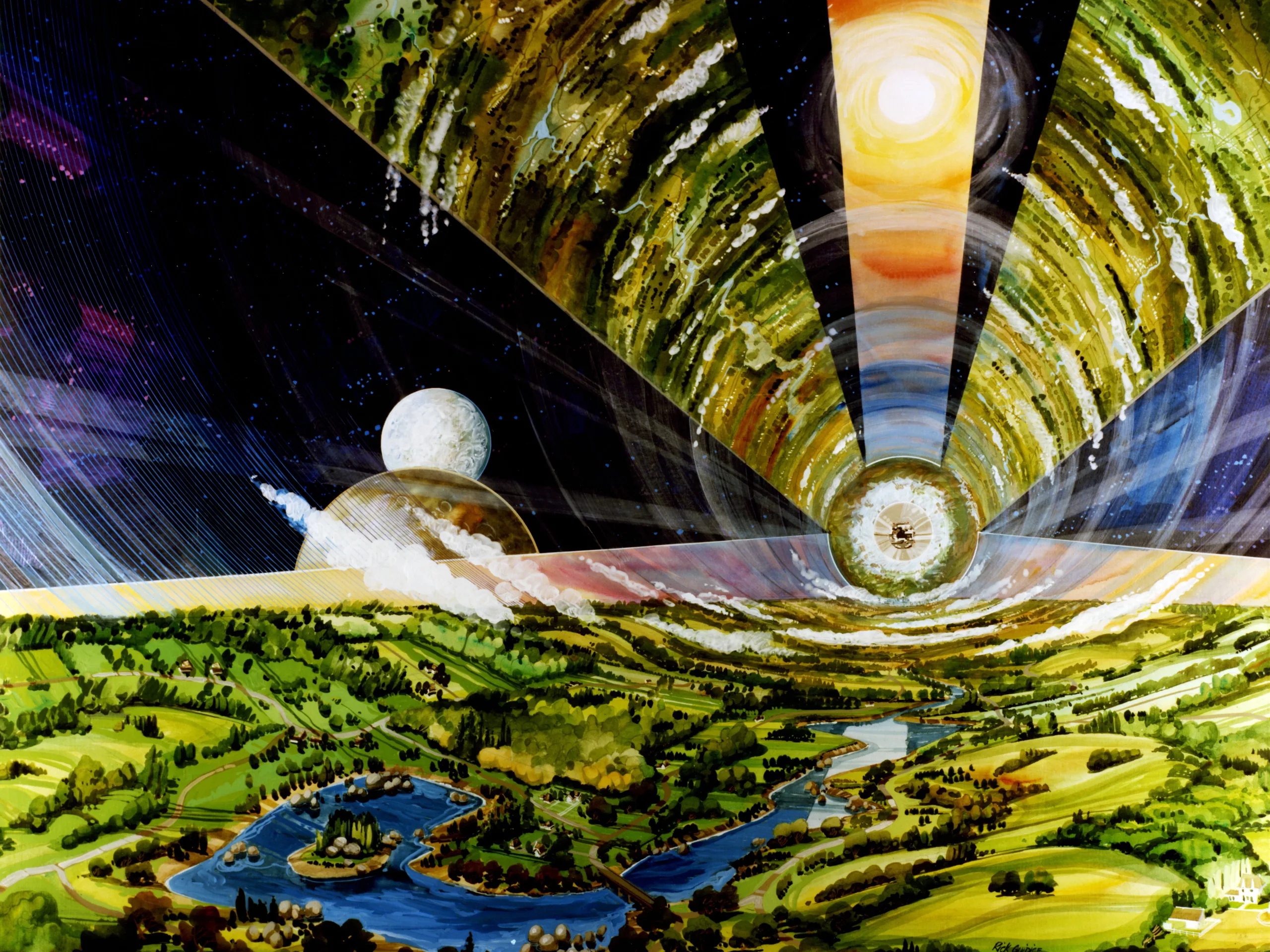
The images gathered below were created in the mid-1970s during O’Neill’s summer research programs on space colonization held at NASA’s Ames Research Center. The artists include Don Davis, who would later help design the visuals for Carl Sagan’s Cosmos series, and Rick Guidice, who illustrated space projects for NASA across fifteen years. In an interview about the project, Davis discusses how his images of O’Neill’s ideas still have a “freshness”, for they continue to embody “the aspirations people have had ever since the space age began”. While this is certainly true — and the artists’ visions of artificial cylindrical worlds have had an outsized influence on science fiction — these psychedelic vistas populated by high-tech homes and cocktail-sipping residents were also a product of their cultural climate.
Image sourced from the Public Domain Image Archive / NASA