I knew my mother would die that day.
I always dreaded finding her dead after coming from school each day. If one grows up with nightmares of having your mother lying lifeless in front of you, the ease with which you recognise the moment it would happen in reality doesn’t frighten you. The specificity of her eyes frozen in the moment her life left them wasn’t alarming anymore. I even made a mental list of people I’d call for help if it happened. I saw a faint image of myself thrashing my hands, wringing the anticipated agony away from the fingertips. Maybe I’d faint, but I’d never leave her side. I’d hold her hands till the fire would set us apart. My anxiety embodied the shape and colour of these thoughts.
And it had begun with an invisible creature that had travelled a revolting distance to reach my home in Kanpur.
It was a restless night. The dogs kept moaning all night. Did they know that the virus was on the hunt in this concrete jungle, asphyxiating anyone it touches? When their barks died down, the sirens of ambulances snaking on the roads kept dissing me. After returning from the hospital yard, I lay down on the mat on the floor. The hardness of the floor felt more assuring against my tired spine. I kept turning. My younger sister, Diksha, was lying next to me. She turned and sniffled. I realized she wasn’t sleeping either. When the minute hand struck 12, I looked up at the wall.
It was 5 in the morning. Darkness had begun to fade. An Oriental Magpie Robin was screeching on the balcony. I was staring at the ceiling. Now, a few sparrows and sunbirds had come to sing on the balcony. I was shaking my leg and clenching my palms into fists. I picked my phone up from the sofa table and then put it next to my pillow. Just when I closed my eyes, the phone rang. I scrambled to receive the call. It slipped from my fingers. Diksha sat up at once and handed the phone to me. It was our mother’s call.
“Hel…Hello Mummy”, I said. My heart was hammering against my ribcage.
“Beta…”, she was gasping for breath. Her voice was partly muffled, but the pain in her voice curdled my blood.
“Mummy…what happened? Do you need anything? I will come in 5 minutes.” I ran to my bedroom to pick up my dupatta and the keys to my scooter.
“Beta, I don’t know… what is habnin… They took…taking me somewhere. Before I was in another room. Now, they are taking me… They are not telling me. I can’t…can’t br….”
I couldn’t understand even half of what she said. But the breathlessness of her voice knocked all the exhaustion out of my body. Nothing makes us more desperate than the helplessness of our parents’ voices.
“Mummy, don’t be afraid. I am coming. Everything will be alright. I promise. Don’t be afraid. I am right here.” And the call was disconnected. “Hello, hello, mummy. Oh god!”. I wiped the sweat from my forehead. Diksha, scared, whispered, “She can’t breathe, and the hospital authorities had said she was doing better? Mummy, she is not fine. They lied to us.” She smacked her forehead. “Come, come fast. We need to be right there right now”, I said.
As soon as we reached the hospital, we ran to the window that was open for queries and formalities. It was empty. I knocked on the window pane. Nobody came. I bent down and tried to look inside the hospital, but couldn’t find anyone. I rapped on the window platform again, a little louder, and shouted, “Hello, reception, doctor, nurse, anyone? Is there anyone here?” I heard scurrying on the left of the window, but I couldn’t see what was there. “Hello… hello… I need to talk to my mother…”
A man grunted and came to the window, his eyes drowsy and voice grumpy, his face covered in a ragged cotton mask, pulling up his hazmat suit. “What?”
“I need to talk to my mother, Kiran Pandey. She called me. You people have transferred her to some other room. Where is she? Where?” A vein in my neck was throbbing, making me severely aware of my aliveness, yet the impermanence of that pulsating vein. “Madam, I am not a doctor. He will come at 9. Get away from the window”. He was waving his hand.
I stepped back, both my hands resting on my waist. I thought of calling my mother back. My finger lingered on the call icon. Confused. Diksha held my arm and said, “Didi, let it be. She might get panicked. I am not sure if calling her is the right thing to do right now. What if she is sleeping? Let us wait for the doctor.” I looked at my sister. Her eyes were red and drooping. I put my hand on her shoulder. She nodded.
The sun was completely out now. Trucks and ambulances were passing by the highway next to the hospital. There was a big neem tree. A few red-whiskered bulbuls and sparrows were flitting from one branch to another, occasionally hopping on the ground and eating the dried rice left by someone. I envied them. A middle-aged man had spread his cotton scarf on the ground and lay down on it. Was he also waiting for someone? There was a pile of boulders near the tree meant to fence the hospital entrance. Diksha and I sat upon them. And we waited.
It was around 8:30 am when a white van wheeled into the parking lot. The tires screeched, and the door was slammed shut. A man in a hazmat suit came out of the hospital at the same time. I stood up at once, saying, “Doctor, my…”. That man ran towards the van. Another patient. There was another gate of the hospital in the back of the parking lot, for two more men came out in hazmat suits carrying a stretcher. The driver of the van and the man who came from the front gate pulled out an old man’s body on the stretcher. The hazmat men took him inside the hospital, but the driver didn’t get in. The man stood at the door for several minutes. Panting. He put both his hands on his waist, but then surrendered. The fingers hung like the pyjamas my mother had hung from a wire a few days ago after washing the laundry. The heat was sweltering without a breeze in sight. The pyjamas were still there, limp and lifeless, coated with dust, and my mother was in the hospital fighting for her life.
What if I could find out the exact moment when we had done something wrong that the trajectory of our lives took us outside the hospital, rather than taking us anywhere else? There had to be a single moment altering everything we knew about life. Would I be able to change it? I wanted to change it. But I was watching a hopeless, surrendered, and defeated palm of a stranger praying that my mother would return to me.
It had happened to me as well, two days ago. Diksha and I had rushed into the parking lot with our mother. The nurses had come to take her to be admitted in a wheelchair. They took her inside. My mother, afraid and nervous, looked back. Diksha was filling out the forms. Mummy looked back, and I looked at her. Did we know? She had tried to say something, but her breathlessness rendered her almost mute. I nudged Diksha and said, “They are taking mummy inside. Look at her.”
I paid the admission fees at the reception and signed the form. The second front gate of the hospital opened. A stretcher carrying a body wrapped in a transparent body bag with a blue zipper and blue corners. There was a woman inside. Her husband, telling someone on the phone that her body had come out, that he would meet the person on the other side of the call in the crematorium. He looked at her body, didn’t say much, cleared his throat, and looked up at us. His hands wanted to touch her, but it wasn’t allowed for the fear of contamination. He ruffled his hair, scratched his beard, patted his front pocket, again cleared his throat, and then went to a nurse who was standing with the woman’s last belongings. A mobile phone, a pair of gold earrings, and an almond-shaped gold ring. The hospital didn’t have any vacancies before. Two hours ago, there wasn’t a bed for my mother. But suddenly they agreed to admit her. Now I knew why. That woman had died, and that’s how the bed got available.
My mother had given me my name, Shreeja. And that day I had to write my name in a document which only claimed to cure my mother, claimed to cure a disease that didn’t have any medicine or a treatment to control it. I didn’t want to sign that name anywhere on the paper. It wasn’t a death certificate, then why? I kept standing near the door. It was the first time in my life that my mother had to be admitted to a hospital. I had always known my mother to be the stoic and healthiest person. It was I who had to be taken to the doctors, for I was always dealing with one disease or another. They were always curable, but they were frequent. Something about this felt ominous to me. Even fatal. My hands had grown numb and cold again.
How could one leave the most important person in your life in the hands of a stranger when the family isn’t allowed to see the patient or the doctor, or even the room in which the patient is kept? What if it was the last time we saw her alive? What if my hands never got to hold my mother? Will we be called orphans? Those burning questions were asphyxiating me.
A couple of men and women started howling and crying. I turned my head and saw a girl collapsing on the ground, screaming, “Maa…”. Her father, holding a sanitizer spray, stepped back from the window. When his daughter ran to him, he squirted the sanitizer on her face. Shock silenced her. Does anyone know what the right behaviour is when your world crumbles around you? Or when your wife dies? Or your mother? Who writes the manual? The world felt crueller.
The only people who came alive from that hospital were doctors. Was the disease that deadly? Or the health system had collapsed altogether? Or the health system wasn’t sturdy ever?
My mother was trapped in a hospital, and I was trapped in this world, without her.
The hospital authorities were calling from inside the building to inform the family about the patient’s demise. My mouth had gone dry. I wanted to run inside the hospital to be with my mother and tell her what had happened outside. I asked the lady at the reception if she could talk to my mother, but the receptionist refused, mumbling something about the process.
It had been two days. The man at the gate was standing there, clueless. In love, we wait. Hoping to meet them on the other end. We wait.
Last evening, the hospital authorities told me that my mother was doing better since the time they had admitted her. However, after the consultation, they called me again to tell me that her oxygen saturation levels had dropped further. They advised me to arrange Remdesivir injections, which were claimed to save lives from this virus. When I asked them to arrange the medicines themselves, the hospital authorities refused, saying that they had already used the quota of the medicine the government had allotted them. There were rumours of drugs being marketed illegally. I asked to talk to the hospital owner, but the receptionist closed the window in my face. So, I asked some of my friends and relatives if they could find someone who supplied the coveted medicine. One of my relatives managed to arrange the injections, and by midnight, the supplier had left five injections on the door.
Everything was lined up. My mother got the hospital bed when she needed it. Now somehow, the injections had appeared on the door as well. It seemed like a test with every help appearing at the right moment. Whenever something happens in our favour, we begin to believe in the powers of morality, manifestation, the universe, the God. We were good people, of course, we should get help at the right time. Why would fate leave us stranded?
I jumped when the window was opened around 9:30. I talked to the nurse, who advised me to wait till the doctor came. I couldn’t believe that my sick mother was in a place where there was not a single doctor available yet. But they had the oxygen cylinders that kept her alive. I remembered how the medical entrance exam paper was leaked and cancelled last year. I ground my teeth and sat again on the boulder under the neem tree. Diksha, my baby sister, sat next to me, hungry, subdued, and confused. She hadn’t had to live with my mother as much as I had. I patted her back and held her hand. Her eyes welled up.
The driver of that white van looked around the hospital. There was no place to sit. He began to walk to his van in the parking lot, but something made him stop his footsteps. He looked at that tiny window and then looked at us. Half of Diksha’s white mask had gotten wet with her tears and the sweat on her upper lip. He came and sat on the neighbouring boulder. He coughed twice under his mask. He called someone and told them that he had admitted his father, and now he was waiting. The cold silence was cutting through our skin.
It was 9:45 am, and two more patients had been rushed into the hospital. He coughed several more times and said, “Can you please give me some water?” I eyed him and then his mask. It was wet with his sweat. I nodded; my hands crossed in a stiff bind. Diksha gave him the bottle. He pulled his mask down and gulped down some water. He thanked her, and the silence prevailed.
He called someone again. From what I could understand, he had called someone from the hospital. When he hung up, I asked him, “Was that someone from the hospital?” He nodded. He rubbed his eyes and began to shake his legs. I took a deep breath and said, “I wanted to talk to my mother. She called me in the morning, but I haven’t been able to talk to her since. I don’t know what is going on in there. Your father is in there, right? Who is attending to him? They told me there was no doctor on the premises yet.” He looked at me. Confused. He stood up, ruffled his curly brown hair, cracked his knuckles, and said, “The ward boy is my friend. He called me to tell me that my father’s oxygen saturation level is dropping fast.”
He had grown breathless. His eyes grew red. He removed his mask and rubbed his forehead. “He told me to buy Remdesivir as soon as possible, but I don’t know where… how. Last time, I heard the news, our city had run out of that medicine, and whatever was left was sold for around Rs. 25000 in the black market.” A chill ran down my spine.
Now my phone rang. The call was from my mother’s phone. “Mummy, hello…hello.” But it was the doctor on the other side. The doctor was asking for the antiviral injections that the hospital had asked me to bring. Remdesivir. I told him that the injections would be here in 5 minutes. I told Diksha to sit and wait if any other calls came. I drove back to the house and came back with the injections. The doctors had asked only for two of them, but I brought all. The doctor’s voice made me feel like they were trying their last options. When I came back, that man was still busy calling different people, hoping that somebody would be able to help him.
He had left for some time, but he came back around 4 pm. He was shouting on his phone about how he could not find the medicine anywhere. Three more bodies had been taken out in the disposable body bags. The relatives mourned but couldn’t dare to touch them. They were taken in a truck and transported to the city crematorium directly from the hospital.
The doctors hadn’t called back. I had asked how my mother was doing at the window, but they told me to wait. That man went to the window, but his friend had left the hospital. He asked about his father’s health, but no one knew better than what he was told in the morning.
He wasn’t able to sit in one place. I watched his worn-out and peeling black shoes walking from one pillar to another. The sound of his steps made me dizzy. I felt as if I looked up, I would faint. I envied his restlessness, though. As long as you are walking or running, you feel you can change something. There is a sense of hope, even if it is false. But true helplessness is sitting and waiting for your fate to unfold in front of your eyes. No matter how excruciating it is, sometimes, you are cursed to bear it.
One more patient covered in a mask, tubes with an oxygen cylinder, and petrified caretakers came to the hospital. How did he find a bed? Was someone else dying now?
Around 5 pm, Rahul gave up the efforts to find the injections. Smelling of sweat, he seemed exhausted. He came and sat beside me. He was shaking his legs and twiddling his thumbs. He washed his face with some water. I felt his eyes on me. I heard him asking, “Heard anything about your mother?”
I didn’t want to see anyone’s face other than my mother’s. I shook my head. I wanted to ask if he found the medicines, but I felt I would vomit if I said anything. Diksha was leaning on my left arm. “I don’t know what would become of my father”, said he to no one in particular.
Around 5:30 pm, my phone rang. It was her call. I picked up the call and said, “Hello.” I heard my voice was coarse and scared. There was a man on the other side who said, “Are you the daughter of Kiran’s? She is on a ventilator now. Stay out there.”
“Stay out…” I told Diksha, and she looked away at once. She heard what he had said. After five minutes, another call came. “No…”. I threw up.
The moment had come. But I hadn’t fainted. No tears came. I wasn’t howling and screaming like I thought I would. Only my heart felt like it had skipped several beats altogether. I was late, they said. I lifted my head. A wedding wagon was passing in front of my eyes. Why wasn’t the world collapsing? Were some people happy at the same moment? The moment my world had died? They fooled us when they said time can be fair or unfair to you. Time doesn’t care.
I heard that man telling someone how his father’s oxygen saturation had dropped further. He came and sat next to me. He said, “I know you just lost your mother, but… can…can you please give me the rest of the injections? My father… I am afraid he will die too. Can you help me?”
I looked into his bloodshot eyes. What was fair? Should we help only when it is convenient? I wanted to rip my chest off. Maybe bleeding would’ve taken my grief away. How could he expect anything from me? But he was helpless, crying and begging. What was worse? Death of your loved one or death of the humanity in me? Is this how this day was destined? Would giving him the injections be a help? To whom? Something was dying in me, yet I couldn’t see even a stranger bearing that torture.
No, the fate wasn’t helping me. Whatever happened, it tricked me into believing that somehow my mother would survive this virus as well. Like we always did. Survived the storms, no matter how hard they hit us. It had tricked me into believing if everything desired and required happened, the consequence would always be in my favour.
Death had come in the form of a virus and taken my mother away. It shredded the tapestry of my beliefs and melted my feet. I was falling, falling, and falling into a bottomless pit. My sister was by my side. I couldn’t protect her. I only knew my mother. She had left the world. I don’t know if his father survived. My mother always told me to be kind and help others as much as I could, whenever I could. She never told me why. I never asked. I had pushed the bag of injections towards him.
I ceased to know anything anymore.
Rijuta Pandey is a budding writer based in India. Her works of fiction have appeared in online literary magazines such as Verse of Silence, The Chakkar, Active Muse, and MeanPepperVine, as well as non-fiction in GOYA and upcoming personal essays in Roundglass Sustain and The Quasar Review, and poetry in the Monograph Magazine.
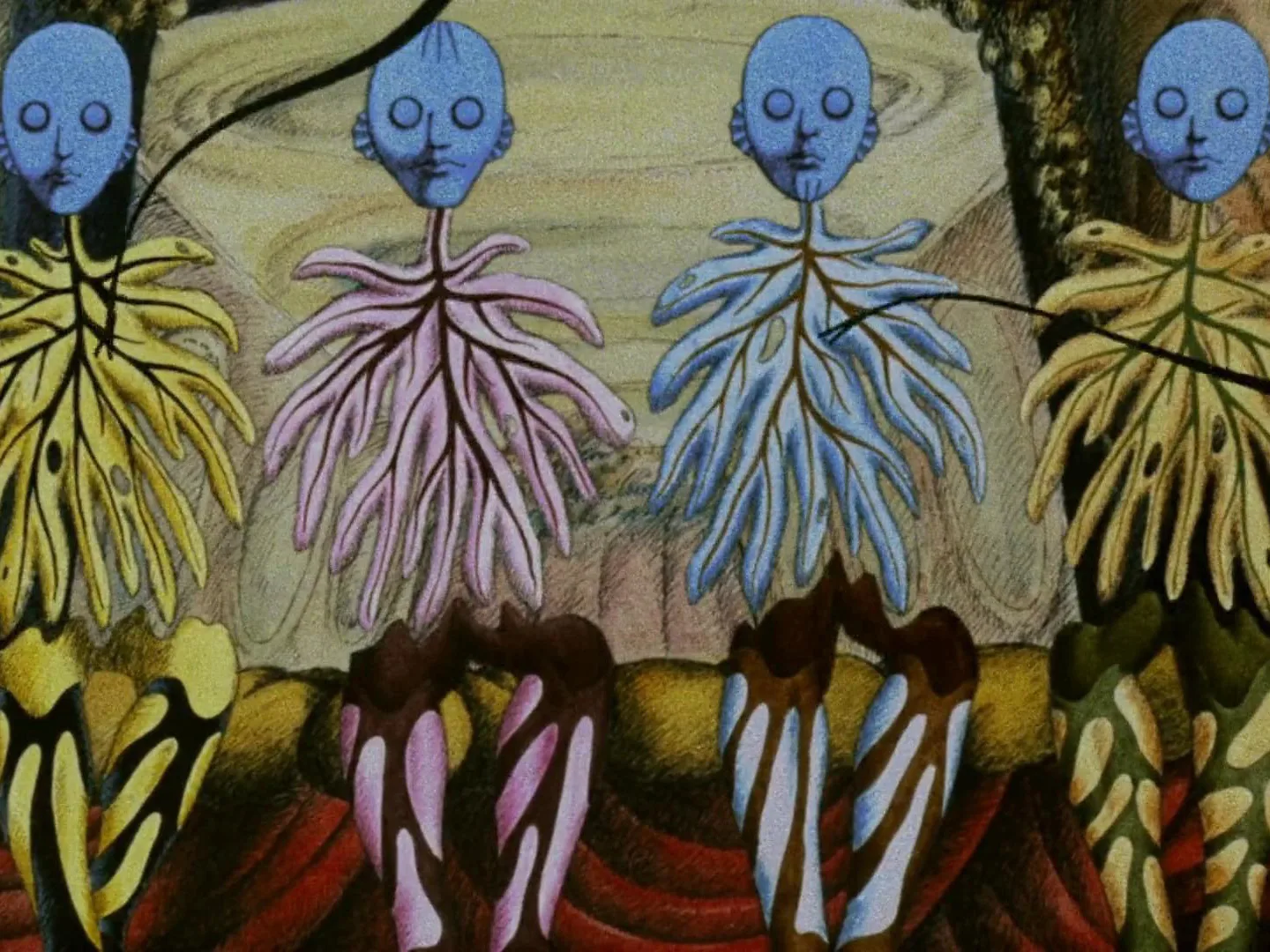
Images from Fantastic Planet (1973), directed by Rene Laloux.