The alumna on the other end of the line knew my name. My full name.
Shocked, I sat up in my pleather chair, the phone receiver pressed tight against my ear. “Um, yes. That’s me. Do you know me?”
“I remember your name from the Honors Day program,” the alumna gushed. “I was there with my son. My goodness, you won so many awards that day!”
And just like that, a routine day – breakfast, classes, lunch, classes, dinner, gym, and my shift as a student caller for my college’s Development Office – perked up. The alumna was right – I had won a lot of awards at the recent Honors Day. Twelve, to be exact. As a broke college student, it was nice to be reminded of my wins. Bonus points that it came from someone who wasn’t a friend, family member, or professor.
I was in the second semester of my senior year at a PWI (predominantly white institution) in Connecticut, that bastion of wealth and privilege. Graduation loomed on the horizon. I was set to start my first real job at Goldman Sachs in NYC later that summer. It had been no mean feat to snag a job offer in 2009, when the financial services industry and America as a whole were still reeling from the 2008 financial crisis. Many of my classmates hadn’t been so lucky. I was relieved and a bit guilty to be one of the few who knew where they were going after graduation.
I was also very anxious for my Real LifeTM to start, the one I’d worked so hard to achieve. I was a first generation college student, the daughter of a single mom and the product of a two stoplight town in the Deep South.
But before I could take my place as a pawn in the professional managerial class, I had to finish college – and my tour of duty as a student caller.
I’d held a slew of jobs on campus by my senior year – an admissions tour guide and barista in the campus coffee shop, to name a few – to earn money for housing during my internships, daily necessities, and the occasional club cover charge. I’d been looking forward to not working at all during my senior year and instead focusing on a last hurrah of parties and laziness, sorely earned after three years of hard study and resume padding. But money was needed back home to help pay the bills. I was expected to handle financial responsibilities like paying the phone bill and pitching in for home repairs. I was also called to step into the gap when my mom fell behind on the bills. As if this wasn’t enough for someone barely out of their teens to shoulder, I had recently learned about security deposits and the expectation for “first and last month’s rent.” That money had to come from somewhere, and I certainly didn’t have a trust fund. Luckily, a friend of mine came through with an opportunity.
John served with me in Student Government and had worked as a student caller for two years. Student callers were a corps of mostly juniors and seniors (and a few lucky sophomores) hired by the Development Office to call alumni to solicit donations. The student caller position was the highest paying – and hardest to land – student job on campus. The application and vetting process was simplified by the fact that John vouched for me. I’d already learned that knowing the right person was an invaluable wheel-greaser for getting a foot in the door for a job.
I was stoked when I was hired. But when I crowed over the high hourly rate, John just laughed at me.
“That’s not even where you make your money.”
“What do you mean?”
“The bonuses are the biggest part of your paycheck. You’ll see.”
For my first day on the job, I reported to the Development Office for my shift. It was housed inside of one of the historic buildings on campus, a soaring Collegiate Gothic tower with brownstone exteriors crusted in ivy. Pinkish evening light filtered down into the cavernous space where the callers worked, illuminating the dust motes floating in the air. There were about a dozen of us. John wasn’t on my shift but a few of my other friends were. We each had a desk and a phone.
A large dry-erase board stood at the front of our row with that week’s goals and the bonus challenges John had told me about. The challenges were special bounties for additional pay, like side quests in a video game. They included tasks like “get 5 alumni to give more than $200” and “get 3 lapsed donors to give this year”. Our supervisor gave each of us a magazine holder stuffed with donor cards. It was time to get to work.
On the surface, the job of a student caller was simple. Each alumni donor had a card with their name, graduation year, phone number, and donation history. It was our job to call them and persuade them to give again. Ideally, we could get them to increase their donation amount.
I was so nervous. For an introvert like me, talking on the phone with strangers was a scary prospect. Especially when I was asking them for money. Fidgeting in my chair, a core memory of being hung up on by a pizza parlor worker when I was trying to raise money for a Junior State of America trip in high school flashed in my mind. I listened to the conversations of the seasoned callers, their disembodied voices drifting over to me above the desk walls that separated us. They were smooth and confident, insistent without being aggressive. I sucked in a deep breath and reminded myself that the alumni on the other end of the line couldn’t see me and didn’t know me. I had a job to do and there were plenty of things that I desperately needed the money for. Fulfilling those needs was more important than any temporary discomfort. I thought of all the hard things I’d done in my life, all the obstacles I’d overcome, the audacious improbability of a poor Black girl from the sticks even being in that room.
I could do this.
After another deep breath, I picked up my first donor card and dialed the alumnus’ home phone number.
For the first few calls, I relied on a script, sounding a bit robotic. But after a few successful calls, I got into a comfortable rhythm. Most of the alums were pleasant and polite, if not downright friendly, and nearly everyone gave a donation with minimal prodding. My confidence grew, especially when I achieved two out of the three bonus challenges that evening.
After that auspicious beginning, I worked three two-hour shifts a week. Sometimes I got to the office before my shift to do homework or work on my thesis. It was quiet and peaceful in the tower, which was mostly empty save for me, the janitors, and a few stragglers from the Development Office ending their workday. The experienced callers took us newbies under their wing, schooling us in ways to game the system. One great trick – if you’d nearly achieved a bonus challenge like, say, getting four out of five alumni to give $250 or more, you could place those four cards in the back of your donor card folder to get a head start on that challenge on your next shift. I was sure our supervisor knew about our chicanery but she only gave us intermittent, half-hearted warnings that were duly ignored.
One of the biggest surprises of the job were the amounts that some alumni gave to the school. It was a small glimpse into the financial lives of others. Before I started, I was expecting to see gifts like $50 or $100. Maybe $200 if someone was feeling generous. But the giving history on some of the donor cards made my jaw drop. I routinely saw gifts of $1000 or more, with some approaching $5000 and up. I couldn’t imagine having that kind of disposable income. Many of those annual gifts were more than the sum total of my bank account balance.
“Sure, I’ll do the same as last year. Put me down for my usual $1000. Thanks!”
These people lived in another world, one I’d fought so hard to get into college for the chance to join. Scanning through my donation totals at the end of each shift, I often wondered if I’d be one of them someday. I sure as hell hoped so.
At the time, I never thought of the student caller job as building any sort of marketable or life skill. As the fall semester wore on, I got comfortable in the role and it became easier to do. And when something is easy, you tend to discount it. But I was building a thick skin, an armor that rejection rolled off of like raindrops on a windowpane. When an alumnus refused to give or went off on a rant about the college’s constant requests for money, I was impervious. I just thanked them for their time, hung up, and moved on to the next potential donor. Years later, I would call on that strength to steel myself against various indignities and difficult people in the corporate world. But those muscles got their first real workout in the caller’s chair.
I also got to develop, refine, and perfect my “white customer service” voice. Every Black professional can tell you what this is, because they have one. It’s the deliberately neutral, upbeat, and friendly tone that’s used to survive in professional settings and put white people at ease. While I was on the phone, no one could see my face. It was a built-in barrier against bias. At least as long as I used that carefully cultivated tone. They may have had an inkling that I was Black, but they couldn’t know for sure.
Beyond race, I had the additional bind of being a Southerner. By my senior year, I’d spent enough time up North to know that for many people, Southern = dumb as rocks. I’d worked hard to excise the colloquialisms of my home from my speech – the ain’ts, y’alls, and ma’ams. Over time, the musical lilt faded from my speaking voice, only emerging when I was angry or excited. Folks back home noticed the loss of my accent as well, remarking on it in hushed tones tinged with worry.
There are levels to code-switching. Most academic literature focuses on linguistics. But in practice, it also covers behaviors, the ways of acting and being that help you to assimilate into a dominant culture that’s not your own. I came to college wearing overalls and Keds, but quickly learned that marked me as an unsophisticated bumpkin. I spent precious funds buying clothes and accessories that hinted at a wealth I didn’t possess: Ralph Lauren polos and crewnecks at Marshall’s, knockoff Uggs, a fake pearl necklace, flats with a gold disk on the toe that echoed the Tory Burch logo. I don’t think I fooled the kids who could afford the real things but these crutches helped me stick out less.
Even though big parts of me were being flattened and erased, the switching I did on the job was also weirdly liberating. My successes as a student caller were due to my professionalism and persuasiveness. As for any failures, they at least had nothing to do with my skin color and other people’s prejudice.
But I was always mentally exhausted after a shift. The thing about masks, even vocal ones, is that they get very, very heavy when you wear them for a long time.
“I must go home periodically to renew my sense of horror.”
That’s always been one of my favorite quotes from Carson McCullers, a fellow Southerner and one of my literary idols. While I didn’t necessarily share McCullers’ vehemence, going back home usually left me with conflicted feelings. It was good to see family, attend my home church, and enjoy the slower pace of life in my sleepy hometown, but I also realized I didn’t really fit there anymore. I’d always felt like an outsider – bookish, nerdy, introverted, and yearning for a completely different life beyond its borders – but it was more pronounced by the winter break of my senior year. I was a different person, had been exposed to different kinds of people and very different ways of thinking. Of course, that’s the point of college, to expand your horizons while you’re being educated. But to keep the peace, I often had to bite my tongue and keep some newly formed, radically divergent opinions to myself. Home became another place I had to mask, just like at school.
But coming back to campus for the spring semester, I had bigger fish to fry. For one thing, graduation was looming. For another, the student caller job was about to get harder.
The first sign was a change of surroundings. The venerable old Gothic tower we spent the fall semester in was closed for renovation. As if to signify our move down into the trenches, we were shifted to a small, windowless room in a building on the outskirts of campus. The room had bright white overhead lights that baked our little cubicles that had been hastily created with particle board dividers. Gray modular carpet covered the floor, the kind where you could easily swap out the soiled squares if someone spilled something or threw up on them. In hindsight, it was great preparation for our futures in corporate offices.
The alumni that semester were also tougher. Their giving totals were smaller, with many flat year over year. A lot of them were sporadic givers, with zeroes in many prior years. It became harder to fulfill the bonus challenges. More than a few were hostile, some downright nasty. I’ll never forget one particular exchange.
Hi, is Karen available?
This is she.
Hi! I’m calling to see if you’d like to donate again this year.
Wait – you’re a student? And you’re calling me by my FIRST name? I’m sorry, are we on the same level?!
I beg your pardon, ma’am.
Wow. That just threw me for a loop. I won’t be giving this year. [receiver click]
By then, I was unflappable with difficult people on the phone but that one rattled me. I thought of everything I’d dealt with and overcome in my life, any one of which would probably have broken that woman.
“Yes, bitch,” I muttered angrily. “We are on the same level.”
Aside from rude people like that, many of the alums that semester just sounded tired. They were from more recent grad years. I often heard kids screaming in the background or the sounds of dinner being hastily prepared. There was exhaustion and resignation in many of their voices as they handed over their card details.
It felt like a looking glass into the future.
I sat up in my chair, absolutely chuffed to be getting recognition for my hard work. “Yes, ma’am, it was really exciting to win all those prizes. I was really proud of myself.”
“You should be! Now not to be a downer, but you should know I don’t feel comfortable giving this year.”
I frowned. This lady was one of the increasingly rare four-figure givers. “Why not, ma’am?”
“I heard about those raucous disturbances on campus last week, with all the property damage and assaults. I’m not sure I want to be supporting the school when things like that happen.”
I rubbed my eyes in annoyance. I knew what she was referring to. For all its New England glory, the school was also a frat bro paradise. It was one of the reasons I couldn’t wait to leave it behind.
“Ma’am, will you give me the chance to rebut that?”
After a few beats of silence, she sighed. “Go ahead.”
I told her about students like me who worked hard to better their lives, who were striving for great careers and achievement, and who didn’t carry an ounce of entitlement. I told her my own story, of my winding path from my tiny town to the prestigious job that awaited me after graduation, won through grit, determination, and tenacity as much as my intellect. It was the longest speech I’d ever given. I reminded her that her gifts supported the scholarships that put college within reach for kids like me, the ones whose parents couldn’t write a full check for tuition but who still had so much to offer.
At the end of it, she was silent again. I waited for what seemed like an eternity before she spoke.
“Alright. You’ve convinced me. I’ll give again this year. And I’ll double my gift.”
Verdell Walker is a speculative fiction writer whose work explores power, legacy, and marginalization. Born and raised in rural Georgia, she brings a sharp eye to the intersections of race, gender, and history. Her stories engage themes of family, history, and cultural memory. Her nonfiction writing has appeared in Bustle, Vox, Forge, and ZORA. She is also the host of the book review podcast “The Book Up”. She can be found on Instagram: @verdellwalkerwrites and Substack: @verdellwalker.
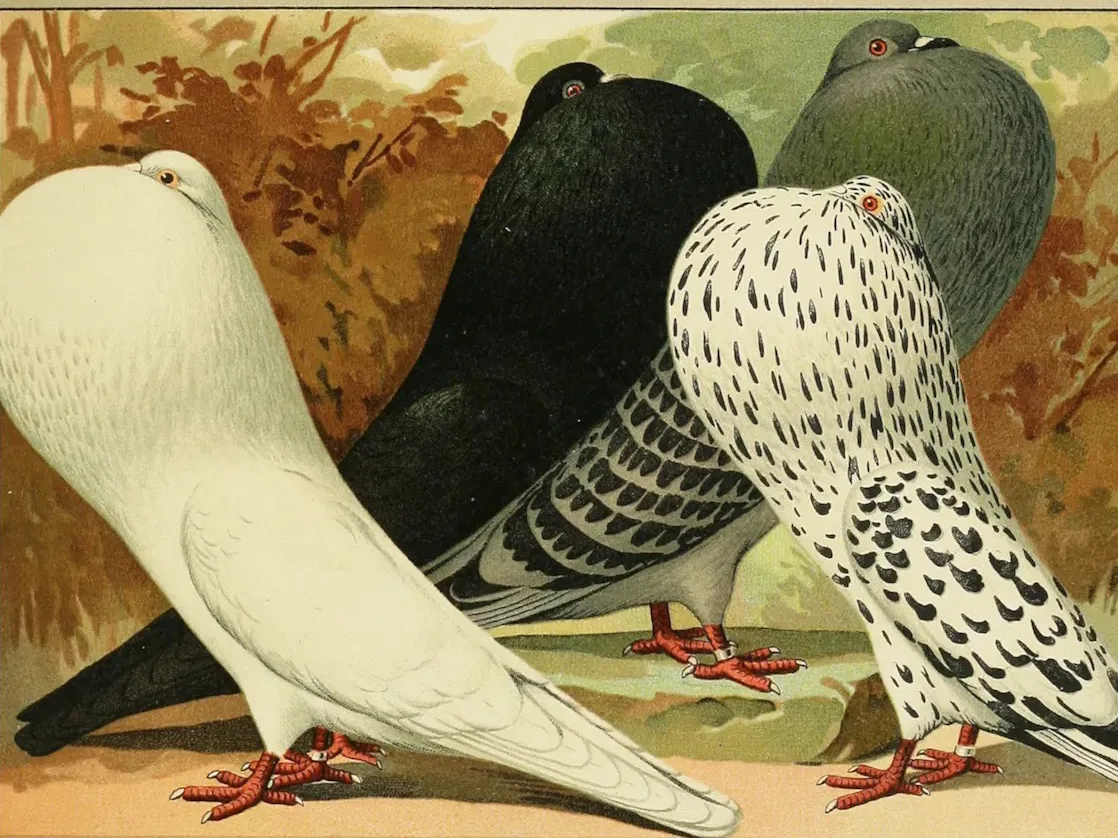
Illustrations of varieties of pigeons from Illustriertes Prachtwerk sämtlicher Taubenrassen (1906). Text by Emil Schachtzabel and illustrations by Anton Schoner.