Even if our father did—after slipping at home and hitting his head—
	wander out of the hospital and fall
fifteen feet off an embankment, whatever spirit

he did it in, it was not
	frivolous. Not him who had always
wanted to dip

into the wild. It was an inexpressible wish
	granted. Rain dripped
from the beak of an eagle to her nest. You slept

on two chairs pushed together. I told him
	it was time. Drive
carefully, sister, but fast. Guide us out of Kentucky, away

from cremation. There isn’t a mortician alive
	who can force us to that table again—the forlorn meeting room
where Stewart “I-don’t-know-about-you

but-I’m-a-Christian-Man” Throgmorton told us he’d
	get a hold of your husband
as if a woman can’t decide for herself whether to buy

the necklace of ash. Maybe he was only hoping
	his own daughter will collapse
stupid with grief when he dies. The complete

and total opposite of what our father
	who art on fire
desired. Our dad knew what he wanted and

what we wanted did not always need
	to converge. He believed
in his own ignorance, it rankled him, and still he seethed

at the false convictions of smaller men. Better to be clueless. If,
	when I stand outside at night, I say thank you,
I am equally as estranged by stars or clouds or the surprise of surviving

as I was by the fires of Ethiopian music and the slideshow of children—
	bellies distended, beset by flies—
when I was tucked between you and mom in the golden pews at Bethlehem Lutheran

and he was at home stealing what sleep he could
	before hunting again
men so desperate for something to cling to they smashed

windows and crawled through. He’d seen enough. Forgiveness, he told me once—
	we were driving along the Ohio River
in the gray, purgatorial light of early spring on a kind of pilgrimage—

forgiveness is not justice. Some things
	are best left unforgiven.
Hominid, sister of a common ancestor, weren’t we just now

crossing the living room in our ring-shaped walkers
	like the riverine peoples of old Babylon
in their coracles—stirring no wake, frontless, backless, beautifully

afloat? If we get lost along the way, it’s only
	an hour. Guide us
over these gargoyle hills. Get us out of here, well

north of this place that ate him, these people with their eighty-five
	dollar Ark Encounter
and its five-hundred-foot-long shadow.
Tell that to the tourist feeding Cheetos
to black bears at the campground. Tell it
to our housebound dead. They never meant
to venture but off they went, bending
no branches. Tell it to the singer singing
Que He Sacado Con Quererte: Natalia,
gardener of dark, your voice pulls me to cliffs.
When I hear you, I haven’t left home in years.

My love has decided this summer
she wants us to face a grizzly bear on its
own ground; she wants us to fight it
if we must. Are you sure you want this
I ask. She does. To brave the corridors and creeks
where it breeds. We must make exceptions
in love and art. Exceptions only. Okay,
I will deliver her to the bear.
Does anyone else here—entering your own dark
apartment after jogging three blocks, walking four,
jogging two, walking five—leave the lights out
and keep the earbuds in so the hallway feels
like some kind of gauntlet? Do you not
imagine a stabber hiding behind the curtain,
and get just a little excited, for a second,
thinking there’s a human snooping around?
Maybe you did once and that was the moment
you decided it was time to get married. Smart.
Some people fly right past those warning signs—
nothing in their head but Sarah McLachlan’s voice
saying hold on to yourself and this is going to hurt
like hell. Some people have a playlist on Spotify
they titled “90’s Movie,” and it feels like
the soft rock soundtrack to a horror film, like
Jeff Buckley climbing onto your boat or Billy
Corgan coming to tuck you in. To be fair,
that Pumpkins sound is stronger than nostalgia.
It’s not Billy’s fault if you refused to get married
and now that last, long decade of your youth
terrifies you. Leviathan of possibility.
God goes ‘mong the world blackberrying, Stubb says,
implying we ripen and get plucked. Does anyone
else here sometimes catch sight of a burglar
padding to the kitchen in pajamas for cinnamon rolls
at midnight and think That bastard better not
eat the last one? You aren’t the only one living with
burglars. It’s a rush, letting them in like this.
Jacob Boyd is from Lansing, Michigan. He works in a bakery in Milwaukee. Poems of his have appeared in American Journal of Poetry, Blackbird, Copper Nickel, Fiddlehead, and elsewhere. His chapbook, Stilt House, was selected by Heather McHugh for the Emrys Press Award.
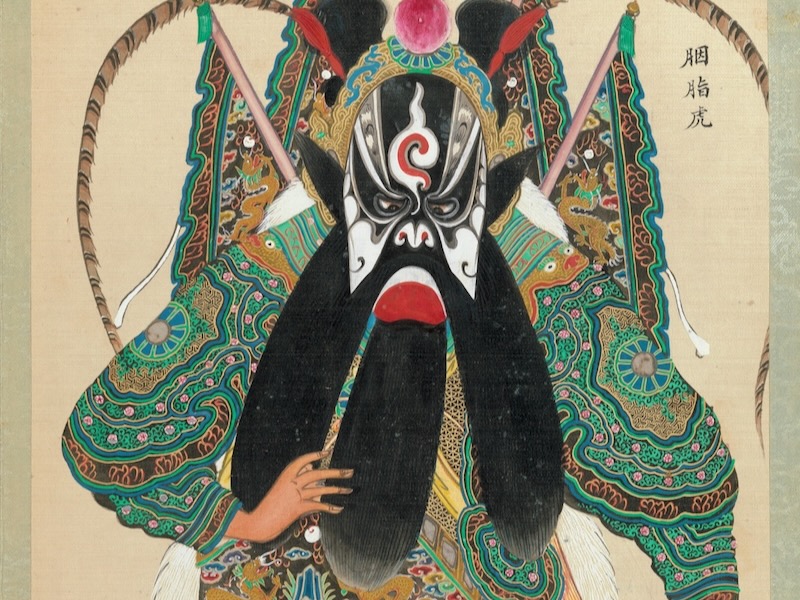
The colorful images below, courtesy of the Metropolitan Museum of Art, were painted by an unidentified artist sometime around the turn of the twentieth century. These portraits on silk each represent a particular character from one of nine plays. Like most operas of this style, the characters hail from diverse sources — literature, military history, and myth — but play stock parts. There are four basic roles in traditional Peking opera: sheng, dan, jing, and chou, each of which have numerous subtypes. Sheng and dan are male and female leads (historically both played by men), jing is a villain, and chou, the clown. As Mei Chun details, complex personas were to be avoided. “The flatness is deliberate. Flatness in characterization contributes to the effect of moral contrast while rounder characterization could lead to ambiguity and disorder.” The characters’ painted makeup, known as lianpu, tracks back to masks worn by dancers during the Tang dynasty, and is mainly used for jing and chouroles. The colors and expressions convey moral qualities that were easily legible to audiences of the opera. From Public Domain Review https://publicdomainreview.org/collection/peking-opera