Every bird is a metaphor; in the center of this country, in between rivers with native
names, guilt waves her hand: a beauty-queen in a hometown parade. A poet is her
trauma and her trauma is probably a man — white and condescending. Possibly her
youth pastor or math teacher. If she mentions booze, it’s her dad. If she mentions fish
or the late night fisherman, it’s absence. If she mentions Tennessee, it’s freedom.
Other images to consider: dead deer, hips, peonies, morning sunlight (or is that
metonymy), the moon, egrets flying west, sparrows with broken beaks, snakes
wound, accidentally, in hay bales. Mothers, here, like any spot in the universe carry
big bags —let’s not go beyond that.  Lovers are bon-fires after homecoming games
and honestly, in a poem, grief scores the winning points. How many country roads
conjured to replace time and space?

Each stanza a bluebird, each semicolon a horse, each enjambment an alley cat
infested with fleas,
                                     every moment of longing a red-tailed hawk.
In the beginning there was no America, no tight-
bodied teen-brunette who doodles his boyfriend’s
name on his notebook, no Betsy Ross
with pin-pricked fingertips, no Great Lakes Museum
in Toledo, absolutely no Trader Joe’s or Miller Lite
or Abercrombie and Fitch. Humans were created
in Rome or born in Paris or emerged right from the Red Sea.
Telephones are only a thing to whisper loneliness,
mouth to ear, and to talk about architecture
and two-act plays. Writing, specifically poetry,
happened by accident. One woman, petite
and desperate, needed to document sex and meat.

She made lines in the sand: It will mean sweat and work.
It will mean satisfaire. It will be good.
The young artist in her cotton dress says,
there is death and then life on either side of it.

She does not know the palm-sized blood clot sliding from between my legs,
or the mad moment of loneliness in every empty room,
or my witness, the mute moon, silver thread of a thing,
or the sickle cat curled at my feet while the bowl to catch the sacrifice
is a toilet.

I say, to correct her,
         there is death and then blood on either side of it,
         under my fingernails, on the rug, on empty cupboard handles,
smeared on my thighs like sunlight on a hill where two horses stand,

quietly looking.
He reminds me weekly—
            We parent well together, he’ll say,
                        She’s only ever wanted to be a mother.

As if to exploit that small empty room inside my body; he walks the perimeter,
laying hands on the walls checking for structural integrity.

As if she has rooted deeply and I am haphazard ditchside daffodils. As if I am to conjure up a black and white photo of a sweet woman standing near a bicycle in slacks.

As if I am the fog that unfurls in his early morning, confusing his sense of direction.

I nod my head, say
            yes. Yes, of course she is. Yes.


                                         What else is there for me to say on the wild side of the fence?
Erica Anderson-Senter writes in Fort Wayne, Indiana. Pieces have appeared in Tinderbox Poetry Journal and the upcoming issue of Midwestern Gothic. Her chapbook, seven days now, was published by The Dandelion Review.
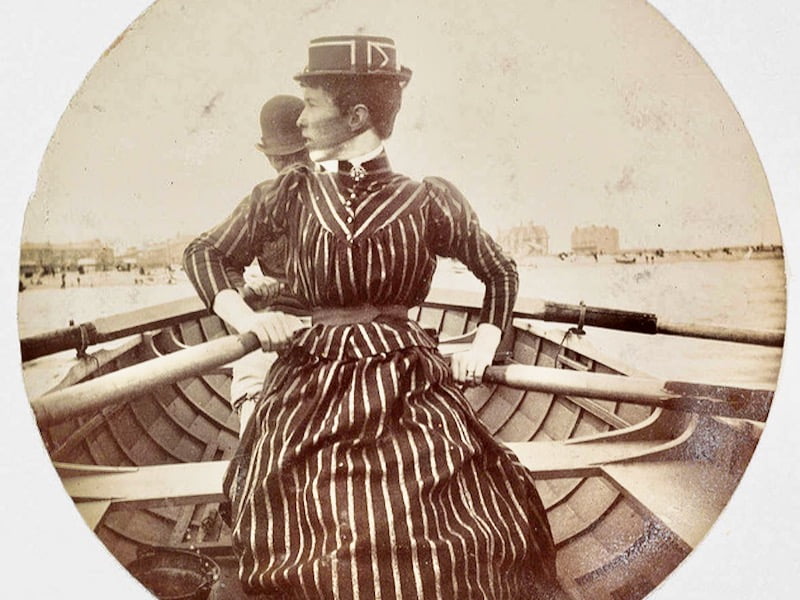
Popular photography can properly be said to have started 120 years ago with the introduction of the Kodak camera, the invention of an American, George Eastman (1854-1932). It was a simple, leather-covered wooden box – small and light enough to be held in the hands. Taking a photograph with the Kodak was very easy, requiring only three simple actions; turning the key (to wind on the film); pulling the string (to set the shutter); and pressing the button (to take the photograph). There wasn’t even a viewfinder – the camera was simply pointed in the direction of the subject to be photographed. The Kodak produced circular snapshots, two and a half inches in diameter. The Kodak was sold already loaded with enough paper-based roll film to take one hundred photographs. After the film had been exposed, the entire camera was returned to the factory for the film to be developed and printed. The camera, reloaded with fresh film, was then returned to its owner, together with a set of prints. To sum up the Kodak system, Eastman devised the brilliantly simple sales slogan: ‘You press the button, we do the rest.’ From the Public Domain Review https://publicdomainreview.org/collection/kodak-no-1-circular-snapshots