To make music from a bone
that’s hollowed out and cut with stops
is a kind of resurrection.
The skeleton with flesh long gone
and bleached to startling whiteness has
both lightness and the strength to hold
with knowing hands, to kiss the ports,
as death becomes a melody
of breath and fingering, to sculpt
the air itself with color, time,
to call up spirits out of earth
and prove time is a miracle,
a stream the music sails beyond
in relic from the common ground.
What is the human need to set
one stone on stone, the loose rocks brought
to this particular place and stacked?
The scattered stones will call until
they’re found and chosen to lie flat,
with slate on slate like pages of
some rough account, memorial to
the source from which the pieces broke,
a cenotaph or elegy
that’s held by force of gravity,
as sign connecting here with
the horizon, approximate
to human form, to show resistance
to erosion’s sprawl, with strength
among the scree of fragments, as
a monument to stand above
the natural wash and wear of all,
to honor the imagined whole.
A universe of billowing
and cosmic conflagrations, stacked
so high they seem to topple
down miles and miles on top of us.
To look this high creates a sense
of falling helplessly away.
Titanic cliffs of vapor dwarf
the hills and humble fields below,
more monumental than the heads
and features on Mount Rushmore. But
the undersides of clouds are smoothed
and flattened by the surface winds,
though higher up the currents twist
and boil in all directions at
the different elevations with
a kind of wildness sculpted by
the knife of turbulence, so far
above the local air we breathe,
in heaven’s mad complexity.
Robert Morgan has published several books of poetry, including Dark Energy (Penguin, 2015). A native of western North Carolina, he teaches at Cornell University.
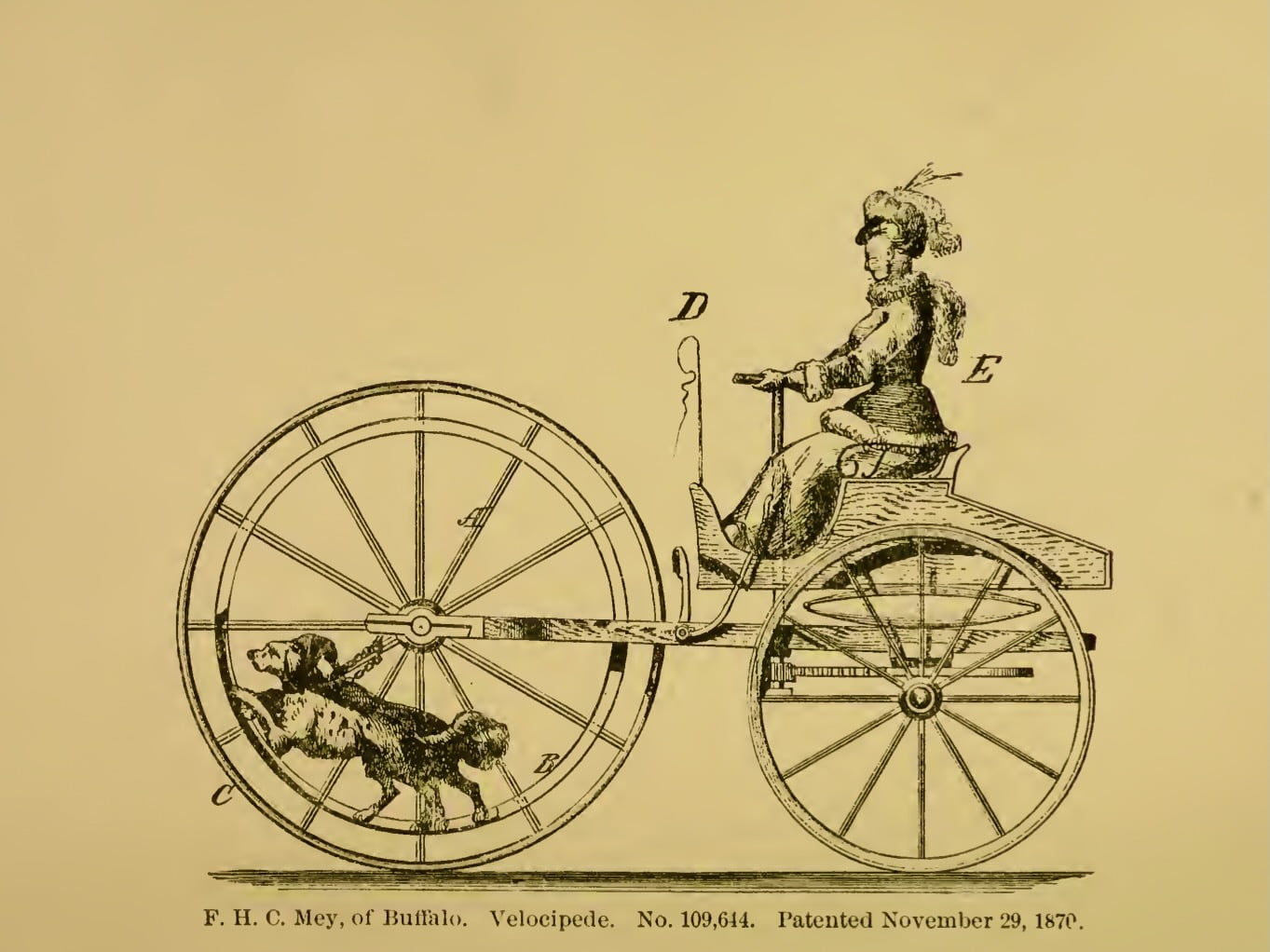
Illustrations of various patents printed in “Cycling Art, Energy, and Locomotion: A Series of Remarks on the Development of Bicycles, Tricycles, and Man-Motor Carriages” by Robert Pittis Scott (Philadelphia: J. B. Lippincott Company, 1889). From Public Domain Review.