and understands what’s done and what’s to come.

He sighs into the hillside
and for the whole length of that breath
he is simply hard ground—

                                    he knows nothing;
                        he is an ocean of sediment,

            a universe of needled soil
            a handful of slim fir seeds
            a horse fly with heavy wings
            a hovering whorl of Jo-Pye
            a shard of broken plastic
            a shoelace tied to a stick
            a shiny Hershey’s Kiss wrapper—

then another breath and he’s back to listening.
Dirt roads sieve mounds of thistle and macadam where mountains of coal once held his family’s home; now, grazing brown scratches of land are herds relocated here with names he does not know, so he just watches and gazes and itches and wonders until he sees one with antlers that look like his brother’s — their arches and how they curve, their points and how they pierce, their balance and how they posture him into an uprightness even as he lies in dry switchgrass — that makes him think of his first pair and how he couldn’t hold their weight. He looked at the world crookedly, constantly nodding left and right, everything slanted and sloped; he knocked them against every branch and pine cone until a pair of woodcocks nested in the crook of his only tine, somehow thinking he was the ground; perhaps because he walked so slowly; perhaps because they knew his adolescence was a shelter of safety; perhaps they were lost like he was. His antlers kept pulling his body towards desire, away from contentment, and he didn’t notice the eggs hatched until one morning there was a nasally peent behind his ear. When he stopped digging his self-anointing hole he finally, actually, listened, and heard the sticky softness coming from the nest he’d been awkwardly cradling. He began to walk slower, more deliberately, and to watch their parents doodle around the timber for food; he gathered so many seeds in every joint and tucked along his ribs he could barely bend and when he breathed and sauntered he felt the small hard hope of life scratching into him. As they ate and grew they became louder and his world was filled with buzzing trills for a whole season as he finally found balance and could walk without tripping. Long after they left for more warmth and the nest fell with his antlers into early spring snow at the base of an oak, he still heard the melodies they taught him; now, with wind sleeving through his joints, huffing air through his large nostril crevices, he spreads wildflower and apple and chestnut and persimmon seeds across stripped soil so next year there will be more twittering and whirring and cricketting and clacketting and chirping and maybe these herds will hear his family name in that nourishing rupture of noise and bugle the songs still echoing along his spine.
The sky is so dark he can’t see

            the red cedar or the puff balls stemming

from soft birch as he steps into spore plumes

            that settle on his ulna and tibia and tarsal.

Awake, willing to walk into that darkness,

            but tired of not treading lightly, carefully,

he arches his atlas and axis and cervical, sweeping

            his antlers across his legs in a perfect balancing act

of grace, agility, and certainty, swinging those bones

            he’s stood on his whole life into the air,

spinning and scattering them across that endless blank

            slate his mother wrote their stories on;

lying on the ground, he watches them

            reach escape velocity, becoming stars

and constellations planted with this final upright act;

            little lights keeping us from trampling our tenderness.
Michael Garrigan writes and teaches along the Susquehanna River in Pennsylvania. He is the author of two poetry collections—River, Amen (winner of the Weatherford Award for Poetry) and Robbing the Pillars—and his writing has appeared in Orion Magazine, The Hopper Magazine, Water~Stone Review, and North American Review. His work has been nominated for Best of the Net and The Pushcart Prize. He was the 2021 Artist in Residence for The Bob Marshall Wilderness Area, and he believes every watershed should have a Poet Laureate. You can find more of his work at www.mgarrigan.com
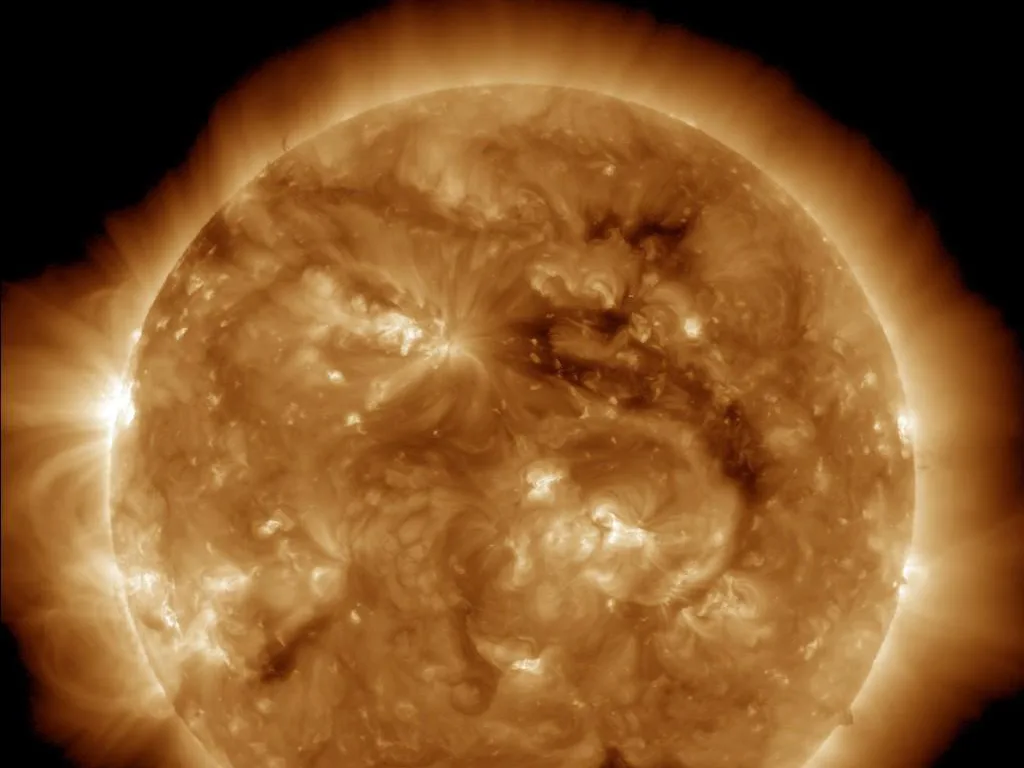
Images of Mars’ polar cap, Uranus on a fly-by, and the Sun’s corona, courtesy of NASA