Rows of pinned husks hang
from hooks, like tools or stolen bones.
But something flops at the base.

Wet wings unfurl, an insect flails
like a caught fish in a boat’s dull hull.
Rows of cocoons tremble, jade green,

plump with cramped life. Pins prick,
rankle molting souls filed neatly
like our embryos in the filed vials

on the 7th floor of Reproduction, Inc.
A pod dilates and opens. Wing tips push,
a wet scrap drops, newborn and writhing.

Dark wings spread to dry, grow twilight
blue, new burn slow, the veined frames
Picasso blue, Bunsen burner’s low flame

blue, beloved, blue as you, your indigo eyes.
Bolivian, Ovidian blue, Blue Morpho blue.
Blue dye #2. Blue, the last incarnation, the best.

In the next room Morphos fly in a humid,
staged forest. Rise in spirals, ping against
the greenhouse glass. Always another ceiling.

By pumped streams, they sip piped water,
the nectar of oranges left in a bowl.
When they close their wings, the undersides

are brown and camouflaged with rings
like the eyes of an owl or hawk. They mock
all birds of prey. A child grabs, his fingers

shimmer dusty blue as the Morpho flies away.
I think of Nabokov’s Blues, that greedy
lepidopterist, a photo of his billowing white

net descending, his gigantic knees
and stomping shoes, framed as he frames
Blue Icarus. And aren’t we all wax-winged

and waiting to fall?  Blue, beloved,
as your shimmering eyes the day we wed
on a dock by a lake and the wind whipped

cobalt waves into a fury. The pier held steady
and we sealed our pact with a ring and a kiss.
How many times since then have we been born

and died? Flinging ourselves against glass walls
on new-born wings and flying toward the sun?
Each time caught by a bluer, colder, sea.
You hate the story of The Three Little Pigs.
What kind of indoctrination is that? you fume.
The first pig and second pig are punished
for making music, building homes of straw
and sticks because they’d rather dance.
They were the hunters and gatherers! you rage.
They lived in bliss until that damned third pig
came along, the one who built with bricks.
Civilization! you sputter. The illusion of permanence!
The Protestant work ethic! First it was bricks,
then steel, skyscrapers, subdivisions, McMansions!
Diapers piling up in landfills! I hate that pig!

How ironic, then, the way you built our house:
with extra lumber and double-thick walls.
Airtight, you explain, energy efficient.
How carefully you cut each board, how perfectly
the stairs are made (except that creak, the second
from the top, the one we skip when Cassie’s sleeping).
It’s not made of bricks, but that pressure-treated lumber
isn’t going anywhere. It’s anchored in concrete.

Which pig are we? We still have music, when we blast
Green Day and dance with Cassie in the kitchen,
when she rocks out with her purple guitar.
And when she sleeps we do our own rocking.
I think the house does move some then.  The grass
is so long in our front yard – a nod to the first little pig.
The forest is not far, but all the wolves are gone.

Or are they? This summer, yellowjackets burrow
in the dirt. We can’t go out without our shoes.
All those larvae, gestating in the ground. We too
have secrets. You in the basement, among your books
and papers, what are you hatching? And me,
a poor imitation of the third pig, industrious
and incendiary. Planting bombs in the bricks.

Let’s be wolves together. That’s why I married you.
When you flash your teeth at me, I know what to do.
By day, play house.  It’s snug and comfortable.
By night, we hunt. Sore and marked but strong
and almost sated. In stories wolves are villains.
But only, you pontificate when on a roll,
only to the farmers, to the third pig and his kind,
with herds too dumb to save themselves.

They say that wolves grow strong in the West.
A law protects them now. They breed fast and close in,
huff and puff at the outskirts of the towns.
Someone will shoot them, rest assured. The question is:
where is our loyalty when the time comes?
My husband strokes my golden carapace.
Crisp husk that the cicada shed.
I am not there. I inhabit other buildings

as the ogre in the fairy tale
removed his soul,
lodged it in a safe place
to save his life.

In the center of a forest,
a circle of trees. At the center of the circle,
a caged bird, a green parrot.
Inside the parrot, the ogre’s soul,
deathless until the hero kills the bird.

I left myself in buildings: the school’s long halls,
the mall’s panoply, the straight church aisles.

In dreams I run through empty hallways.
In dreams I stow myself in a box.
I plan to return, but I forget where I left it.
It is always the end of the world.

In the Chinese story, the Golden Cicada is enlightened.
Its abandoned shell is a decoy.
In the end it sheds all forms.
It molts until it is done with skin.

I am not done with skin. I try to feel his hands.
Disrobe and disrobe. Expose the pink and white
flesh he craves, the soft buds of my body.

Somewhere there is a bird. When it is safe
to retrieve it, I will.
Donna Coffey Little is a Professor of English at Reinhardt University and the founder and Assistant Director of Reinhardt’s Etowah Valley Low-Residency MFA in Creative Writing. She is also the Director of the George Scarbrough Center for Southern and Appalachian Literature at Reinhardt. Her creative nonfiction essays, poems, and scholarly articles have appeared in numerous journals, including Five Points, StorySouth, Tiferet, Georgia Backroads, Calyx, The Atlanta Review, The Florida Review, Women’s Studies, Modern Fiction Studies, and Contemporary Women’s Writing. Her chapbook Fire Street was published by Finishing Line Press.
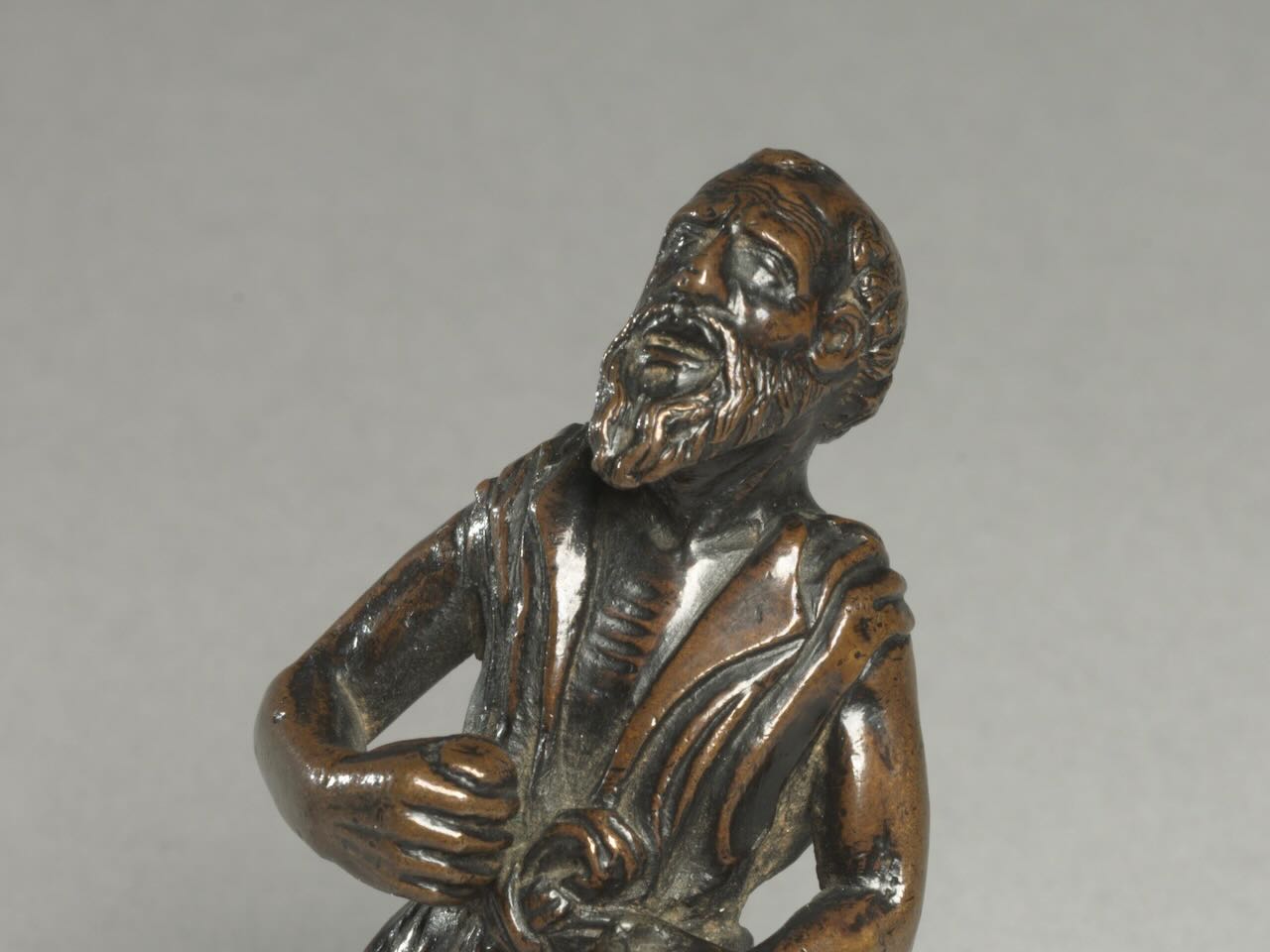
Three sculptures by Severo da Ravenna (Italian, c.1496-c.1543):
1. Kneeling Saint Jerome,
2. Writing Casket (container for pens, inks, and sand for blotting),
3. Inkwell of Hercules.
Courtesy of The Cleveland Museum of Art.