The starlings are nesting
in the walls and the harvest is
half-finished. I have not
lost my mind. What wakes
me now is not the reaping
but the threshing. The starlings
have only just started to nest.
The fields have not finished
with me yet. My mind fills
with the threshing, or thrashing;
some sound of fear or frenzy
or feeding. The distinction
won’t be made unless
I go mad, or until.
I do not call for help
but men will still come,
bearing solutions in
the shape of threats. Sickles
and pitchforks, claw traps
and snares. Surely something
must be done;
with the overfarmed fallows,
with the life
in the walls. When they say cultivation
I hear culling. When their fixing is
finished the crops will fail.
When the evening
ends the fledglings will be dead.
When something dies
in the walls
it dies in the fields it dies
in my mind. I can still hear the thrashing.
Or threshing. It makes no difference,
unless or until.
If new seeds are sown
this spring I know
that nothing will
grow. If children
are born this year
they will never be safe.
The machines have finished
off the fields.
The exterminators have started
on the nests.
I have boarded up my own home
and locked myself
outside.
I have not lost
my mind.
Something in me
has overgrown and
if it is a child
I will never be safe.
The doe moved through the underbrush
with such calm that she was close enough
to touch before I knew that I was not
alone. If she saw me, she did not see me
as a threat. She did not behave as though

she was fragile. I stayed very still as my fears
found root in her vulnerability, though
I knew that fear could not save her;
though even terror had never
saved me. I flinched at the snapping

of twigs while she grazed, my heart
the only prey thudding and thrashing in the
bracken. When she stretched I caught the pulse
at her neck, steady. When she grew tired
she lay down among the cornflowers

and cottonwood fluff, unconcerned.
In the sunlight her fur seemed the same
shade as my own hair, and for a moment I felt
crosshairs settling on my throat; a distance
and a safety removed. I wondered if

she had ever felt it too. I wondered if
she had ever felt herself inside of her skin
and understood that men might watch her,
wondering only when they could take
a clean shot. That her body would glow

in their thermal sights, begging to be called
a target. That they would be willing
to sit in wait, already cutting
their teeth on tender thoughts
of how she might taste.
In this meadow the only doe is
a nursing rabbit; still prey enough to
give me pause, to pull the hairpin
of fight-flight-freeze. I know that
in fear of predation a mother might
eat her children. I know that then my
heartbeat would limp ragged for
a day or two, that forever my chest
would echo echo empty and bloodied
as a nest abandoned just after
birth. I can’t watch a soft animal
without waiting for the gunshot.
I can see that somewhere in the flowers
is a snare. Beyond the treeline a set of
teeth. Across my own flesh a flinch,
an understanding that softness always
ends in pelt or meat or trophy.
Just as my body has been worn
or consumed in victory; unlucky
rabbit feet becoming soft little
trophies. Likely they never even
sensed a threat, just like every time
I bared my throat instead of teeth.
I’ve learned that some victims are seen
as more sympathetic but I haven’t yet
found the magic, the trick. If I had been
born a witch and my mother had never
felt this type of fear I could have turned
all of the rabbits into rats and they might
have kept their feet if not their lives.
Of course then all that would be said
is that they deserved it, and I would be
burned, or drowned. Regardless, all things
feral know that sometimes the only spell
against death is to eat the young. When I sense
a threat I remember fight-flight-freeze, forget
fawn. When any animal enters a meadow
the human instinct should be to beg
for something far worse
than forgiveness,
and less soft
than death.
Christine Barkley is an artist and writer based in the Pacific Northwest. Her writing explores themes of chronic illness, trauma, and nature. Her work has appeared or is forthcoming in The Massachusetts Review, Salamander, Rust + Moth, and Autofocus, among others.
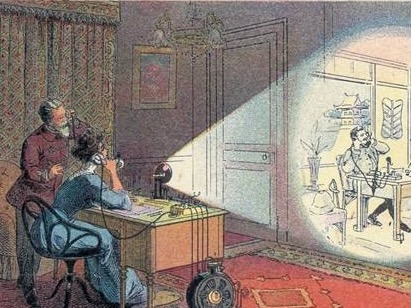
Postcards depicting the “Telephonoscope,” an imagined future device following the invention of the telephone and film. From Public Domain Review.