If a learned man scans
the work of your mind and finds
the meter lacking (unrefined?)
put a wolf in your poem.
Because a wolf is not a symbol,
it's a mammal, a carnivore.
Like rusty train wrecks (in which
steel cargo cars lie crumpled
in a field beside aloof cattle) or
someone else’s suffering, it’s hard
to look away from a wolf.
Make him surprisingly thin
through the hips and thick around
the forelegs and chest. He is just
steps from the shadows
of old conifer trees, bare trunked near
the ground for having shaded each other
out of flourishing. There should be
a little snow on the ground, a veneer,
with sharp grasses poking through, little
spears of the earth around his paws.
The ambiguity of not knowing
if we are headed toward winter
or spring keeps the reader’s eye
moving from line to line because
who can relax when a wolf,
(eyes much smaller than
legend would have it, much closer together
on his triangle face, and more focused
than the eyes of a loyal horse or family dog)
is present? When he turns toward
your reader, make sure it’s only
his head that rotates—his body
still oriented toward a grassy valley, mountains
just beyond—where they meet, invoke
the blue-green color
of a bruise, healing.
Here are some things a person can fix:
A flat tire, though, sometimes
the tire’s not fixed, just
replaced; a bad haircut,
but, if it must be fixed
now, the one solution is to
take away more. Waiting
for new growth is not fixing,
it’s patience. A wooden spindle
cracked in half when
a chair’s knocked over in
a fit of anger, can be smothered
in wood glue and
clamped with a vice. Sometimes
you need new parts, sometimes
you need mercy. See the shepherd
boy in Germanic-looking shorts and
funny hat cast in porcelain? He has that
dreamy look figurines like to take,
an ornamental gaze, a self-indulgent gaze
of unnamed sorrow. The real boy leaping
from cushion to flowered cushion,
arms in the shape of an airplane,
will knock the figure
from the shadow box
(a ping of fissured porcelain
on a pinewood floor)
and having looked at nothing sorrowful
in all his life, will afterwards,
feel ashamed. And will afterwards
apply himself to fixing:
chairs and tchotchkes,
bicycle chains, lawn mowers, picture frames—
but wondering, always, how
to fix the whole world?
Stuck in my craw:
To say, I praise you, is not
to praise. It rattles
hollow—one penny in a tin can bank.
The can in an empty room sounds
its echoing clang, the clang
diminishing, the way
a cry for help falls deeper
into canyons in cowboy movies—
the half-life of sound, shrinking. But the sound
of flattery (which has volume)
is not praise. Praise the world
by making lists?
-An old hand, veiny, along a banister in half-light
-A honeybee landing on a curved branch of catmint, bobbing
-Clean fire on a cold night
No.
Say praise and mean tell the truth.
Say praise but mean, I don’t deserve what is here.
What is here is the penny—
its small, raised face so
serious and precise.
Who decided the least worthy
coin should be the loveliest color?
Who invented the tin can bank, soft
beans swapped for
copper-joy of small value?
It rattles, not hollow, but makes
solid sounds like pangs (of hunger, regret)
and a baby laughs at the sound,
a deep, flowering laugh, growing
louder as it spreads. She laughs
at the penny sound, at how
silly all the small things are.
Theresa Monteiro lives in New Hampshire with her husband and six children. She is a former teacher and holds an MFA from the University of New Hampshire. She has had poems published in The American Journal of Poetry, On the Seawall, River Heron Review, Pittsburgh Poetry Journal, Tipton Poetry Journal, Black Fork Review, Presence, The Meadow, Banyan Review, Cutbank Literary Journal, and Dunes Review. She received the Dick Shea Memorial Prize for poetry in 2019.
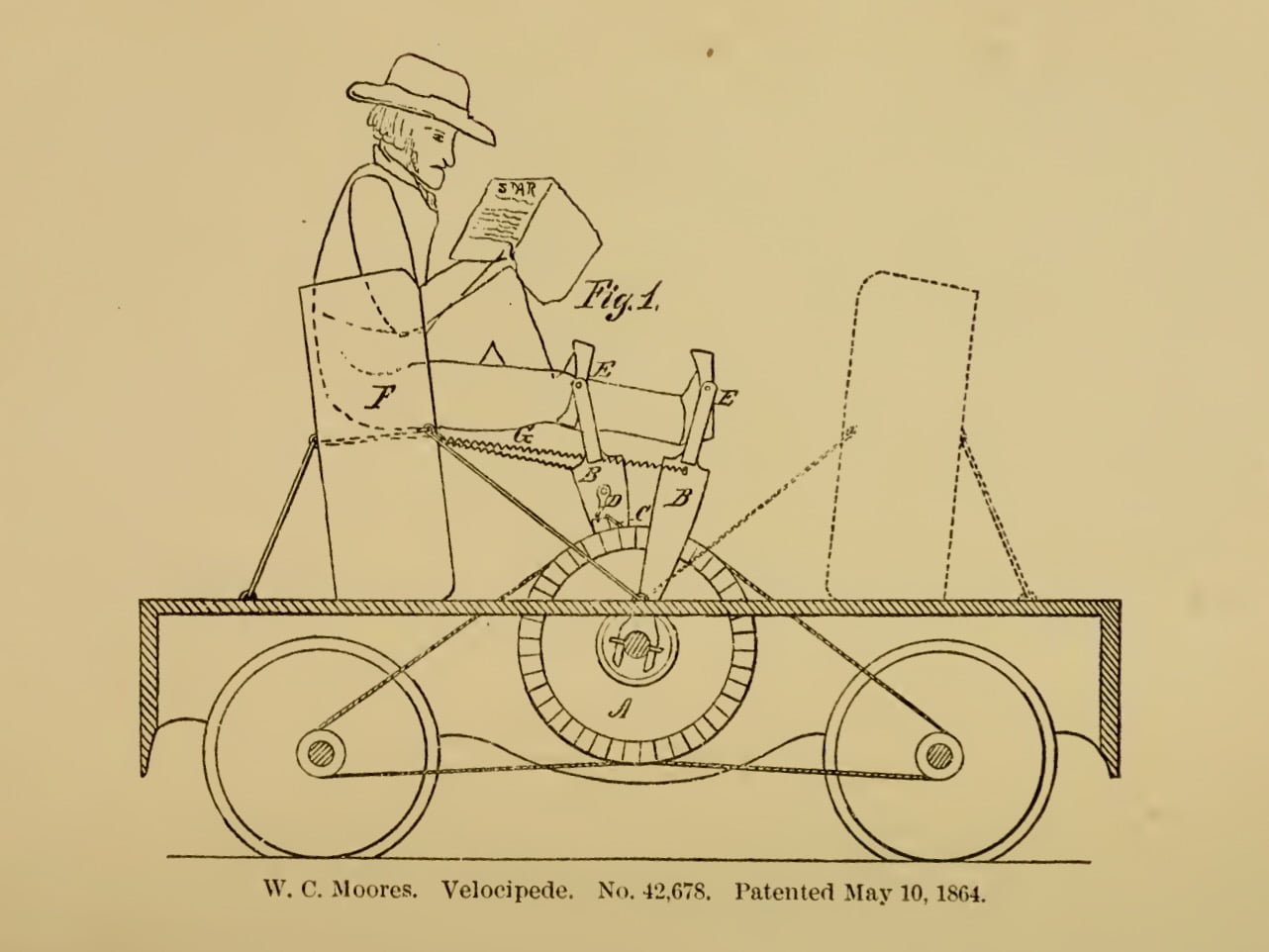
Illustrations of various patents printed in “Cycling Art, Energy, and Locomotion: A Series of Remarks on the Development of Bicycles, Tricycles, and Man-Motor Carriages” by Robert Pittis Scott (Philadelphia: J. B. Lippincott Company, 1889). From Public Domain Review.