When I was thirteen, Pam, a family friend’s daughter, told me she was a “bare branches” child, meaning the bloodline would die with her. A dead end. Pam theorized that her parents planned to feed her to the garden. She also claimed they descended from a long line of witches. I didn’t know what to believe.
Then she ran away from home. “An extended abroad program” was the official excuse. She disappeared two weeks before our final exams, a period during which I didn’t see the sunlight for days while memorizing textbooks because I was no good at applying material but plenty talented at retaining information. Several days later, she texted me saying how happy she was after leaving, a secret I kept to myself.
Pam returned last week with a five-year-old son and a green card husband who immigrated here from Dalian. Pam invited me to get tea with her, and I, with no real hobbies and plenty of free time now that the semester had ended, accepted. We decided to meet at an old coffee shop established before both of us were born, frequented by the local police and editors of the city’s newspaper. I had put it on my bucket list of places to visit before I die because who knew when the urban planning committee would finally raze it down and replace it with tall, compact homes equidistant from each other and the road like a row of soldiers.
I arrived five minutes early. Pam arrived five minutes late. She walked in carrying the type of satchel a lawyer carries—dark brown and leathery with a patina forming over the larger surfaces, full of flaps and buckles and a long strap draped over her shoulder. It looked too large and floppy for her rigid and narrow shoulder, like an iron fence barring the coyotes from civilization. I waved at her from the small table where I was seated. She headed straight toward me and sat, her hair swaying behind her back, the wind swept up in her inertia as I inhaled her perfume—chamomile and amber. As a child, she dressed like a boy, hair cut in a bowl shape and clothing loose on her frame. Her parents even referred to her as “son.”
“You can get something to drink first,” I said, wrapping my hands around my cup of coffee.
Pam waved her hand. “I already had tea today, one more drink and I won’t be able to sleep. It’s great to see you. It has been ages!”
“Same,” I said. Not that we hung out of our volition when we were young. My parents liked to stick me at Pam’s house when they left for their “Bible Studies” of which I was never invited. They claimed they wanted me to find my own religious beliefs outside of a rhetoric ricocheting between CCP propaganda and Christianity propaganda. I later discovered that they received payouts from the underground church and engaged in “rituals” that entailed having sex with other worshippers (who left hickeys on Mom’s neck and lipstick stains on Dad’s collar). I never blamed them—not as a child and not as an adult. I figured they’d grown up so sexually pent up, separated from the opposite gender, unable to even glimpse the tiny bone protrusion on the outside of an ankle or watch someone lick oyster sauce off their lips, without getting your head beaten into the table.
Pam leaned forward, her voice dropping in volume. “I came back because I was worried about you. You know, with your family situation and all.”
“What family situation?”
“Didn’t you say your parents were going to pull you into the church once you turned twenty?”
“That’s not a ‘situation.’ That’s just a series of unfolding events,” I defended. “What about you, what happened to being a ‘bare branch’ person? You came back with another sapling to graft onto the family tree instead?”
Pam sighed and waved her hands in the air as though to ask ‘So what.’ “When you’ve been alive as long as I have, you realize that there really isn’t much more to life after a certain point, so you’ve got to create that forward momentum on your own.”
“By having a child?” I wondered.
“By grounding yourself,” she replied.
I learned later that Pam had reunited with her parents and they’d added her back to their will. Pam wanted to buy a house nearby so she could put her son in the blue ribbon public school district we attended as kids. The same school district where the computer science club hacked the history teacher’s desktop computer and sold exam answer keys for fifty dollars a piece. The same school where people would have sex in the orchestra pit or on the piano bench and leave empty boxes of strawberry pocky littered on the ground.
Pam asked me to watch over her son while she and her husband visited a few open houses. “I’d rather die than let my parents take care of my son, they’d probably feed him to the trees,” she explained to me. When we were little, we’d play in Pam’s backyard, a plot of land so large you could climb the slope and lose sight of the house. Fenced off in the back grew several plants in straight rows, each more exotic than the previous with leaves the size of faces and flowers that resembled smashed mooncakes. “Poisonous herbs,” she’d whisper. “My parents feed them their failure-children. These plants grow from human vitality.” I stayed far away from the plants, and whenever a frisbee or birdie landed within five steps of the garden, I let Pam retrieve it.
“I thought your parents were happy about your son?” I asked, confused.
“Well, they were happy about me at first, too,” she shrugged. “You can transition between plant food and filial spawn like that.” She snapped her fingers in front of my face.
I agreed to take care of Pam’s son because I didn’t want the possibility of a plant devouring her son weighing on my conscience and because it might be fun to change up my routine. I never mustered up the determination to buy a pet, so babysitting seemed like a good first step. To prepare, I cleared away the stray church pamphlets my parents left on my counter and ripped open a bag of egg roll cookies, a food I pined for as a child. I gathered the ripped condom wrappers from the last few one-night stands and emptied the trash can in the bathroom. I tossed the bras I left hanging on the backs of chairs into the closet and gathered the empty wine bottles in a cardboard box to later exchange for cents. I sat my stuffed mochi turtle on the couch, its round, black eyes staring back at me, waiting for permission to topple onto its side.
When Pam arrived, I’d finished removing anything her son might stab himself with—the steel picture frame of my family in a rare, smiling moment together like we’d emerged from a fairytale, the needles I used to pierce and extract fat granules from the papery skin around my eyes, the plank of wood I meant to turn into a gardening bed for the balcony.
“Elliot doesn’t need much. I’ve left a bag of cornflakes in the backpack if he gets hungry, although feel free to feed him whatever you’ve got. He’s not picky.” Pam handed me a backpack that weighed as much as a small watermelon. I held it with both hands.
“Don’t worry about us, just focus on house hunting,” I reassured her. “Don’t buy anything with a backyard of man-eating plants.”
Pam nods solemnly. “Definitely not. We want something small where there are no trees to hide behind or corners out of sight. The house should be like a lighthouse. All-seeing, even in the dark.”
The dark was how Pam ran away, according to her. Her parents despised artificial lighting and the moment the sun set and their candles burned through their wax, it was bedtime. They feared light bulbs would disrupt the local insects’ pollinating schedules and artificially boost their garden’s rate of photosynthesis to the point of collapse. This created the perfect time to sneak away—while the rabid plants and parents slept.
I led Elliot to the main area of my apartment. He seemed smaller than most five-year-old boys, with wrists like chopsticks, a large forehead and even larger glasses, and short, spiky hair that magnified his head, as though all the nourishment Pam fed him had been siphoned off for his brain.
“Are you hungry? I have egg rolls,” I offered. Elliot shook his head.
“Do you want to play something?” I attempted again. Elliot grabbed at the backpack I was holding. “Let me help. This is too heavy for you.” I set the backpack on the floor and slid the contents out. A wood board tumbled out, and several flat polygon pieces sitting on the board fell from the frame.
“Are you solving this tangram?” I asked. I hadn’t touched a tangram since I was young. Pam tried to teach me to solve one, but I always gave up after several tries. She had a whole closet full of games like these from before her parents realized she was a “bare branch,” after which they stopped purchasing “brain-stimulating” games and left her alone. She attempted to pawn off the old tangrams and checkerboards to me so she could make space in her closet (for what—I never found out), but I refused. I didn’t like games that I couldn’t solve.
“Mom and I already solved it,” Elliot replied. “But you spilled it, so I need to redo it.”
“Sorry about that. But it’ll be easier for you to put it back together now, right?”
He shrugged and sat on the ground, quietly trying to fit a triangle and trapezoid together.
“Let me know if you need anything,” I said. Elliot didn’t respond.
I sat at the kitchen table in front of my computer, watching Elliot from the corner of my eye. I wouldn’t be surprised if he were one of those kids who could focus on studying in the middle of a hurricane. I refreshed my email. Another ad forwarded by my parents regarding bible studies. It read “Forsake your soul for God in return for eternal blessings and prosperity” in large, blue letters. The moment I turned eighteen, they reversed their standpoint on my participation at church, inundating me with flyers and bribing me with mooncakes and water-salted ducks. “You’ve grown up so pretty,” they’d say. “It’d be a shame for you not to join.” I suspected the referral bonus they’d receive from my membership was more than they could pass up. I deleted the email and set up the auto-spam filter I should’ve created months ago.
For several minutes that felt like hours, I only heard the clacks of wood polygons and the occasional whoosh of water through pipes from the floor above. Then sniffling. Elliot’s face had turned pink and he started rubbing his eyes and nose, a dark moist spot spreading on his striped sleeve. He gripped a parallelogram in the other hand, its edges digging into his palm and fingers.
“Don’t do that. You’ll hurt yourself.” I knelt next to him and attempted to pull the shape from his soft, pillowy hand. I’d forgotten kids resembled marshmallows, their skin clear of calluses and wear. Elliot refused to loosen his grip.
“If I can’t solve this, Mom is going to die,” he whispered.
“What do you mean, die? She’s not going to die.”
“Grandma and Grandpa will feed her to the man-eating trees.”
“Your mom is a lot tougher than that. No tree can eat her.” I patted Elliot’s head.
“But Grandma and Grandpa said that if I can’t solve this, I won’t be able to carry on the bloodline, and then they’ll have no choice but to feed Mom to the trees.”
“You know why that’s not possible? Because man-eating trees only eat men,” I lied. “Your mom is a woman. Very different things.”
“But humans are human, aren’t they?”
I wished Elliot were more gullible. “Okay, let’s say the trees are capable of eating your mom. I’ll just make sure it never happens. You can trust me, right? I grew up with your mom and was never eaten and never will be.”
Elliot looked down at the tangram for several seconds then up at me. “I guess so.” He attempted to fit the shapes into the frame again, reorganizing the rhombus and the parallelogram but leaving the large triangle in its spot to the side.
I crouched down next to him. “Do you remember where the red piece should go? Maybe the big triangles don’t belong in that corner at all.”
Elliot frowned. “I don’t. Mom helped me solve this the first time. She said if I took too long in front of Grandma and Grandpa, I might become tree food.”
“So she did it for you, huh,” I muttered. “Well it’s good to start with no assumptions if you don’t remember where any of the pieces should be, else you might be digging yourself into a dead end.”
Elliot pried the triangles in the corner out, the frame now empty and the polygons scattered next to him.
“We’ve got time. We can figure it out,” I encouraged him. Not that I had much faith in my ability to help. I’d never been as good as Pam with puzzles or anything that required a keen intellect and intuition. I preferred brute force tasks where, if I repeated an action enough times, I’d achieve competence, which was how I ended up beating Pam in track even though she’d started running years before me. “You’re just going in circles,” she’d laugh. “There’s no need to run like a tide will swallow you.”
“Look, these two pieces fit a right angle. We might be able to build on this.” I placed a triangle and trapezoid next to each other. This was the best I could do. We continued moving pieces around, thinking up combinations and spinning wood shapes until we’d considered every angle.
I glanced at my phone, the sharp buzz of the Nest doorbell camera notifying me of an approaching figure. I watched the camera as my parents pressed the doorbell, thankful I’d replaced the window with fogged screens. My mom stood a footstep in front of my dad who carried a plastic grocery bag in one hand and a bottle of wine in the other. He wore a gray suit, clashing with his long, solemn totem pole face and his gelled-back hair. My mom massaged her knuckles and looked down at her dress, a red camellia-patterned monstrosity that aged her by a decade or two. She believed red would bring her prosperity. This philosophy only applied to red clothing and decor—not red pens which I’d once gifted her for her lunar birthday and she asked if I was trying to kill her before tossing it into the trash can and warning me that only Lord Yama used a cinnabar pen to tick off a person’s name once they reached the end of their life.
“It’s okay. You can ignore it,” I told Elliot who resumed his puzzle. The doorbell rang again. I looked through the door hole again. They showed no signs of leaving. Mom pursed her lips, her lipstick clean and streak-free and smooth as always. I placed my hand on the doorknob, counting to ten. If they didn’t leave within the next ten seconds, I’d let them in. I’d tell them to give up.
“I told you. I’m not joining your cult,” I sighed, barricading the entrance with my body as I cracked the door open.
“Is that how you greet your parents who fed and raised you?” My mom asked, her dark, sketched eyebrows in a deep frown and arms crossed. From behind me, Elliot slotted one of the polygons into place. My dad looked past me, his height more than enough to peer into my apartment and note the disassembled cardboard boxes I used as stovetop dividers to prevent oil from splattering, the sandpiper painting I’d gotten from Goodwill, tiny Elliot sitting on the ground feeling each wooden shape in his hands again and again.
“When did you have a kid?” My dad interrupted.
“He’s not my kid,” I said.
My mom’s gaze shifted from infuriated to forlorn. “Oh, daughter, no matter how nice a man is, you can’t just latch onto them, especially if they have so much luggage in tow. That’ll ruin your youth. We can find you a good partner to build a good family at the church.”
“If you need money, just text me. You don’t have to see me in person. Plus, I’ve already had plenty of partners. I know what I want,” I replied.
“Let us at least come in and sit,” my mom insisted.
“No, I didn’t clean up. There are condom wrappers all over the place.”
She failed to suppress her gasp.
“You know that if you have premature sex, you lose your chance of obtaining a higher position in church,” my dad tsked.
“You mean you lost your chance of selling a lucrative virgin to an ocean of thirsty farm boys whose most useful skill is slaughtering ducks,” I corrected.
“We’re not trying to sell you,” my mom cried.
“Well, thanks for not trying to sell me, I guess. Have a good day.” I closed the door and waited until their footsteps faded.
Elliot glanced up. “Maybe the trees can eat your parents.”
I laughed and returned to my spot beside him. “Maybe,” I repeated, rustling his hair and holding out my hand as he placed a rhombus in my grasp and considered the remaining pieces.
Lucy Zhang writes, codes, and watches anime. Her work has appeared in Virginia Quarterly Review, Shenandoah, The Massachusetts Review, and elsewhere. Find her at https://lucyzhang.tech or on Twitter @Dango_Ramen.
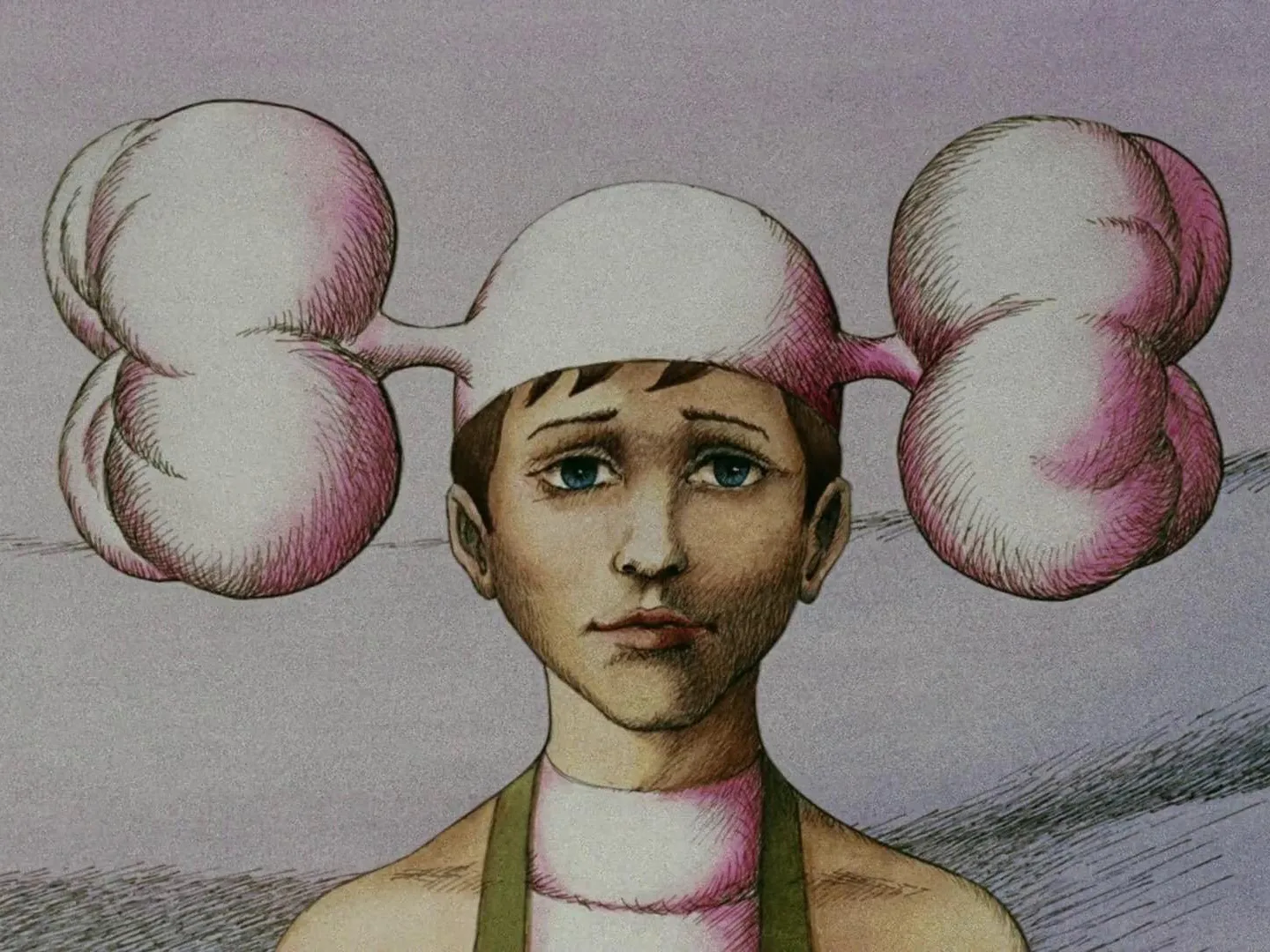
Images from Fantastic Planet (1973), directed by Rene Laloux.