The following excerpt is the opening of Tatiana Schlote-Bonne’s What Feeds Below, which released from Bindery Books in October 2026. In this novel, orphaned best friends Petra and Jade guide treasure-seeking tourists down into the Void, a massive chasm that extends miles into the earth, its treacherous terrain overrun with vicious monsters and carnivorous plants.
Chapter 1
Thank you for choosing Void Adventure Services! Our experienced guides will keep you safe on the most exciting journey of your life!
I understand and am aware that entering the Void involves risk, including, but not limited to, loss of limb, vision, taste, hearing, fertility, cognitive function, and life. I am also aware that much of the Void is still unexplored and there are risks I may have not yet considered. I acknowledge that my Void guide(s) will keep me safe and alive to the best of their ability but there is no guarantee.
—Void Adventure Services liability waiver
The man’s lips have been ripped from his face, his teeth bared in a terrible grin. Blood oozes from the mangled flesh where his right hand should be. I wince. Which creature could it have been? The stringy bits of tissue make it hard to identify specific teeth marks. Any predator in the Second Layer or deeper could’ve done that, really.
“What do you think got him?” I ask Jade.
“Stupidity.” She pops her bubble gum.
I shield my eyes from the early morning sun, searching for this man’s guide. I want to ask what went wrong so I can add his misstep to my ever-growing list of “Things Not to Do in the Void,” but no one’s claiming the lipless man. He didn’t go into the Void alone, did he?
The rescuers heave his body onto a tarp to carry him away from the mist of the First Layer and toward the nearby crematorium.
“Any chance we can save him?” one of the medics asks his colleague.
The other medic shakes his head. “We lost his pulse a minute ago. Looks like the poor bastard went in by himself. Barely made it halfway through the Second Layer.”
Jade and I give each other a look.
“Told you,” she says.
The medics pass by us with the corpse, the rank stench of shit and piss souring the air. I itch the raised scar on my calf from the time I was bit by a cavetrapper. Jade and I are skilled Void divers with more than a thousand climbing, hiking, and caving hours in the Void’s upper layers, but still . . . each time we take a job, we’re one wrong step away from suffering the same fate.
Jade reads the look on my face. “If you’re scared of that happening to us, don’t worry. We know what we’re doing, and more importantly, we have each other.”
I nod. “I’ll always get you back to the top.” It’s been our saying since our first Void dive together five years ago. We’re best friends, practically sisters, and dive partners—for life. No matter what, Jade and I will always make sure the other returns to the surface.
“Me, too, Petra,” Jade says. “Nothing will happen to you as long as I’m here.”
Jade’s the strongest person I know—she can literally do more push-ups and pull-ups than the boys at the orphanage, while wearing her caving gear. Add that on top of everything else she’s been through? Yeah, she’s tough as granite. And as long as we’re working together, I can do anything.
We can do anything.
As the medics carry the man’s body up the hill toward the crematorium, something glints on his left wrist: a silver watch. I’m hit with the realization that I knew this man. His name was Gunther—I remember it because I thought it sounded funny. Last night in Blackout Sea Bites & Brews, Gunther drank at a table near mine and Jade’s, the watch glinting on his wrist as he gesticulated and boasted about how he once climbed the world’s tallest thirty-thousand-foot mountain, and if he could do that, then he could make it to the Void’s deepest layers, and he could do it without wasting money on this city’s “filthy scammers.”
He wasn’t entirely wrong about the scammer part; a lot of Void guides do rip off the tourists. But Jade and I are part of an honorable—well, mostly honorable—business escorting the rich on Void adventures. We’re only guilty of occasionally swinging by the crematorium on our way to work in case there’s any good loot.
“Wait!” Jade calls out to the medics. “Let us pay our respects to a fellow diver.”
The medics eye us suspiciously.
“We know him,” I add, to sell this story. “His name was Gunther.”
“Fine.” The medics let go of the tarp. “Make it quick.” They lean back, taking a moment to stretch.
Jade kneels beside the corpse, bowing her head. I join her.
“Thank you for offering your life to the Void,” Jade mutters. Her hand swipes low by the body, then back to her pocket. She brings a handkerchief to her nose.
“Your death was not in vain, Gunther,” I say.
Jade stands. “So senseless when visitors of our great city lose their lives.”
“Uh-huh.” The medic side-eyes her. “You two done?”
“Yes, sir!” I say, then Jade and I hurry down the cobblestone alleyway toward the tourism district.
Under the shade of a willow tree, Jade pulls the bloody watch from her pocket, wiping it clean on the grass. The watch is leather bound, the clock part of it a polished, shiny silver. She flips it over. “There’s an engraving.”
Etched into the silver back are a few words that I can’t read: it’s one of those languages they speak across the sea, chunky letters that all look the same, though I’m betting the last word is Gunther’s name. Something, something something, Gunther. Probably from his wife or kid. Years ago, my mom and I gifted my dad a similar watch with an engraving.
“You think this writing will depreciate the value?” Jade asks.
“Naw, maybe it’ll even raise it. Personal touch and all, proves that it’s foreign.”
“Good point.” Jade tucks the watch into her backpack.
I look up at the clouds, trying to picture the country Gunther is from, where they use block-letter language and name their kids funny names like “Gunther,” where instead of climbing down a hole that traverses miles beneath the ground, people climb up a mountain that grows miles into the sky.
I bet I would like it there. But moving costs a fortune. People don’t get to relocate unless they make it rich in the Void.
“Let’s get to the Tourist Center before all the good gigs are taken,” Jade says, already heading for the alleyway shortcut.
I hurry up, watching my step as we cut through the muddy, pothole-ridden roads of the slums. The city is built in a ring around the Void’s mile-wide opening, with emergency services and the crematorium close to the northern edge. The orphanage is a few minutes’ walk away from that, while the Tourist Center is a mile east, in the nice part of town, so the tourists don’t have to see the “poors” and the “weirdos.”
Outside the ramshackle wooden Church of the Void, the Void Truthers line up for their early morning service, wearing their usual black robes with green hoods. Like all cult members, they claim they’re not in one, but they worship the Void like it’s a sentient goddess. Their most devout followers have a tattoo of six concentric circles, the smallest one filled green. The tattoo is usually on the arm or shoulder, but the snobbiest ones have it on their forehead.
Across the street from the church, panhandling cultists do their usual lap around the neighborhood, holding wooden signs painted with their favorite religious drivel and conspiracy theories:
Praise Goddess, Thank Goddess
Surfacewalkers Are Real
They Live Among Us
The End of the Surface Is Near
I can’t help but laugh at their dumb signs. The “normals,” like me and Jade, accept the Void for the natural phenomenon that it is and don’t try to explain it away with wild theories, but these guys . . . well, they believe alien shape-shifters from the Void are out to body snatch divers and take over our world on the surface. It’s a boogeyman story, a way for some people to cope with the fact that we live around the edge of a literal hell hole.
A clammy hand grabs my arm. “Careful when you enter the Void, a surfacewalker might steal your skin,” an old man with more gums than teeth says, his face way too close to mine.
Jade smacks his hand away from me. “Don’t touch her.”
“Don’t go into the Void,” he croaks. “They prey on the nonbelievers.”
“And are you going to pay our rent?” Jade asks him.
The gummy old man doesn’t acknowledge this question. “The mayor is a surfacewalker,” he says to Jade with grave seriousness. “He never blinks. Never!”
There’s an awkward pause in which the man stares at me and Jade, waiting for us to acknowledge his insider info. Then a woman in the shop behind him dumps out a bucket of stinking, brown sludge, the splatter breaking the silence.
“Thanks for the tip.” Jade drops a half-nox coin into the old man’s bucket.
“That was nice of you,” I say as we continue down the street.
Jade shrugs. “I felt bad for him.”
Half a mile later, the roads become smoother, the cobblestones clean and maintained. The air is nicer here, and it’s quieter, the streets free of any crazies. Women in pastel-colored dresses walk by, accompanied by men in suits. In the street, carriages are pulled by horses, their manes bouncing, shiny hooves clomping. In the distance, an airship descends, bringing in another batch of eager tourists.
My favorite part about the nice side of town? How well the plants grow here. Despite my best efforts, my herb garden outside the orphanage is constantly fighting for its life, always getting trampled and eaten by stray animals and bugs. It’s also too small. I can’t even grow a fraction of the plants I need to make medicine. But soon, that won’t be a problem anymore. This time next year, I’m going to have a clinic with a greenhouse attached to the orphanage. The greenhouse is going to grow turmeric, ginseng, milk thistle—every medicinal plant that I can get my hands on—and with the clinic, I’ll be able to help people. I’ll be able to treat kids in the way I wish I’d been able to help my little brother, Mica, when Void parrot flu plagued this city.
Jade’s going to help with the clinic too—she’ll be head of security and logistics, handling inventory and making sure we don’t get robbed. The business will generate enough income for the orphanage to house even more children, and Jade and I will never have to set foot in the Void again.
“Let’s get a good gig today,” Jade says. “I want to go deep.”
I fidget with the edge of my sleeve. The deeper we go into the Void, the bigger the potential for a high payout, but the greater the chance our hands and faces get torn off, or we straight up die. “Well, maybe not too deep.” I want—actually, need—the nox for the clinic, since its addition to the orphanage is the only reason Ms. Opal’s going to let Jade continue to live there after she turns eighteen next month. I still have another six months until I turn eighteen, and if we consistently take First and Second Layer gigs and maybe even our first Third Layer one, we can hopefully have enough nox to start the business before my birthday.
Jade scoffs. “Come on, Pet. If we go to the bottom once, just once! We can find an Obscuris relic and never have to dive again.”
“The bottom?!” My heart leaps at the thought. “Six hells, Jade, I was thinking maybe the Third Layer.” I tug on my earlobe. “Fourth at the most.”
Jade frowns. “People don’t make life-changing money in the Fourth. The real treasure is in the Sixth.”
“I know. I’m . . .” Not ready. I’m not bold like Jade. I prefer to play it safe.
“If we found a piece of lost tech—or even an old nail clipper from Obscuris—you know how much we could sell that for? We wouldn’t have to worry about taking enough rich people on tours to afford the clinic. Aaand”—Jade sticks a finger in the air—“think of all the cool plants you could find on the way.”
I perk up. Tassala flowers, which only grow around Fog Lake in the Third Layer, are supposed to have anti-inflammatory properties, which could be useful for Calcy’s skin condition. And I’ve always wanted to find a lunglily in the Fourth Layer’s Blackout Sea; when eaten, it lets you breathe underwater for, like, ten seconds, which is ten seconds more than I can currently breathe underwater. And in the Fifth, sanaroot is supposed to have extraordinary healing properties. Even though Void plants can’t survive on the surface, I can still make powerful medicines with their extracts. If I can get my hands on sanaroot, I could make so much medicine. I could help all the sick kids, wounded, and elderly in our neighborhood who can’t afford the hospital.
“See?” Jade nudges me with her elbow, and I realize I have a grin on my face. “You know you want to.”
The Void Tourist Center is one of the city’s oldest buildings, made of wooden planks and a concerning amount of rusty nails. You’d think the government would upgrade it to look appealing, but it’s a “historic” structure, and Bramida has treated the City of the Void like its ugly stepchild since its initial mysteries were exploited.
Two hundred years ago, explorers discovered an uninhabited continent with a giant hole in the middle: the Void. When they ventured into the mist, they found treasure and evidence of an advanced buried civilization. Word got out about the pit full of gems and artifacts. People from all the other ten continents piled onto ships and came here to grab some of the treasure, establishing outposts and infrastructure to support the excavation. When the miners realized they’d only been plundering the top two layers, competing countries sent in elite caving teams, and everyone’s tits were flying to get to the bottom of the Void first. Bramida’s crew of seven won the race to the Sixth Layer, where they found an ancient, abandoned city and grabbed the good stuff. Only two people from that team made it back to the surface. Satisfied with their loot, they decided that the cost wasn’t worth repeated trips. After experiencing their own hellish journeys, the survivors of the other countries’ crews withdrew too.
But all those builders, chefs, medics, and other workers who had moved here to support the Void’s initial exploration? In the time it took for the explorers to plunder, many of the support crews had already claimed plots of land. Most were too poor to travel back where they’d come from and wanted to stay. To make a living, they kept scavenging from the Void, but customers were needed to sell the goods to, so people started advertising the Void as a tourist destination. Bramida had claimed the Void as its territory and was on board with the tourism industry, as long as we paid out the ass in taxes. So here we are, generations later, scavenging, giving tours, and handing over half our pay for the occasional pothole to be filled every few years.
I pull open the heavy front door to enter the large hall. Dozens of tourists mingle, waiting to get paired with a guide. Even in a crowded room, it’s easy to tell who’s a tourist and who’s a local: the tourists are almost always scar-free and dressed in fine clothing from their home countries, and they have all their limbs and eyeballs. Jade and I only have a couple small facial scars from rock-climbing fails, but considering that we’re wearing Void diving suits and have our backpacks of caving gear, it’s pretty clear we’re not tourists.
We head to the bulletin board, looking for the highest paying gigs. A couple divers shout their achievements, pointing to the leaderboard and swearing that they’re the best at finding treasure and killing monsters.
“Eight hundred nox and I’ll take you to the Fourth Layer and back, in one piece, guaranteed!” a towering diver shouts, not so subtly flexing all his muscles.
“The Fourth?” the guy next to him retorts. He has a mechanical arm and is wearing a clawripper’s taxidermized head as a hat, the clawed hands on the monster’s face swinging around as he gesticulates. “You barely survived the Third!”
“Don’t listen to him! His last client had to be shipped home in a matchbox!”
Clawripper-hat shoves Muscle Man, and the two grapple with each other, cursing. Several tourists snicker while others glance around uncomfortably. A few tourists raise their hands, apparently interested in hiring these guys.
I roll my eyes, turning back to the bulletin board, searching for something good. Most tourists just want to go to the First or Second Layer to say they’ve been in the Void, but those areas have been picked clean of valuables. Last week, our best paying job was for a couple who wanted to be taken to a safe, private spot in the Second “for a blessed conception.” They heard a false rumor that doing the deed in the Void would give their fetus special powers and wanted to know if it was true. Jade said, “Yeah, we know loads of magic babies.” When the time came, we turned our backs and plugged our ears.
A note written in the common language with surprisingly neat cursive catches my attention:
In search of a guide willing to take me to the Third Layer to collect a pink glow gem! Offering 150 nox. This offer is nonnegotiable!
—Henry Pembroke Winchester IV
Jade snags the note off the board.
“Really?” I ask. “It’s a Third Layer gig.” The deepest we’ve gone is the bottom of the Second. “What about this one?” I point to another job asking for a tour of the Second’s Crystal Canyon for forty nox. “They’re not trying to bang this time.”
Jade scoffs. “I’m done taking jobs that barely cover the cost of the supplies it takes for the trip.”
“Forty nox isn’t bad.”
“Not after taxes.”
“Maybe we’ll get a tip.”
“When was the last time we got a tip that was worth more than a stick of gum?” Jade gives me a few dramatic blinks with her big green eyes. “Come on, Pet. Other than the fog, everyone says the Third really isn’t much worse than the Second. We’re lucky no one’s taken this gig yet.”
I chew my lip. After taxes, we’d pocket seventy-five nox from this Henry job, and that would be another step toward the overhead costs of the clinic. And in the Third, I could find tassala flowers, maybe even a corpse-driver mushroom.
Jade flicks her long auburn hair over her shoulder. “Plus, we can probably snag a gem to sell ourselves while we’re down there, make it that much closer to our five thousand.”
The thought sends an excited tingle across my skin. Five thousand nox is what we need to build the clinic, get the permits, and buy all the supplies. We’re not even close to having that kind of nox yet, and why have I been reading every medical book I can get my hands on and shadowing at the hospital if it’s not to make this dream happen? “We’ll play it really safe?”
“Of course.” Jade crosses her heart. “The safest dive ever.”
“Okay.” I suck in a breath. “Let’s find Henry”—I glance at the note and put on my best fake posh voice, waving my hands to show how fancy he is—“Pembroke Winchester the Fourth.”
Jade snickers. She cups her hands around her mouth and shouts Henry’s full name.
A stocky middle-aged man in tweed suspenders shuffles over, clean shaven and balding with white, pinkish skin. Henry Pembroke Winchester IV studies me and Jade warily. “You young ladies are really Void divers?”
“Yes, sir,” Jade pulls up her sleeve, showing her Void tracker to Henry. “I’m Jade.”
“I’m Petra.” I show him my wrist too, displaying the tracker that counts how many hours I’ve been in the Void. It looks like a watch, but it’s actually a fancy altimeter with six small gauges, each one tracking the time spent inside each of the layers.
Instead of a regular strap, the tracker is sewn into my skin, and not just because it looks badass but because the internal and external sensors work together to read my blood pressure, nitrogen levels, and Void Core energy to detect which layer I’m in, or something like that. I do plants, not tech, so I don’t know exactly how it works. A doctor and an engineer developed these using an artifact brought up by the Bramidian crew that reached the Sixth Layer, and I’m thankful they did, otherwise we’d be collecting rocks and cool-looking sticks as “proof” of how deep we’ve gone.
Henry squints, reading the tiny green numbers inside dials one and two. He raises his eyebrows. “Over a thousand hours in the Second. That’s more than that guy over there who offered to take me.” He points to a tatted-up diver I’ve seen around before. Henry’s brows furrow. “It doesn’t say you have any hours in the Third, though.”
He has a point, but Jade’s already swooping in.
“Not yet, but we have an outstanding success rate,” she says confidently. “We’ll show you.” She leads Henry to the leaderboard, crowded with a few fatigued tourists and their guides who’ve just returned. Geode, a retired Fifth Layer diver, oversees the leaderboard, checking divers’ trackers and signing off on their returns.
There are around fifty diving crews listed, and our names are near the bottom because we haven’t been to the deeper layers. But what we do have is a perfect row of forty-three green check marks, while other divers have red crosses and black check marks next to their names, even on First Layer dives—really, how negligent do you have to be to let your client lose a limb in the First Layer? At the very bottom of the leaderboard are crews with strikethroughs—divers that never returned after thirty days and are assumed dead or unrecoverable.
“You’re in good hands with Petra and Jade here,” Geode says, reading Henry’s job request with his left eye, the right covered with a patch. “They’re careful, smart. Every diver’s got to go to the Third for the first time, and with their track record”—he nods at the board—“I’d trust them.”
I beam.
Henry also looks pleased by this. He reads over the contract, his pen hovering above the box asking if he’ll be paying for a rescue deposit.
“You don’t need that,” Jade says. “It’s astronomically expensive, and the chances they actually find you if you need rescue? Not great. It’s practically a scam.”
Henry looks to Geode.
“She’s telling the truth,” Geode says. “Our guides are very good at their jobs. They don’t get paid if they don’t bring you back happy and healthy.”
“Well, alright then.” Henry signs the paperwork. “Now what?”
Geode grabs a pen in his gnarled, three-fingered hand, signing off on our forty-fourth dive.
“You leave your deposit with Geode.” I shake Henry’s hand. “Then it’s time to go shopping.”
Excerpt from What Feeds Below published with permission from Bindery Books.
Anna K Young: The first question I want to ask obviously is kind of a basic one, but I was curious: what inspired the premise of What Feeds Below?
Tatiana Schlote-Bonne: The premise was mostly inspired by the anime Made in Abyss. In that world, there is this giant mysterious abyss that has layers and people go in it and they find relics and they die in horrible ways. It’s more of an adventure-driven story. The protagonists in Made in Abyss are searching for the protagonist’s mother who got lost in there…and it’s almost like a suicide mission because they’re not planning to come back out. Anyway, when I was watching that anime, I was like, if the abyss existed in our world, it would have a gift shop and be some sort of capitalist tourist attraction. That was the initial kernel of the idea that I pursued.
AKY: In this book, and maybe in your other two as well, how do you use horror and strange, unexpected, weird things to reflect the real world?
TSB: I think all of my books have real-world themes in them somewhere. The Mean Ones had a lot of material pulled from my memoir that I wrote when I was in the nonfiction writing program at Iowa—toxic friendships, emotionally abusive boyfriends, body insecurity. I think horror is a cathartic outlet to explore real-world horrors. Women especially, and any marginalized people, experience so much real-life horror that is easily mined in the horror genre.
AKY: What are some ways that you’ve incorporated that into What Feeds Below, whether through the characters or through the premise itself?
TSB: At the heart of the story, it’s really about finding your own identity outside of the friendships that you’re in. I’ve definitely struggled with that, you know, absorbing the personality of my friend to try to fit in, and figuring out who I am on my own. I will say that this book is quite a departure from my personal writing because I was doing so much personal writing at Iowa and for The Mean Ones. For this book, I was like, I want to write an escapism book that barely has anything to do with me. A lot of these characters aren’t like me at all, so this book was really freeing.
But, in the real world, people do get trapped in caves and die horribly. And I’m very fascinated and horrified by that. I did spend a lot of time researching caving deaths, and all the various awful ways one can die in a cave.
AKY: Between writing your first book and now your third, what changes have you kind of made along the way?
TSB: I’ve refined my process a lot, going from story concept to blueprinting it out, to figuring out what the story is really about. I think I’ve gotten better on a craft level. Also, I’ve recognized my pitfalls and the things I like to repeat and my easy, default descriptions.
I also challenged myself a lot more with this book because my previous two books had very compact settings. We’re just in one room or one house for a lot of the story, so the scope was tighter in Such Lovely Skin and The Mean Ones. That made it easier to deal with the scene choreography. In this book, I have sprawling miles of unknown terrain. There were many points when I was drafting where I was like, I’m in over my head. I’m not a fantasy writer. It’s too much. But I pushed through and I’m glad that I did. It was very exhausting and very challenging because the scope of What Feeds Below is so much broader than anything I’ve written before.
AKY: I thought that was interesting because in one of your personal essays, Riding Dinosaurs with Boys, you mentioned being relieved the game didn’t have a bunch of fantasy tie-ins. So I was curious how you managed that with this book because the premise is fantastical.
TSB: It’s funny that you mention that essay because I hardly remember anything about it…how I managed it, I don’t know. I kind of enter a fugue state when I’m drafting, but I do remember relying on my beta readers a lot. I have some wonderful sci-fi and fantasy friends who know more than I do. They were able to beta read it and tell me where the gaps in the world were. I also read Wonderbook by Jeff VanderMeer and some fantasy books and looked at what they were doing that I enjoyed, but it really was kind of a try-and-fail process and learning as I went.
One thing that does help me, and part of the reason why I like writing really close interior narratives is, I was just thinking about what Petra knows about the world, and what she knows is what the reader needs to know. That makes it a lot more digestible for me because we’re grounded in her very narrow point of view, and so I don’t have to infodump about how the whole world works because we just know her limited experience in the world.
AKY: There’s this sort of fabricated divide between literary fiction and genre fiction. I’m curious how you might have incorporated some of that literary style into writing horror.
TSB: I still think of my genre fiction as extremely character-driven. I think genre fiction gets dunked on for being just plot-driven. Stuff happening. All external. I don’t necessarily agree with that at all. My horror books are about characters making choices and then dealing with the repercussions, and the horror emerges from these wrong choices that they’ve made and these situations that they’ve gotten themselves into.
On a sentence level, I learned a lot at Iowa about crafting very vivid prose, very tight prose. I also had some great instructors who taught us a lot about narrative tension and focusing on sharp, visceral details in a scene. I think I carried that over to my genre fiction. So I can still be a bit of a sentence snob, but I’m definitely having fun on the page and not taking it too seriously.
AKY: You mentioned the complications in the friendship between Petra and Jade and also themes of capitalism. Are there any themes or connections you think readers might miss on a first read that you would hope they pick up on?
TSB: I feel like it’s obvious because I wrote the book, but I think that readers will be frustrated by Petra. I was definitely frustrated writing her, and that is intentional. That’s part of her growing process and her arc. And so if you feel like you want to throw the book across the room because Petra is too weak and dependent on her friend, you’ve just got to give her time and space to figure out who she is on her own, because that’s really the story…it’s about Petra becoming her own person. It’s also a story about society crushing you down doing whatever you can to survive.
AKY: In a fantasy realm specifically, how do you go about presenting these issues of class or race or gender in a way that is connected to the real world, but unique to the setting?
TSB: I thought about this as an alternate earth, so I didn’t think it was too terribly different from our society. I was also thinking a lot about Attack on Titan and how those characters live in this oppressive society. They’re just doing whatever they have to do to get by and live.
I’ve experienced, you know, the crushing despair of having to work some shitty job just to pay rent for some apartment that’s way overpriced. Transplanting those real-world details into my own made-up society worked well because it resonates.
AKY: All of your books currently are standalones. Do you foresee yourself ever writing a sequel to any of them?
TSB: Possibly, but it’s not at the top of my priorities. I’m much more interested in moving on to a new story. I like really focusing on one character and developing their arc, and I see the end of the story as closing that character’s arc. If I were to return to the What Feeds Below universe, I think it would be from a different character’s point of view, but I don’t think I would do a straight sequel as of this point in time. I might change my mind. I also get sick of the book after I’ve been working on it for so long. I’m like, there’s no way I can possibly keep writing about this right now. I need to write something completely different.
AKY: From beginning to end, about how long did this one take?
TSB: This one took a solid year of brainstorming, drafting, revising, and then getting the book deal. I was writing this book for a year and then we went on submission, and then that took at least six months.
AKY: Your bio says you’re quite into gaming, so I was curious if you’ve ever thought about or dabbled in adapting your work into a video game.
TSB: I would love that. I have no idea how that works. I imagine that writing for games has an entirely different skillset, which I would be willing to learn if someone was like, I’ll do the programming if you write it. I think What Feeds Below would be a fantastic game. So if there are any game developers out there who are looking for source material to adapt, you can email me. I don’t know that I would personally be the one writing it, but I would sell those rights.
AKY: If you got a developer and all that, what kind of genre and style would you want?
TSB: I would love for it to be an open world RPG because I love doing my own side quests. I would love for the player to be able to be a void diver if they wanted to, or to open a shop and sell trinkets on the surface. I really like management-style games. And so I think it would be fun to run your own void tourist industry, but that’s my city management brain.
I also think it would make a great classic RPG in the style of Skyrim or Fallout where you have your one main protagonist that you’re playing, and you could go off on side quests if you wanted to, or follow the main quest. It could also be a great co-op sandbox game that you log in and play with your friends, and you go through the layers fighting creatures. It could be like, ten different styles of video games. I think there’s also a great trading card game that could be made. It could also be a board game. The game potential is great.
AKY: I was definitely envisioning a dungeon crawler, roguelike thing, where the levels get harder the further you go down and, you know, you’re more likely to die horribly and have to start over with new gear and stuff.
TSB: Yeah.
AKY: So—trading card games. Would you ever do a Magic: the Gathering crossover?
TSB: I mean, if Wizards of the Coast called me now, I would absolutely say yes. I don’t know if you’ve seen my stuff on Instagram, but I do my own mock-up Magic: The Gathering cards. I’ve made mock-up cards for this book and also my own fake trading cards. They don’t really have a play system yet, though I have been thinking about how to turn it into a game.
AKY: How did you set Jade and Petra up [for MtG]? Like colors, abilities, things like that.
TSB: Petra is green and white. She’s a legendary creature because I was imagining her as a commander for a saproling deck. She would basically buff creatures and do lifelink and healing stuff. We have Petra, the Humble Healer, and Jade, the Daring Diver—those are my commander names for them. Jade has a descend feature where every time she descends, she buffs her insects. She makes insect creatures. There’s lots of graveyard play too, and milling creatures. I had her as green and black.
AKY: Are they partner commanders or are they separate?
TSB: Partner would be fun, but I was thinking two separate. They could probably be a flip card, but I might have to change the abilities a bit. There’s so many fun saproling and fungal cards already in Magic: the Gathering that I think they’d fit well into the existing cards that are out there.
Interviewer Bio:
Anna K Young is a writer and English instructor at Montana State University. She specializes in speculative fiction and conversational, humorous flash. Alongside a novella published through Running Wild Press, her fiction has been featured in (among others): Blood+Honey; Cutleaf; Unfortunately, Literary Magazine; Hellbender Magazine; and Crack the Spine. You can check out her website at akyauthor.wordpress.com.
Tatiana Schlote-Bonne (Shh-low-tee Bo-Nay) is the author of What Feeds Below, The Mean Ones, and Such Lovely Skin. She has an MFA from The Nonfiction Writing Program at the University of Iowa. When she’s not writing, she’s either gaming, lifting weights, or teaching people how to lift weights. She is of Japanese, Mexican, and European descent, and lives in Iowa. Find her on IG @thebuffwriter.
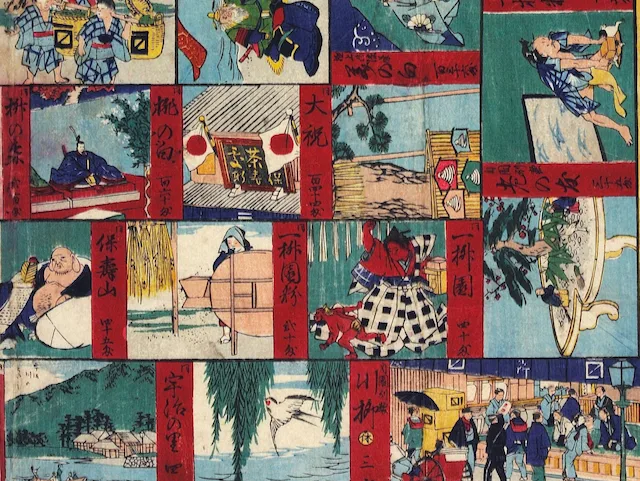
Detailed selections from a graphic sugoroku game map by Andō Hiroshige, 1797-1858, published in 1875 by Masuya Zennosuke, between 1868 and 1912 and archived at https://japanmaps.davidrumsey.com.