El niño holds the empty coffee can tightly and looks up at Papá. They stand in a shaft of sunlight that slips through the barred window, fuel for the hot air that hangs around their shoulders like a thick coat. The window looks out at a bare concrete wall that runs around the house, its top encrusted with green and orange shards of bottle-glass. El niño imagines the wall clawing at the empty blue sky, trying to make it bleed.
He can see the top of the wall behind Papá, the light shining in a nimbus around Papá’s head. He squints his eyes and sees a glass dragon broken on the ramparts of a magic castle, its body bleeding a river of bright color.
He blinks and tries to bring his attention back to Papá’s words. For every fly that he kills that day he will be paid a thin, shiny, American penny. He is to keep the dead flies in the coffee can so that Papá can count them. He looks out the window again, watching the flies circling and buzzing into and out of it.
Papá leans over, grasps el niño’s thin shoulders, and squeezes. “Do you understand? I am sick of these maldita moscas. I don’t want to see any here when I get home.”
Papá stares into his eyes until el niño nods. He is eager to please Papá, perhaps even make him smile. And he wants the money, already thinking ahead to the comic books and dulces he will buy, looking forward to the heavy bulge the pennies will make in his pocket, jingling and bouncing when he runs.
Papá straightens, breaking eye contact to stare at the clock ticking on the wall. One hand adjusts his tie while the other picks up the black plastic briefcase from the floor. Papá turns away and walks silently out of the room. El niño watches Papá’s back as he leaves, noting the sloping shoulders and short sleeved shirt, the looseness of his pants around his legs, his stiff, curly hair more matted than combed down.
El niño waits until he hears the front door close and then rushes into the kitchen. He crosses to the back door and takes down the wire-handled fly swatter from its nail. He knows the kitchen will be a good place to start; there is always a small swarm of flies hovering around the trash can under the sink. He walks quietly towards the sink, the swatter in his right hand, the empty can cradled between his left arm and side. He spots a fly crawling on the wall beside the stove, stopping to inspect a blob of grease and rub its wings before moving on.
He creeps up to it, holding his breath, and slowly lifts the swatter above his shoulder. In one quick motion he brings it down with a sharp, flat, crack. The sound reminds him of an open-handed slap. He stares with satisfaction at its crushed body, flattened between the plastic grid of the swatter and the wall. He slowly peels the swatter away.
The fly falls, spinning quickly to the cold floor, leaving a splatter of blood and one wing on the wall behind it. El niño squats and scoops the smashed body onto the stained swatter, tipping it into the can. It makes a small ping as it bounces off the bottom. Surrounded by bright tin, its reflection is stretched onto the inner surface of the can.
“One penny,” he whispers.
The day flows like a river over polished stones, effortless, without surcease. Death after little death encircles el niño as the swatter swishes and thwacks through the house. He is grim, no longer thinking of pennies and candy but instead becoming fascinated with the mangled bodies themselves, their tiny, inward-curled legs, broken wings, leaking abdomens, and multi-faceted eyes reflecting greens and blues, each one a crushed jewel. They twitch and buzz with a desperate tenacity that he finds admirable. Nothing exists for them but the brutal instinct to live.
He stops to eat lunch, resting the coffee can between his feet. He looks down between bites of quesadilla to make sure that the can hasn’t tried to crawl away.
Mamá had rolled her eyes and gagged when he had proudly presented his work to her. “¡Puaj! Get that away from me, and wash your hands before you eat. And use hot water.”
She stands before a stove on which pots and pans bubble and spit, each releasing a different mouth-watering aroma. She is always cooking over the hot stove, or washing dishes in hot water, or scrubbing clothes under a fiery sky on the washboard beneath the lean-to at the side of the house. Her arms are always red and chapped, the skin on her hands cracked. Her shoulders sag with exhaustion. Her neck is bent beneath a weight el niño can sense but cannot understand.
She turns back to her cooking and el niño walks to the table, unconcerned with her reaction. He knows the can holds more promise than she can see. He imagines what he will buy with the hard-earned pennies. The clear, solid candies he loves to suck on, the caramels and chocolates that are sold beside them. A kite, or a plane, one that can fly when you throw it, gliding in smaller and smaller circles around you, and if you are quick, you can catch it in your hands.
The air is heavy with golden dust trapped in the late afternoon light. Knowing that Papá will be home soon, el niño begins to work in a frenzy, double and triple checking the kitchen garbage can and the pile of empty soda bottles into which the flies crawl, greedy for the sticky sugar at the bottom. He goes out to where the dogs are kept, a bare, wretched patch of ground full of holes, old bones, and piles of dirt. He checks the corner where they shit and kills dozens more.
He is still hunting when he hears the roar of Papá’s car pulling into the driveway. Suddenly tired and anxious, he is overwhelmed with the desire to show off his work, filled with pride. The can is full, packed with dead flies to its rim. He returns the stained swatter to its nail and hurries into the front hallway, the can held tightly to his chest, ready for inspection.
The lock turns, and the towering, dark form of Papá comes into the house. His tie hangs loosely around his neck, the top two buttons of his shirt undone. Dark stains spread under his armpits, the briefcase swings in a cage of limp fingers. His brow is furrowed, and he stares ahead with a disconnected and glazed expression.
El niño walks up to Papá, the can held high above his head. “Look, Papá. I killed them all. The can is full. Will you count them? Can you pay me now?”
Papá glances down, a deadness in his eyes. “¿Qué? Don’t bother me now. I’m not going to count that mess. Where’s your mamá? Is dinner ready?”
“But you said you would pay me!” El niño trembles as tears well up in his eyes and his lower lip tugs down. He lowers the can to his side.
Papá’s voice barks down at him, angry and demanding. “I changed my mind. Now you know what it’s like to work all day for nothing.”
El niño feels pain slowly growing within him like a bubble trapped under heavy grease. Hot tears roll down his nose, his vision blurs.
“What are you crying for?” Papá yells. “Don’t just stand there! Throw those flies away!”
El niño cowers under the voice, turns and runs into the kitchen and through the back door to the metal trash can beside the lean-to. He pushes the lid off and throws the can in, imagining the sound of his pennies crashing and echoing away inside it.
He listens, crying, the murmur of his parents’ voices rising and falling in the familiar rhythms of argument behind him.
He looks at the falling night sky, watching the shadows stretch towards him, the way they indiscriminately swallow everything in their path. One star hangs alone above the broken teeth of the wall. He hugs himself and squats down to look at it through an orange shard. He squints his eyes, the light stretches into a streak, and he sees a starving beast leering down at him in a rictus of pain. Its legs are bunched beneath a bone-thin body, ready to lunge forward and swallow him whole.
The dogs rattle their chains against empty bowls, barking into the dark at what they cannot understand.
El niño stands up and locks his thoughts away, burying them deep inside where he won’t be able to hear their whisperings. He wipes his face dry, puts the lid back on the trash can, and walks slowly back into the open door and through it, to his familia.
Miguel Alfonso Ramos lives on the West coast, works as a librarian, reads widely and voraciously. He is a musician and has played in several bands, from mariachi to big band, jazz to circus band, punk rock to bluegrass. He loves to climb mountains, jump into oceans, and ride his motorcycle at night. He writes SF, fantasy, horror and poetry, and is a graduate of the Clarion West Writers Workshop. He is Hispanic, Wyandotte and Chinese, plays chess and D&D, and watches lots of movies.
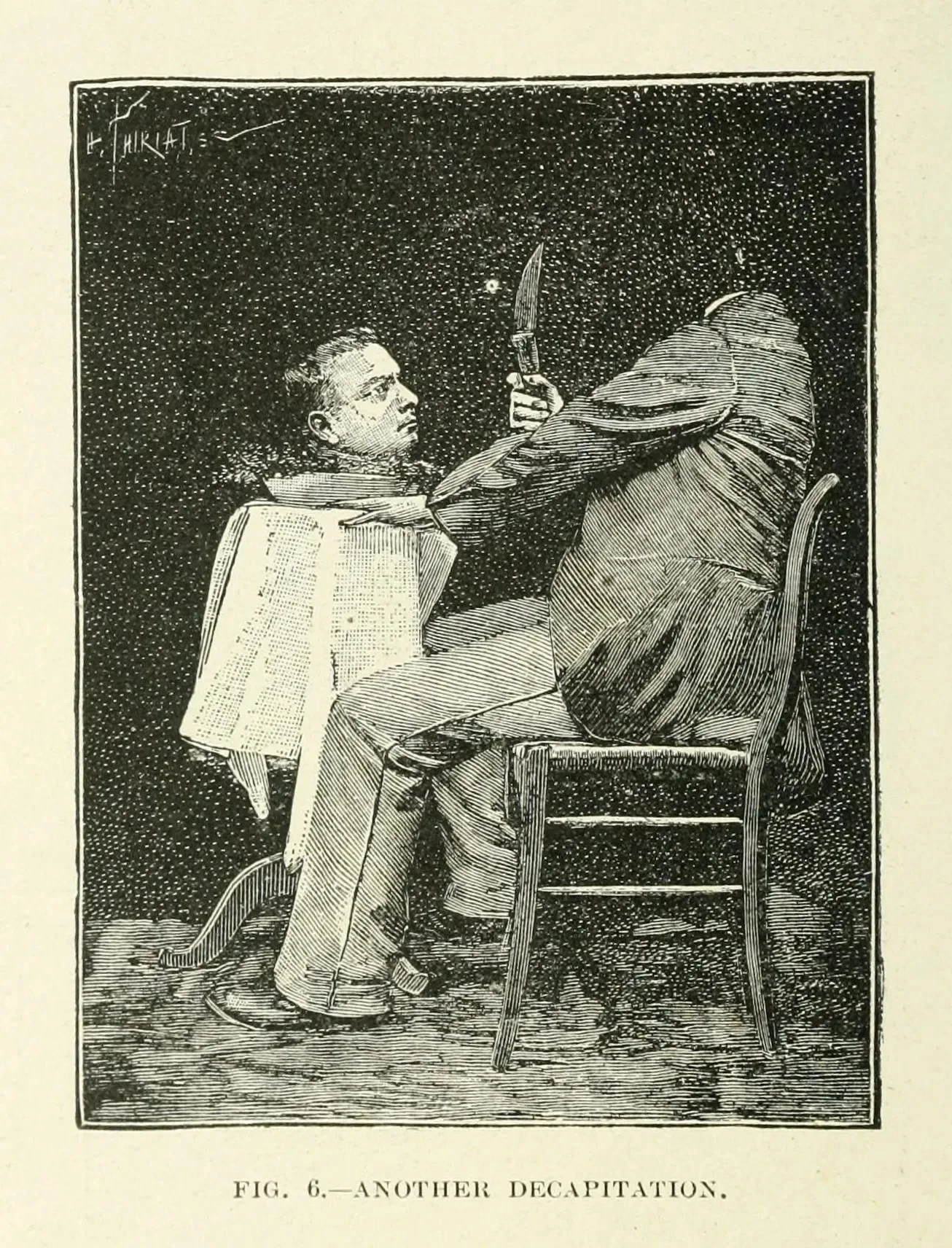
Albert A. Hopkins, Magic: Stage Illusions and Scientific Diversions, Including Trick Photography (London: Sampson Low, Marston and Company, 1897). Among the 550 pages of this encyclopedic history of magic, we find tricks that might be familiar to modern-day audiences: conjuring tricks (“The Disappearing Lady”, “The Appearing Lady”, “Decapitation”); optical tricks such as the infinity mirror or “mystic maze”; so-called “theater secrets” (“Siegfried’s Anvil”, “The Skirt Dance”); ventriloquism; and tips for eating fire. More unexpected are performances from the annals of illusion, such as the extended section on chapeaugraphy (the manipulation of hats). See https://publicdomainreview.org/collection/magic-stage-illusions-and-scientific-diversions-including-trick-photography-1897/