Han-shan says:
“I have traveled lightly back
to this mountain.
The few things I brought in my case
have fallen out on the way.
Behind me along the road
strangers pick up the curious flotsam
of my journey saying:
‘Who in his right mind
could ever have valued this?’
When they find the empty box,
they will be even more bewildered.
But I have reached the mountain,
the high face under a coronal of cloud.
How unchanged it is:
how incredible still its autumn color:
how purple the shivering sedge
among the gray headstones.
The church is like an October cloud
dropped to the foot of the mountain.
Everything turns simple again:
leaf-shape, mountain-shape, stone-shape,
the shape of the beholder’s face
lifted simply into the simple air
in beautiful seeming.
If I were to look back,
I could see down the red road
a bright scrap of blue
bouncing in the wind.
But I can only stare, entranced,
at the great mantled capstone of the county,
as fabulously whispering now
in the autumn wind
as in yesteryear
before the angry, purposeful dream
came true.”
Han-shan says:
“Among peacocks sparrows don’t count.
I’ve a taste for the flamboyant,
For dyed-in-the-wool folk
Whose appearance makes a shout
On the quiet mountain,
Even among autumn trees.

Come to see me if you have
Something startling to wear
Or a poem in your head.
I don’t much care for visitors
Too pallid to stain the mist.

Some of you I would
By nature prefer to others.
But love is a gambler’s choice.
I am not the same man you left
When we were both twenty,
Whoever you are. If you dare
To make the journey, look
For me among mountains.”
All winter,
Like turreted head-dresses
Of congelated kings,
Crown gourds stood along
The windowsill, golden as autumn.

Now an opened door discloses,
Pitted and pale,
A row of old lepers.

Han-shan sees the bowl of diadems
On the bureau’s top
Has become a dull heap of glories.

He will bury the ruined mitres
In the garden where they grew,
Sponge the windowsill,
Scrub the rot-stained
Wooden bowl.

He has always believed in succession
And adored sweet princes and dynasties—
This spring more than ever before,
Being old and maudlin.
Because he refused to toss
The football in the meadow
With his seven brothers, shouting
And somersaulting in victory,
Sulking in defeat,
Choosing instead to keep
An imaginary house at the edge
Of the wood, under an oak tree
Where the moss is silken
And blue as his mother’s eyes,
She worries about him.

Pretending a visit from her,
He sets his table with acorn
Shells for cups and saucers
And sweeps his floor
With a milkweed broom.
How delightful she will find
The cakes of white pebblestones
He has baked for her on a plate
Of obsidian he found under
The meadow waterfall.
Like her, he likes a home.

But what will his brothers do
About the curious Child
When she is gone?
Who will read to him the stories
Of gnomes and djinns and leprechauns
He delights to hear
And pretend with him that star
Flowers once bloomed in the sky?
Interpret for him what the wind
Is saying? “Listen,” she says.
“Hear the voices of the wind.”

“Listen,” she says again,
And sings for him mysterious
Alphabets far travelers bring
Into the marketplace,
The alphas and omegas of things,
The first and the last,
While he sops sweet news
From a honied bowl.
“You will soon,” she tells him,
“Have spoons for fingers!”

“My thumbs will make big
Spoons,” he tells her.

But Han likes best the tale
Of the wooden boy with the tell-tale
Nose that grows longer with each
Lie he tells, and Han loves lies,
Especially when told by his mother,
Whose nose, he can plainly see,
Is no longer than his own.
George Addison Scarbrough (1915-2008) was an Appalachian poet from Polk County, Tennessee. Scarbrough published six volumes of poetry: Tellico Blue (E.P. Dutton, 1949); The Course Is Upward (E.P. Dutton, 1951); Summer So-Called (E.P. Dutton, 1956); New and Selected Poems (Iris Press, 1977); Invitation to Kim (Iris Press, 1989); and Under the Lemon Tree (Iris Press, 2011, posthumous). Scarbrough also published a novel, A Summer Ago (St. Luke’s Press, 1986, reprinted by Iris Press 2011). Scarbrough’s poems appeared in over 65 journals, including The Sewanee Review, Harper’s, The Atlantic, The Southern Review, The Virginia Quarterly, and The New Republic. In the 1990s, Poetry published over twenty of his Han Shan poems, written from the persona of the Chinese poet. Many of these poems were collected posthumously in Under the Lemon Tree.
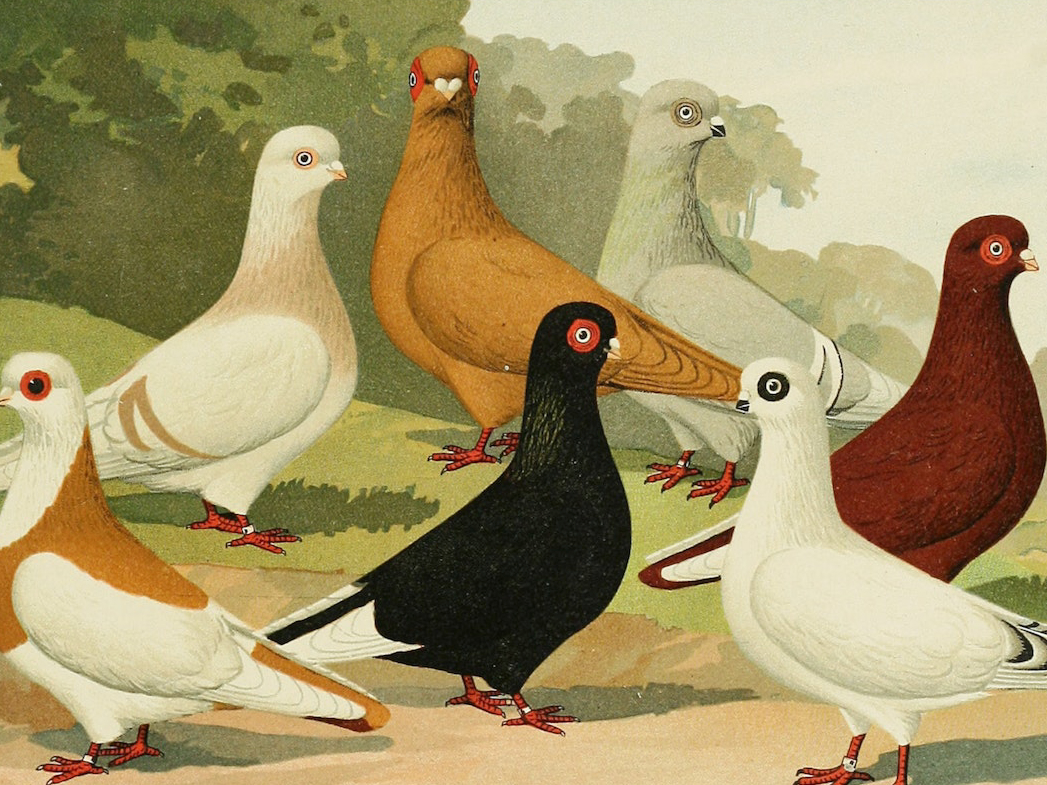
Illustrations of varieties of pigeons from Illustriertes Prachtwerk sämtlicher Taubenrassen (1906). Text by Emil Schachtzabel and illustrations by Anton Schoner.