That summer in the last-minute rented cottage
both doors and every window’s screen, it seemed,
had a patch. Some had tiny bits of fabric, white
flags of surrender stuck in the space
made by who knows who, or what. The Maine
mosquitoes were enormous, as were the flies. June,
the most sumptuous month of the year, here,
this June of my life. Everything wrong (at
home), and everything in sight was right,
the unsurprising unswimmably cold ocean,
an inlet really. Alone. No phone, pre-phone, no light,
all reading and writing by flash, or by on-again
off-again power which sometimes worked and
sometimes did not (like life.)
is more beautiful than money.
Patience is more beautiful
than achievement. Green is
more beautiful than its absence
on a branch or the spine of a tree.
Red is more beautiful with
the sun bending and stretching
right on it, more beautiful peeling,
or about to peel,
where red has come to
rest on the west side of a clap-
board Cape, in Maine, or
New Hampshire. And if enough
time has passed, this particular
red might be more beautiful
in proximity to a body of salt
water marsh or a fresh water lake
that resides near a lightly trafficked
road alongside a woodland of scrub
pines or spruces or fir, and not so
remote that none could see it,
but right there so that anyone
could place their face their hands
right up close, so they could,
but wouldn’t need to touch it,
to feel it, or see it like this
through paned glass
adjacent to it. Look. What could
be more beautiful than
this –– time + patience,
with just enough light + color,
combined.
I can’t stop hearing and touching its
splintering and yawning
its mothering its calling its bang
and air moving through its face
its trim never quite lining up
its wood its warp
its hook and eye
its new hampshire its beach
and flies caught in it
its passage its call back
its self-slamming shut
its banging and banging
and its spring
its longing to be pressed
its screws coming loose its green
paint peeling summer cottage hush
its winters in the basement
its basement its coming up for air
its robert frost its wallace stevens
its william carlos williams
its weeping its mind never
satisfied its roads diverging in a
wood its spine its sunshine
of late afternoon its doing
what it says it is going to do
the way it paints its own way
its draw its draft
its closing and not closing
its back door its back
to everything overgrown grass
on the other side of
its wrist its small knob
its metal its morning
its very early morning
it’s always very early morning
As it is
happening, as the dog
you adore is alive
in his chew, snout

in the air, as the oyster is
alive in your sea
sour mouth as the sail is
gusted wide open,

full, the spit of a wave is alive
on your face, this
white cap of a sunset
as it is, hours away, as is

the fade of the buzz
of the grass
cutter,
light, not coming back,

the breakwater is
still granite is still
weight bearing,
your mother is still alive

in what you trod on,
can’t slip over, you, awake, in
the comb of,
the twist of, the bread of,

the lash on
the lid of
this
this

this.
Elaine Sexton’s fifth collection of poetry, Site Specific: New & Selected, will be published by Grid Books in 2025. Her poems, reviews, essays and works in visual art have appeared in numerous journals and sites in the US and abroad, including the American Poetry Review, Art in America, Plume, Poetry, andwildness. She lives in eastern Long Island and New York, and teaches at the Sarah Lawrence College Writing Institute.
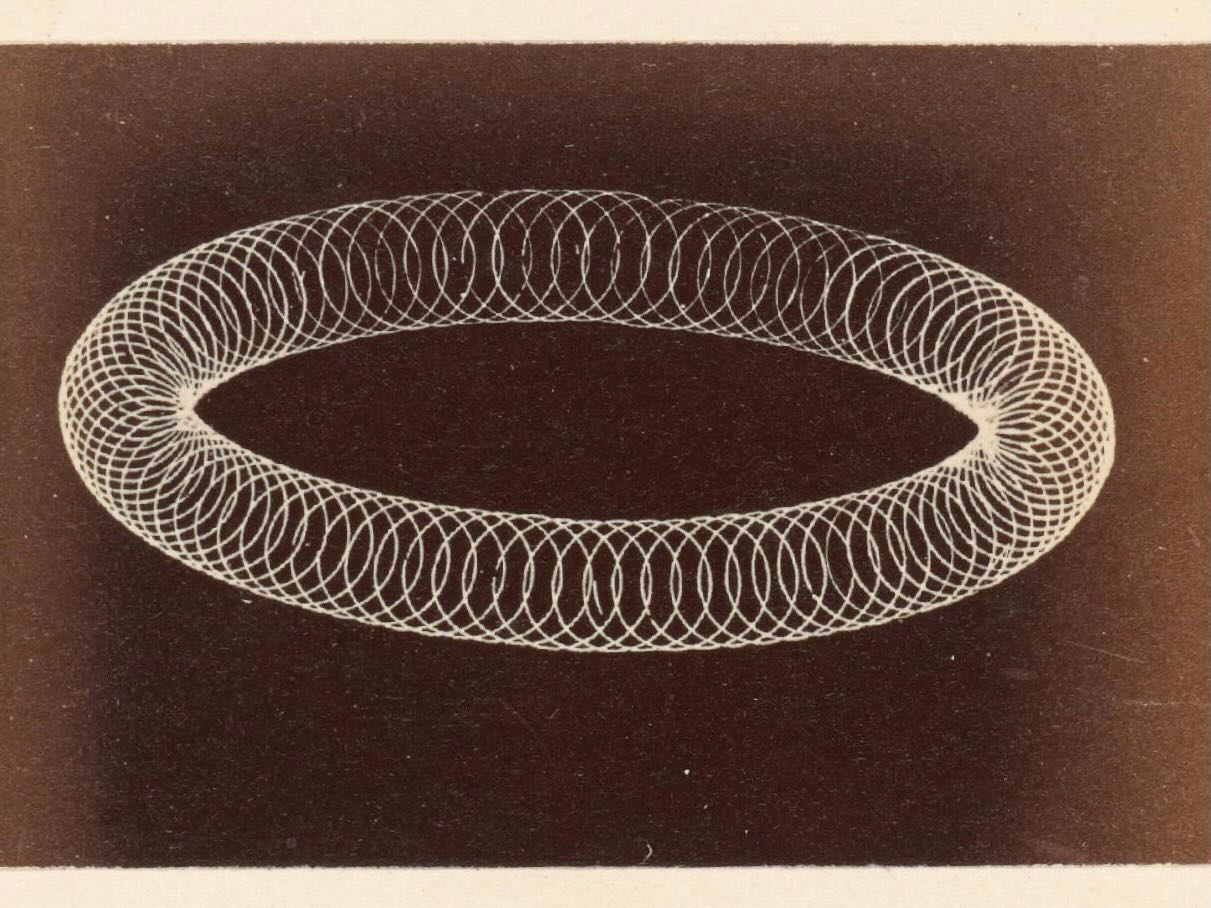
This early photography book, titled Specimens of Fancy Turning, features thirty tipped-in albumen silver prints of geometric designs created on “the hand or foot lathe”. Resembling something between spirograph drawings and textbook diagrams of orbiting electrons, the figures were created using geometric, oval, and eccentric chucks and an elliptical cutting frame. Attributed to “an amateur” on its title page, the book is the work of Edward J. Woolsey (1803–1872), an heir of the mercantile Woolsey family and partner in the New York Patent Sugar Refinery. From Public Domain Review.