My best friend and I were finally alone, pinning baby roses in our hair. Our dresses hung ready from curtain rods in the kitchen. We were still in our slips, ready to don our wedding attire when an authoritative banging on the front door startled us.
The screen door and porch windows shuddered as whoever it was pounded again. Perhaps someone had forgotten something and come back for it? I threw on a pinafore apron and hurried to the door. A sturdy white-haired man in striped Dickie coveralls and a frayed canvas jacket was planted on the stoop. A woman I took to be his wife stared from the window of a truck idling in the narrow road.
The stranger touched the brim of his engineer’s cap. “Ma’am, I’ve come for the oil stove. Your man said I could have it for forty dollars.” He didn’t flinch at my attire. “Sir, I countered, can you come back in a few weeks? I’m just leaving for my wedding.”
“Missy, I can’t wait that long. Just show me where to find it.”
To celebrate our engagement, Jerry and I had bought a cast-iron wood stove. We’d banished the cantankerous oil-fired heater to the garage where it had become a handy catchall for wedges, chainsaw tools, towing straps and a coffee can of old nails and screws. We’d stashed the flue sections in the garage rafters.
The man stood rooted to the porch, mute, with the barest hint of amusement playing on his fine-cut lips. It was plain he wasn’t about to negotiate.
“Okay. Just a sec,” I said through my teeth, and ran to the bedroom for my robe. I stormed barefoot out the back door and across the splintery woodyard to the dirt-floored garage. The stranger walked around from the porch with a bemused expression on his face that purely irritated me. I flung my arm in the direction of the oil stove where it stood under its burden of junk. “There.” I turned to go.
“Fine, I’ll fetch it later,” he said, calm and businesslike. Then, “How about the flue pipes?”
“There’s the ladder, sir. You can see the pipes up there. I really must go.”
“I can’t climb that ladder at my age, missy. Just hop on up there and hand them me down me, and I’ll leave you to it.”
I wasn’t going to get rid of this guy until he left with what he came for. He insisted on setting up the ladder. I climbed and reached for the pipes. Soot, cobwebs, and debris sifted down on my face and hair. He touched the brim of his cap and said he would bring the money by.
“Name’s Art Rice,” he said as he turned to go. I was fit to spit nails.
It took a long time before I could look at the man who made me late to my own wedding. I pretended to ignore him as he drove by every afternoon on his way to the post office. But I knew he saw me splitting kindling, raking pine needles, building willow chairs, and painting the window trim of our bare board-and-batten cabin. He’d give a slight nod, but I’d look away and go back to my work. I wasn’t ready to forgive him. I’d learned from friends that Jerry, waiting at our wedding site at the meadow, had gone mute with worry. Plus, Art never did bring the five dollars he’d promised for the flue.
Like country people do, Art and I found out about one another piecemeal through the neighborhood grapevine. Turned out, his house was just down Silver Creek Road from ours. I learned he was a miner and mechanic who worked on big equipment in his shop, a former livery stable. I often passed his place on autumn walks. The shop’s thick pine boards glowed in the low light and smoke curled from a metal flue pipe. I sometimes heard voices and banging from within. Other times I could hear him coughing¾a wrenching gurgle followed by wheezing gasps. I guessed he struggled with an illness.
Winter stole in, with clear nights and blazing stars. My handsome new husband and I bundled up ourselves and my schoolboy to skate the high lakes by moonlight while the Milky Way floated overhead like a diaphanous scarf. When the snows came, the chain on Art’s shop door froze to the hasp. His sage-green Rambler stood axle-deep in snow for weeks. The only sign of life was a pale light glowing from his kitchen window.
The new year turned over and spring promised to return. The weather warmed, and summer crept into the mountains. Grouse drummed in the woods. I was in love and expecting our baby. I sometimes caught sight of Art in the quiet road, steadying his pendulous wife on an adult tricycle she struggled to pedal. It was plain she wasn’t well.
Hoarfrost ushered in another winter, encrusting pasture grasses, barbed wire and fenceposts with its jewel-like sparkles. In any other year I’d be wild to skate Snake Lake, but I was unwieldy with the fetus I carried so lightly all season. I could barely lean over to tie my shoes.
For one of those primal reasons particular to pregnant women, I decided to take a walk on a frigid Saturday afternoon when Jerry had gone to town on an errand. Dreams about the baby had held me in sway for so long that I was surprised when labor began—fast and insistent. I was about a quarter mile from the house. Specks of frozen fog spit sideways as I stumbled past the volunteer fire station. A powerful contraction overwhelmed me with an urge to push I tried to deny. I feared I’d have to squat in the ditch.
As I lurched along, Art Rice’s car rolled toward me, slowed and stopped. He cranked the passenger window down and leaned toward me. “Best let me take you home, missy,” he said, gentlemanly like. I must have been a sight. I’d taken to wearing my tall husband’s jeans rolled at the cuffs. I’d stuffed my curly hair into a ratty red cap his grandmother had knitted in a bygone era. The twisted ties of a shaggy wool Mexican coat barely reached around my middle. I clambered onto the front seat and rode with Art the scant distance home. We didn’t speak, but Art stifled a watery cough. He slowed and stopped at our place. “Your man home?” he queried in a worried voice as I climbed out. “He’s in town,” I breathed, “Coming soon. Thanks.”
The seasons turned around again, and autumn glowed in the woods. I pushed young Carson, already a chattering toddler, in his battered stroller on the way to Art’s with my camera dangling from my shoulder. I stopped to admire Art’s ’forty-nine Kaiser sedan where it stood becalmed in the weeds beside the old livery just as Art was fastening the chain on his shop door. The Kaiser’s rusty hulk made a poignant portrait against the cedar planks of the old stable. “Oh, Mr. Rice, I called to him, “Would you mind if I photograph your car?” So, he and I begin to speak. Soon, I was coming over to shoot vignettes of his scrap iron and equipment. This pleased him, I guess, and he became fond of baby Carson.
Now that he heats his house with our old oil stove, Art doesn’t have to fuss with firewood, except for the cord or so of doug fir he keeps for the barrel stove in his shop. So, when I stroll down the road on a brisk, bright January day to check on him, no plume of smoke rises from his spare turquoise house. The only beacons of his presence are the dangling chain on his shop door, his friend James’s forest-green Lincoln, and Art’s ’fifty-seven Rambler station wagon parked by the front steps. Sometimes the Rambler will stand for weeks, unmoved in a sea of unsullied snow, or axle-deep in browned-out summer grasses. Later, Art will tell me that he’d visited his son in Missouri at his dairy farm. Or I might learn he has been in the hospital.
Which turns out to be the case this winter day. Art and his sidekick James are sitting at the kitchen table. James drives the river road from town to Meadow Valley once or twice a week from the new senior housing project where he and his wife have lived since she began to have problems with the stairs. This morning, I had been in our woodyard gathering chips and scraps for kindling as James swerved around the corner onto Silver Creek Road in his Lincoln. I stepped into the narrow road to hail him, but he was oblivious. He, like Art, has failing eyesight and drives with an expired license.
When I step into Art’s kitchen they’re hooting about the time James, his wife, and Art drove the hundred miles to Reno in the snow for a doctor’s appointment. Art’s delighted snort peters out in a gasp as he slaps the table and James crows, “It took all three of us to make out the street signs and traffic signals!” They like to boast about their working and drinking days. “Oh sure, missy,” Art brags, “our rigs knew their own way home in those days!”
Then their talk turns to women. I think they’re swaggering on my account. They want me to know they were once randy, lithe, and handsome. Art sits heavily at the table in a pair of light cotton pajamas and a blue hunting vest. The skin of his ankles between his slippers and pajama cuffs has gone a rheumy purple. He shoots a watery gaze my way, but Art’s fine thin lips curve into a boyish smile as he works his way into a tale about Hattie Wheeler. “What a gal,” he reminisces, shaking his head. “Oh, she was a corker, that gal, I’m tellin’ you. But cold . . . yes sir!”
Fifty years ago, he tells us, Art took Hattie Wheeler up onto the shoulder of Spanish Peak in early summer to show her where the cool dark miners’ shaft led into gold-bearing rock. Snow slaking from the seven domes of polished granite watered hanging meadows strewn with wildflowers. His story peters out as he stares at the ridge through the kitchen window and wheezes. Then he begins again with a start: “It was a mighty dark hour when old Hattie passed away. But she never had a warm drop of blood in her heart, no sir.” He drifts off. Then: “What’s that? Oh, sure. She liked the miners’ tunnels just fine.”
There’s a long pause as each of us struggles to address the unspoken problem that hangs in the air of the cluttered kitchen. Art shrugs and wheezes, “Doc’s put me on restriction from driving and wrenching until the muscles in my abdomen knit.” I gaze out his smeared kitchen window and don’t ask¾ and he doesn’t say¾why he needed the procedure, or when. He announces flippantly, “This is the last time.” James, who is fiddling with the tattered vinyl of his chair, giggles and exclaims, “Hell with doc! We get need to get crackin’ . . . work the bugs out of a few more things around here. Besides,” he says, wagging his head, “Art can’t leave us yet! I’m the senior member of this outfit and I’m still a-going strong!” Their other working buddy died a few years back, so James’s enthusiasm provides important momentum for their projects and keeps Art on his toes. With a shuddering breath, Art holds me in his gaze and confesses, “It’s pure torture being housebound . . . I’m just scraping for something to do.” Then, turning to James, “At least, we can clean this place up.” But whatever plan he has in mind is lost in a rasping cough.
Where to start? I look around the small room. Since his wife’s death, the kitchen counters have grown piles of empty cans, dented saucepans and food wrappers. He’s worn a faint pathway through dust and dirt to the hallway and bathroom. Outside, scraps of his metal work take up the entire two grassy acres that surround the house and rough-lumber shop where he has amassed a lifetime of mechanic’s tools and ore-sampling apparatus.
“That’s right!” pipes James. “Clear the workbench and get moving!”
Art shifts uncomfortably in his chair and takes up his ore-divining rod from where it leans against a grubby kitchen cabinet. He points it at the gleaming snow on the Seven Sisters¾what we call the glacier-polished granite domes of Spanish Peak. “Got work to do. Who knows but that we might get up and work that little pocket behind Jacks Meadow Pond. Ahhh . . . That’s pretty country up there. Ever heard of the Monte Christo mine? I’ve been meaning to get back up there, but I just haven’t gotten ’round to it somehow.” He sighs and shakes his head, lost in a reverie.
I leave Art’s warm kitchen and walk home, pulling my shearling jacket close against the January chill. It pains me to see Art adrift and fretting, so as the winter days lengthen, I drop by to chat as often as I can. I sometimes find him sitting in his nineteen sixty Chevy pickup on clear afternoons, clutching his portable phone and gazing at Spanish Peak where snow glimmers on the Seven Sisters’ gleaming shoulders. “Planning summer’s project,” he declares, motioning to a blank notepad in his lap. I know he tells me this to keep me from worrying about him. And to buoy his hopes for complete recovery.
Art and James used to work together every day: Art doing the diagnosis and repair; James hovering over, hard of hearing, myopic, fetching tools. The rock crusher stands in front of the shop door where they hauled it two summers ago and in a grand finale of methodical workmanship, painted it construction yellow. The water truck is parked ready in the side yard where weedy dock lies in a tangled ruin around the sturdy tires.
Just last summer Art and James had been hot on a big scheme. They’d spent the blistering days of August rebuilding a backhoe in preparation for an important mining expedition to Nevada. They planned to camp at the mine, in a quarter section of a certain geologic quadrangle in the desert—a place about which Art has spirited geological philosophies. But summer passed, and winter followed. The expedition appears to have stalled.
On a false spring afternoon in February. I amble down to Art’s place with Carson, who’s two and an energetic walker these days. I’m surprised to see Art step out of his shop. He looks unwell. He’s put on weight but seems loose inside his skin. He pauses in the dark opening of the sliding shop door in his frayed canvas work jacket with the collar turned high. A rattling cough grips him for a long moment; then he moves to lean against the richly glowing planks of the shop’s siding. His face lacks the quick devilish expressions that usually spice our conversations.
It turns out that his buddy James has broken his arm—a fall on ice—and hasn’t been out to the valley for a while. Art announces this news with a shrug. “James’s wife keeps him home some,” he opines. They had worked on the backhoe throughout an unseasonably dry autumn and it’s ready to go. But with James out of commission, Art has nothing to do this bright February day but sweep out the shop.
They’d been planning to make that trip to the Mojave about when the Canada geese would return to Meadow Valley. They’d worked out a gold extraction plan for a tailings pile. “Forty-four dollars a ton at ten percent,” Art says flatly. But it seems like everything’s on hold.
Carson totters into the shop so we follow him in to establish an atmosphere of restraint among the thousands of tools, parts, and mysterious fluids. The shop looks strange— swept and clean. Art scoops Carson up, sets him on the workbench and gives him some fist-sized washers to drop into a coffee can. After this effort, he struggles for breath and lowers himself into his shop chair. He tells me by degrees that he slipped on the ice and had to go to the hospital for a hernia and blood clots in his groin. The doctor discovered an aneurism and just like that, they wheeled him into surgery. Thirty-six days in the hospital, flat on his back, nothing but fluids intravenously and he gained seventeen pounds. I can’t decipher whether the hospital episode happened in ’fifty-nine or this past winter, so I ask him about his gold extraction plan for the Mojave.
“Nothing to it. Just run her over charcoal. Don’t even have to do any work. Tell them what to do, and otherwise, just play around.” Then, as an afterthought, he adds, “Told him, ‘That’s all right doc, don’t worry. If I come out of it, you’ll have saved my life. If I don’t, I’ll never know the difference.’”
The coffee can clangs to the floor and Carson wants down. I settle him on my hip, and we walk outside again, into the wan, early evening light. Art’s motions seem slowed, as if he’s making his way through a thick clear, fluid, or as though he’s working to counteract the absence of gravity. He breathes with difficulty, says, “Had to go to Reno to have my eyes checked. Old James, boy was he mad at me. Went to Reno on the tenth. On the twelfth I was gone to my son in Missouri. Your man working pretty regular?”
As a matter of fact, Jerry was laid off for the winter six weeks ago. Anyone passing our place in its pool of pine shade can see both our cars parked in the side yard. The recession has hit us hard. To keep us afloat the past few years, Jerry’s been commuting to temporary surveying jobs a hundred miles away in the high desert. Then, seasonal work in the woods came to a halt when the spotted owl was declared threatened and endangered. I won’t have work next season. We’re just trying to hold on.
Art is off and running on a related theme, I think, but I’m having trouble connecting the dots. He says, “Well, that’s just like I told my son. You’re working hard, seven days a week, sunup to sundown, but at least you have work. Don’t see how people make it these days. Me, I work for something to do. I ’bout went crazy when my wife died. I’d taken care of her so long I just didn’t know what to do with myself.”
Both Art and I are at a loss for a sequitur to this. We stand in the fading day, gazing up at the Seven Sisters. Then he turns. “Hang on a minute, hon,” and moves off toward the house. He emerges carrying something and makes his labored way back to where I wait with Carson in the gathering cold. “Thought you might like these,” he says as he thrusts something into my hands: the owner’s manual for his ’forty-nine Kaiser and his mother’s Searchlight Cookbook. “Take care of that boy,” he says, as if we are saying a last goodbye. It hits me like a stomach punch.
On the walk home, I’m anxious about Art, who, against all odds has become a friend. The school bus rattles to a stop and my big boy jumps out. The lady driver honks the horn for Carson, who is wild about school buses. She blows a few kisses out the door and honks again. I climb the side steps to our cabin with my sons. My schoolboy already wants to know what’s for dinner. The sweetest question of life, I think, savoring the moment. But the question of our dwindling finances gnaws at the back of my mind, and with it, the knowledge that at some point my little family will have to leave these mountains and start over among strangers in a city far away. But my heart is down the road where my friend Art is marooned in his own house, lost in time, adrift without work, a wife, a buddy, a project, his former robust health, and is running out of time.
Martha Mitchell is a physical geographer, nature writer, poet, and musician who lives and writes in the Pacific Northwest. Her short stories have appeared in Heimat, Meadowlark, Farm Girl Press, Prairie Fire (Canadian), and the inaugural edition of Haymaker. Her photography and articles on Erosion for Forester Communications have been featured in the journal for professionals in water resource protection, Erosion Control
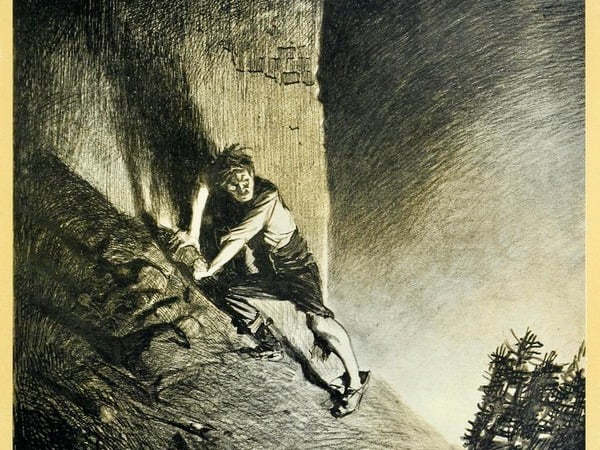
Images from La Roue, directed by Abel Gance, 1923. The actress is Ivy Close, once declared the most beautiful woman in Britain.