1.
There’s a house on Fairway Drive that the man you are newly dating tells you to go see on your walk from the funeral home where he works. Already, this story is complicated by death: in this case, death of your first marriage which you carry in the casket of your heart—heavy, all wood and nails and hot pink liner that you picked because sometimes it’s better to laugh than cry.
2.
This house on Fairway is about to be gutted to make space for a new kitchen, new bathrooms, new wiring and plumbing. He gives you a key, and you go see it on your walk while he works. Already he knows your need to move your body forward.
3.
The house has a dimness in its kitchen, the cabinets quiet and dark, the fixture offering weakness. You’ve never been able to imagine how a place can be transformed. All you see is what is, and you walk back to the funeral home where he is working and hand back the key.
4.
Still, the house on Fairway Drive lets the plumber in, and then the electrician, and the construction workers who know how to tear out cabinets and rearrange appliances. A pantry turns into the spot for a convection oven. The new and silver refrigerator slides under overhead shelving. The window gets a valance and a pendulum light that makes the room swell with brightness.
5.
He asks you to help him pick paint colors, and you choose a shade of yellow that could be mustard or the belly of a daisy—or the shade of the end of a very long day. Each moment could go any which way.
6.
Six months in, he goes on a work trip to Miami and asks you to take some vacation days and fly to meet him there. You stroll the boardwalk while he sits in a meeting inside the hotel. Outside: combed beachfronts, and then farther, uncombed. You could go miles, so you do. Your body has always coaxed you to another spot. Orthodox Jewish mothers, hair covered in scarves, push their babies in strollers. The sun is a bulb that can choose to burn.
7.
He looks for you by the pool, but you aren’t there. He looks for you in the hotel room, but you aren’t there. He will not find you until later, when you’ve chosen to come back from all the places you’ve been, which is to say, a heart mends slowly.
8.
He wants to look for rings.
9.
You don’t look for new. You go to jewelry stores with estate rings. You want something with a history, a ring that has known death or divorce, a ring that has said goodbye but is willing to try again.
10.
You buy a dress from TJ Maxx, but your sister insists on something fancier from a frou-frou store. At first you wince, but standing in the mirror with the little white dress—its ruffles and organza and buttons so small it seems impossible they will hold anything together—you begin to understand how pretty it could all be.
11.
You’re careful with the vows. You don’t include ‘til death do us part because you said that once before. You write that you will always try. That’s all you’re asking of him: just try.
12.
And now, fifteen years later, you live in that house on Fairway, one mile from the funeral home that he owns now, that you own together. You’ve walked that mile many times; you used to walk it with the dog you all got together, but now the dog has passed away, which is a nice way of saying that life takes everything eventually, but it makes offerings in exchange. Your husband returns from work every night, and when you wake at 2 a.m. or 3, you check to make sure he is still there. He always is.
13.
The kitchen on Fairway has remained that yellow you chose. Sometimes you both notice the scuffs on the wall. It needs to be repainted, but you won’t get around to it anytime soon.
You think of the yellow as mustard now. It was probably always mustard, or the belly of a daisy, but you know now you were wrong about this: it was never the shade of the end of a very long day; it was always only the beginning.
Shuly Xóchitl Cawood teaches writing workshops, doodles with acrylic markers and metallic paint, and is raising two poodles and a dwindling number of orchids. She is the author of six books, including What the Fortune Teller Would Have Said (winner of the Iron Horse Literary Review Flash Prose Chapbook Competition) and The Going and Goodbye (a memoir in essays). Her work has been published in The New York Times, The Sun, and Brevity.
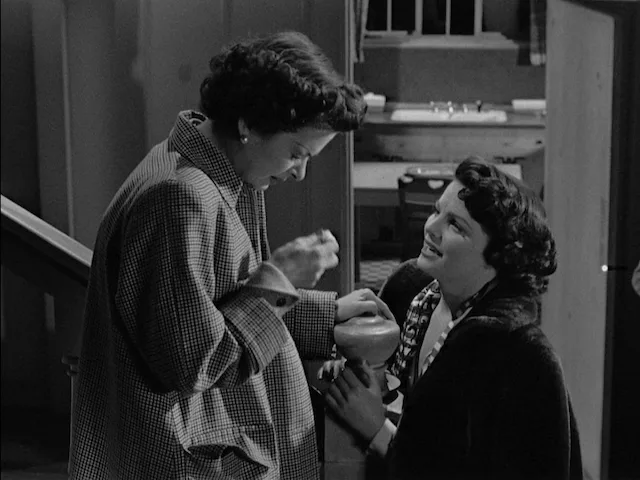
Image stills from The Reckless Moment, a 1949 American film directed by Max Ophüls and starring James Mason and Joan Bennett. The film is based on The Blank Wall (1947), a novel written by Elisabeth Sanxay Holding.