Map-dot of scorn and insufferable summers,
your corrals and dead ends drove me coastal.
I sought some unhemmed fringe where ragged waves
shush like a comforting bedtime mother.
Locked in by toll roads and bloodlines, your people
detest the salt and light of a shifting beach.
Your trembling livestock turn circles, confined
by barbed wire and their thinning shadows.
Brown as a horseshoe crab, the sod under hooves
feeds the frenzied stampede to nowhere.
Single-story buildings wall in Main Street
with green brass names, diminishing bricks.
Daily I press fading footprints in sand populated
by overnight shells polished and pushed ashore.
It has broad, old trees with bear-paw leaves
offered by hands of wind onto a blue pond,
and the poet has told you these leaves are ships
of a season, smaller Argos floating toward winter.
Winter will mean death as it does in a poem,
and you’ll ponder mortality – your life as leaf-boat
crossing this finite and funny-shaped body, driven
by holy breath wholly beyond your rudder stem.
Your sadness will be rich and brief
like boyhood butterscotch in church,
and your eyes will leave the page as you sigh,
content with humanity still sweet on your tongue.
Later you’ll attempt your own poem and some
of those same words will slip into your stanzas,
unmoored from branches in the brain, placed
upon a rippled plain to begin another voyage.
Begin the collection
with a backyard blue jay’s
fallen plume, or the beige
quill from a mockingbird.
From there, take to the woods,
and seek striped specimens lost
by hawks, or brown and black
chevrons shed by turkeys.
Avoid the frill and fluff
of fakes: craft store ostrich
or peacock phonies molded
and glued on a factory line.
Wade the creek instead,
and locate a left-behind
owl feather dropped in nocturnal
hunting where water runs life.
Let the discovered speak wisdom:
textures and colors united
but scattered like so much ambition
melted from Icarus.
For one who will not return here

You reject the universal rural truths
like rusted nails in a cloudy canning jar:
Relics bent by someone else’s force.

Behind an expatriate grin, you hide our dialect
like warped boards we conceal back of the barn:
Too good to burn, too turned for building.

The homesick tears behind your eyes
thicken like wood glue, stick in your sockets:
Hardened to hold your gaze toward the future.

You muscle memories into rebellious reasons
like a crooked drawer that still closes flush:
Stubborn friction preserves continuing conflict.
John Davis, Jr. is the author of four books of poetry including Hard Inheritance (Five Oaks Press, 2016) and Middle Class American Proverb (Negative Capability Press, 2014). His poems have been published in literary journals internationally, with notable appearances in Nashville Review, The American Journal of Poetry, The Common, Tampa Review, and many more. He teaches college English courses in the Tampa Bay area of Florida.
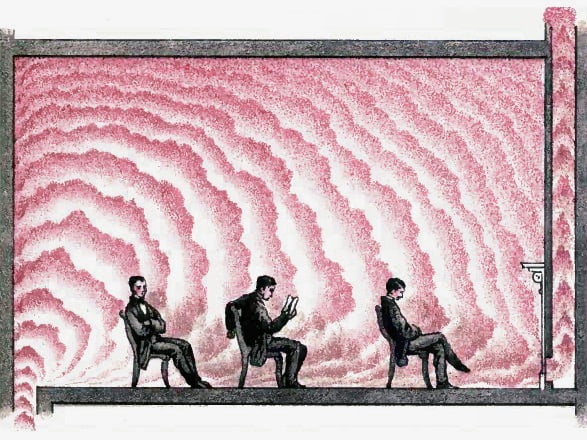
Three illustrations from Lectures on Ventilation—Being a Course Delivered in the Franklin Institute of Philadelphia during the winter of 1866-6, by Lewis W. Leeds, Special Agent of the Quartermaster General for the Ventilation of Government Hospitals during the War and Consulting Engineer of Ventilation and Heating for the US Treasury Department. “Man’s own breath is his greatest enemy.” JOHN WILEY & SON, PUBLISHERS, 1869.
(Suggested by the Public Domain Review.)