I cannot say why they picked this place,
why they stopped moving where they did,
those ancestors of mine who settled
in this steep tangle of over- and undergrowth.
They started from outskirts of glorious cities
of the 18th Century, Heidelberg, Rotterdam,
Philadelphia, before some wayward gene
rejected that life, some code imprinted deep
in the blood line that led me back
from my own private Ithaca,
where the valleys and lakes stretch
invisible wings around a sojourner.
I cannot get close enough to the forever-
sunken spot, homeland beneath the lake,
where they built log cabins and plank barns,
turned up stony soil for scattering seeds.
Cut loose from the vision they must have had,
I strain my eyes to see, to dig my fingers
down into the dirt, to turn my mind toward
that long-ago time, to dream it as my own.
There were nights in 1989 when we drove around
in my cousin Paul’s black Ford pickup truck
listening to Waylon Jennings and Bob Seger tapes
that had belonged to our uncles or older brothers.

The backroads of Leadmine Bend and Leatherwood
unfolded like maps we carried in the glovebox
but never needed, our bloodline designed to track
signs back to the nest, the cave, the hollowed hill.

After we had talked out our problems, we rolled down
the windows and turned up the songs, knowing
somehow: if not now, when, and that the rest of life
would have us running forever against the wind.
My uncle held his cigarette like a pencil
he could suddenly start writing his life
story with, the loosely-related vignettes
of cinder and smoke rising into open air.
When a tale animated him, he waved
patterns like jet trails with one hand,
and shook the coffee right out of his cup.
He was a man true to his moment in time,
cheerful but with sudden melancholies,
willing to invent a character or stage a scene
if it made the story suit him better.
He loved the tight line of a hooked catfish,
the upshift of a V8 engine on a blacktop
straightaway, driver’s front tire never
losing touch with the yellow center line,
free to release the fish, the gas pedal,
and any fact that tried to pin him down.
Jesse Graves grew up in Sharps Chapel, Tennessee. His first collection of poetry, Tennessee Landscape with Blighted Pine, was published by Texas Review Press and was awarded the 2011 Weatherford Award in Poetry from Berea College, the Book of the Year in Poetry Award from the Appalachian Writers’ Association, and the Thomas and Lillie D. Chaffin Award for Appalachian Writing. Basin Ghosts, also published by Texas Review Press, received the 2014 Weatherford Award in Poetry. His third book of poems, Specter Mountain, was co-written with William Wright and published by Mercer University Press and received the 2018 Book of the Year Award in Poetry from the Appalachian Writers’ Association. Mercer also published Merciful Days in 2020. His essay collection, Said-Songs: Essays on Poetry and Place, will be released from Mercer in 2022. Graves received the 2014 Philip H. Freund Prize for Creative Writing from Cornell University, and the 2015 James Still Award for Writing about the Appalachian South from the Fellowship of Southern Writers. He is Professor of English and Poet-in-Residence at East Tennessee State University.
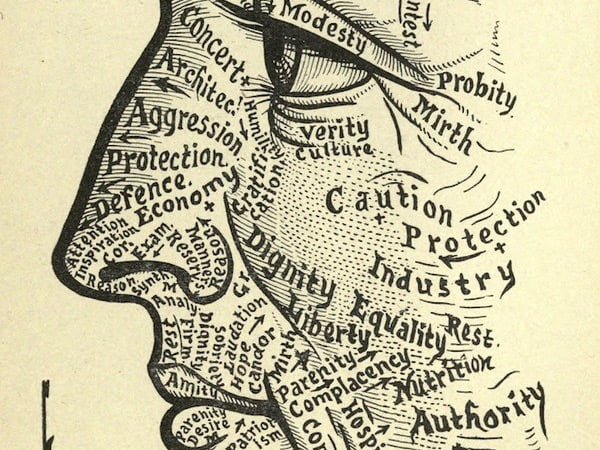
Titled The Book of Life: The Spiritual and Physical Constitution of Man, Dr. Alesha Sivartha’s enigmatic 1898 work expounds his unique blend of blend of science, sociology, mysticism and religion, a spiritual teaching which apparently attracted the attention of Mark Twain among others. Sivartha was clearly a man bursting at the seams with an abundance of complex and esoteric ideas, and while in written form this might translate into somewhat dense and bamboozling prose, visually it gave birth to a series of superbly intricate and striking diagrams. Obsessed with the magical properties of the number 12, Sivartha, in each of his wonderful “brain maps,” breaks down the grey matter into twelve different sections, as well as turning his gaze to other parts of the body such as hands and the nervous system as a whole. From Public Domain Review