The hotel towers sixteen stories over the Monongahela, just at the edge of the Hot Metal Bridge, a truss bridge, the length of a football field, built in 1887. The Hot Metal weds lower Oakland’s Bates Street with the Southside’s Carson Street – neighborhoods infamous, not that long ago, for dope; Romilar; revolution and ennui hatching in black leather jackets; derelict high school football under dim lights, tattered marching bands slugging through “The Stripper” and “Watermelon Man”; dingy barfly lounges, one particularly notorious that featured a tattooed dwarf who capered the bar-deck in silver snakeskin Tecovas and poured shots of Rebel Yell, directly from the fifth, right down patrons’ throat.
During WWII, the bridge had borne white-hot ladles of steel from blast furnaces to rolling mills, one side of the river to the other, 180 tons an hour, 15% of the American steel, forged by Pittsburgh Union men, that inevitably assassinated the Axis. The father of the lone man seated at the hotel bar, John Calvino, had been one of those men: Giovanni Antonio Calvino, the son of a blacksmith from Naples, who had endured weeks in steerage on the moiling Atlantic to shovel slag for forty years on the open hearth.
Calvino stares at the bridge: a scarred fretwork of black, brute symmetry silhouetted against an indifferent, gunmetal sky where its past holds no capital. The river’s placid current spangles in light from other hotels; breweries; bistros; boutiques; university laboratories – seemingly unpeopled, spare stories of boxy Bauhaus mystery – concocting the murky future along on the river’s shoulders. Gentrification: a pretty word for amnesia.
When Calvino was a kid, J & L – nobody called it Jones & Laughlin – where his father had labored – marshaled up and down the river on both banks, spouting fire mirrored on the brow of the Mon. Tonight, no barges, no tugs, inch coal upriver from Kentucky. Tonight, the wide river, hushed, feigns forgettery.
Calvino has the entire place to himself, as he prefers. No checking entrance and egress, who comes and goes, no shadowing everything. Low alert. The bar surface itself is zinc – something he’s only seen abroad – common in France before the war – the bluish-grey of a very late autumn sky about to snow after a day of sun – reminiscent of the zinc bar in Hemingway’s “A Clean Well-Lighted Place”: the beautiful bereft old man, his forbearance and dignity as he sips brandy, the soldier and his girl risking curfew, the electric lamplight on the soldier’s uniform buttons.
Calvino’s entire purpose, his raison d’etre, is to be alone at this bar, and watch the Steelers on the TV mounted above the top shelf labels. After the game, maybe walk the Hot Metal to Scufka’s – stop exactly in its middle, where it moons over the river, gaze downtown at the skyline, and allow himself one maudlin moment indulging his Pittsburgh boyhood – then perch on a barstool, among the locals as they bitterly rehash the game, have another shot and beer, and a fish sandwich.
Through the kitchen saloon doors strides the lean, clean-shaven, handsome barkeep: black, lacquered hair; black Western shirt, pearl snaps; bolo with a silver slide and aiguillettes; black jeans. Introduces himself as Ryan, asks Calvino how he’s doing and what he wants.
Calvino says he’s fine, asks how Ryan is – Ryan is “well” – orders an Iron City draft and a shot of Black Velvet.
“You got it,” says Ryan and smiles winningly, nearly charming, but a little too smooth, too practiced. He’s gotten this far on his looks. He desperately craves validation. His voice gives him away – the vaguest, pleading warble when he ends a sentence. Calvino catches that bit of declension, a barely noticeable tic in Ryan’s upper lip at the Iron City-Black Velvet order. Like Calvino doesn’t really know any better. Like Calvino’s a rube, a square, in his rumpled corduroys, and black blazer, white shirt, black knit tie, his practical lace-up Bluchers, still a little mud-caked at the soles from his earlier trek to Mount Carmel Cemetery.
“You in town for something special?” Ryan asks.
“Nah, nothing special.”
“First time in Pittsburgh?”
“Yeah.”
“How do you like it so far?”
“I like it.”
Ryan keeps his violet eyes perfectly composed, but gives himself away again with that barely perceptible snotty purse of his lips. Maybe Calvino should assure Ryan that he’ll lay on him the biggest tip he’s ever received, but to just keep his mouth shut and leave him alone. If he has to suffer assistance, a wry, brooding, chain-smoking, clairvoyant barkeep with a bowtie and suspenders, a busted spud nose, maybe a brogue – Lon Chaney or Victor McLaughlin – would be perfect. That’s the mood Calvino’s in.
Calvino tells himself to get a grip. He doesn’t want to give a shit about Ryan who, after all, is just doing his job. Calvino doesn’t have time for him. He’s a perfectly okay kid. He smiles back at the Ryan, who turns his back on Calvino and goes to work.
The Steelers are having a rocky year. A rookie quarterback, that everyone had high hopes for, and he’s fizzled – the offense dysfunctional, flaccid at best, often embarrassing. And way too much locker room drama. November, late in the season, and the city is taking it very badly, personally: like a soured marriage, hanging on by a thread, about the detonate. Fans are pissed, blue and bitter – desperate actually – their lives so pathologically wrought up in whether the Steelers win or lose of a given Sabbath. The sportswriters call for the head of the Offensive Coordinator. Even the iconic head coach – whom Calvino loves – suffers insults and is said to be washed up, the owners too goddam loyal. It’s time to move on. Past fucking time. Even those unborn, when it all went down, wistfully invoke Chuck Noll’s Steelers: four Lombardi trophies, the Immaculate Reception, Hall-of-Famers at every position, the entire mythos. Sports talk shows spill vitriol into the dark, mizzly morning commute. Unimaginably, the cruel world has even caught up with the Steelers.
Ryan turns and places in front of Calvino the shot of Black Velvet and the Iron on a coaster with the hotel’s ruby crest and a QR code. “You can scan the QR code on the coaster if you feel like ordering food.” Hoists an imaginary glass and says, “Cheers.”
The men in Calvino’s family – all gone now, his father and uncles – he never met his grandfather, who refused to leave Formicolo – said “Saluto,” “Cento Anni,” when they raised a glass in benediction. But Calvino proposes neither of these toasts, simply flashes the kid a steeled movie smile and theatrically fires back the shot. But “cheers” isn’t bad, not a thing wrong with it. He could have said, “Cheers,” indulge the kid a bit. Calvino’s not a jagoff. He’s not indifferent. He likes young people and typically encourages them, even goes out of his way. But, this very late afternoon, as the sky cinches eventide over the city, and the Hot Metal Bridge hovers twitching in its light traffic over the Monongahela, he yearns to be alone – suspended as he is, too, several stories above the river – in the hours before he catches a pre-dawn cab for Penn Station and the Capitol Limited that will deliver him, by noon the following day, to DC and the other end of things.
Ryan lingers a moment, gazing querulously at Calvino, as if expecting more, but Calvino’s eyes are back on the TV. The Steelers are getting shellacked, but that’s of no matter to him. Ryan whips out his phone and disappears into the kitchen.
The first time Calvino made a pilgrimage to see his parents at Mount Carmel had been twelve years earlier with his little sister, his only sister, Chiara. They hadn’t been able to find the graves. Ceremental snow clouted alabaster across the cemetery. They treaded upon the faces of their parents, a mere two meters beneath their shoe-soles, without even realizing it. Not simply ineptitude, grief, vile weather: snow and ice, muddy slush, six degrees and a bastard wind whipping in the next unbearable front. Chiara had wept as Jesus wept: not locating the graves was unforgivable, a curse, sacrilege, disgrazia – like they had put the eyes on themselves.
As if lost, she called, “Mama. Papa.” Black-haired Chiara, all that black hair, like their mother’s. Same eyes. Same face. Calvino looks like Brooklyn Dodgers pitcher Ralph Branca after the New York Giants’ Bobby Thomson hit the home run off him in 1951 – the same shocked, dark Italian good looks, elegantly disheveled, heavy ebon beard, immaculately straight-razor shaved. Not slick-handsome like Ryan. Branca was so undone over giving up that homer that sunk the Dodgers and sent the Giants to the World Series – “the shot heard round the world” – that he sought consolation from his parish priest.
“What can they possibly think of us, Johhny?” Chiara had asked.
“That we’re either stupid or lazy.”
They laughed and shambled arm-in-arm from the grave-heads to shelter in the columbarium. They never found their parents.
Earlier this very November sabbath – not many hours before Calvino now sits gazing at the TV, the Hot Metal Bridge, through the mammoth panes, at his shoulder, he had minced carefully among those same markers – the cemetery sodden from days of cold drizzle – and there they were: his mother and father, Giovanni and Maria; and, next to his mother, Chiara Rosalie – three modest bronze rectangles flush with the wet turf, bearing the reductive facts of their lives on earth.
Calvino aims to be happy, not morbid, in these few hours he has to himself. But it’s crucial he be alone. Yet the mud on his shoes – even on the cuffs of his pants, he suddenly realizes. What would his parents think? His mother declared that the first thing she looked at upon meeting a man was his shoes. He cleaned them up as best he’d been able, but they shame him – and now he’s letting this blameless bartender get to him.
Ryan dances out of kitchen: “Another round?”
“Sure.”
“Same?”
“Yeah. Same.”
Evening insists itself against the wall of windows fronting the river. For a moment, Calvino and Ryan are cast in a platinum hue. An ambulance screeches over the Hot Metal. A boat with turquoise lights glides the river.
“I can make you my signature cocktail,” offers Ryan.
“Nice of you, but I’m okay with what I have.”
“I invented it. On the house.”
“I’m just an old-fashioned shot and beer guy.”
“Perfect. Then you’ll love this drink. It’s an Old-Fashioned – you ever had one? – with a little personal flourish.” Ryan goes on about how he’s stumbled upon this new spin for an Old-Fashioned – his “invention.” He’s studied YouTubes and researched vintage cocktail books like Cocktails, by Jimmy; and Harry Craddock’s The Savoy Cocktail Book – both published during Prohibition. Calvino has read both volumes. He’s had an Old-Fashioned or two in his day.
Calvino doesn’t want to be rude. He should indulge the kid –and what the hell is he so worked up over anyway? Nevertheless, he wills Ryan to evanesce, spontaneously combust. Anything. Just go away. He keeps his eyes on the TV: Najee Harris busts, off the rump of the pulling guard, through the six-hole on a trap and slices eight yards untouched before shaking a linebacker and trampling a corner, jabs up-field, jukes toward the sideline, dragging another linebacker and a safety, behind his half-ton entourage, for a gain of twenty-two yards.
Ryan confides that he’s at Point Park University studying to be an actor – That explains it, thinks Calvino – that he’s written a play he’s sure is the real thing – about, yes, a bar. Of course, Calvino is instantly put in mind of The Iceman Cometh, and there’s that Saroyan play, but he can’t quite pull it. A bar’s as good a place as any. Calvino occasionally writes plays. He writes poetry too. But that’s not how he makes his living.
“I’m an actor. That’s why I got into bartending. It’s a bit like social work. Even the priesthood. A vocation. That’s how I view it. People show up in bars because they’re lonely. Something’s gnawing at them. They crave company. Maybe enlightenment. Even – may I say it? – a spiritual breakthrough. A reason to believe. So, my play’s about a lonely guy, who shows up at the bar. Somebody, I don’t know, maybe a guy like you – with dried mud on his shoes.
“You don’t know anything about me, Ryan.” It’s the first time Calvino’s uses the kid’s name.
“Are you lonely?” asks Ryan.
Calvino smiles at Ryan – a big unrestrained smile. He’s almost starting to like the kid – maybe because of this out of the blue brass balls interrogation and the memorable way he strings words together. All he lacks is the Confessor’s stole.
“Let me think about loneliness while you make that miraculous drink you promised.”
Calvino examines Ryan – forensically, as he might someone dangerous, some known bad actor he’s surveilling, as if life and death depends on it. The kid wags a perfectly manicured finger, longish nails, like he and Calvino have just struck a bargain, and flashes again that nearly charming smile. Disarming, really. Seductive. Calvino detects cigarette smoke and spies a smudge of ash, between the third and fourth buttons, on the front placket of Ryan’s shirt. The kid’s hairline is imperceptibly receding. He wears contacts – almost-purple pleading eyes, totally innocent. Fried by Adderall, anxiety meds and shrinks since puberty, two years of Zoom and Covid, the gathering thunderheads of the Anthropocene, immobilized at the thought of the future and little prospect of finding a place in it.
“I need to disappear for a minute,” says Ryan – as if he’s Houdini – “and fix your Old-Fashioned. Back in a flash and then we’ll talk about loneliness. On the house.” The kitchen doors beat like wings behind him.
Yes, disappear, Calvino thinks, but he doesn’t really mean it. Ryan has his attention. He no longer wants to punish him.
The Steelers try to come back, but the clock’s against them, and they have no deep game, and only one time-out left. Just those little dinks over the middle, fans and swings in the flat: five yards, four yards, a single yard. Click, click, clickclicks the clock. Calvino catches the aroma, from the kitchen, of sugar and orange juice near sizzle in the saucepan, the zest of orange rind expressed. Hears muddle, dash and splash: a couple jolts of bitters, stirred; two ounces of Angel’s Envy distilled into a crystal lowball glass; then plop: a colossal ice cube. Sad howls of boo chorus from the stands in Heinz Field – a few miles away on the Northside, now dubbed the North Shore – and rake lonesome upriver to the hotel bar in which Calvino sits.
“Boo,” Calvino says aloud. When he looks away from the TV, Ryan stands in front of him, holding on a sterling salver the shimmering Old-Fashioned. He sets it in front of Calvino, then reaches beneath the bar and produces an orange and paring knife. He turns the orange against the still blade, lifts its perfectly round decapitated crown for Calvino to witness, strikes a Diamond kitchen match one-handed against his thumbnail, twists the crown, holds the flame to it for an instant until it torches, then drops it in the glass, where it suspires, and its incense ascends.
Only then do Ryan and Calvino regard each other.
The game ends on a dropped pass.
“I don’t like football,” says Ryan.
“Why am I not surprised?”
“You don’t know anything about me.”
“Touché.”
“To touch.”
“Yes.”
“Shall we talk about loneliness?” asks Ryan.
“You first,” Calvino responds.
“I was never any good at it.”
“Loneliness?”
“Football.”
It begins to snow. Calvino wonders who Ryan is.
“Aren’t you going to taste it?” Ryan asks.
Calvino lifts from his seat and strolls to the windows, clutching the Old-Fashioned. An inch from his face snow swirls, caught in some phenomenal updraft. That first time, when he and Chiara couldn’t locate their parents’ grave, all he’d really desired was to genuflect and wipe the grimy slush from their faces; and, now, this very moment, snow falls on Chiara and his parents.
Ryan’s palms plant on the zinc bar. He leans expectantly, even pensively, towards Calvino, and calls, “You’ve never had anything like it.”
A rumbling freighter whistle blows. A cowled, huddled figure in a motorized wheelchair cruises fitfully over the Hot Metal Bridge. How many had died in the transfer of its mythic molten tonnage?
Calvino turns to Ryan, lifts the glass, and says, “Cheers.”
Flare towers from long-vanished steel mills – that haven’t torched the Pittsburgh ether in decades – spout stories of fire into the firmament. Child laborers, punched out from the Deadman’s shift on the open hearth, swing lanterns on their ways home along the Monongahela. The river quickens with the sizzling glister of phantom steel, then cloaks in otherworldly mist.
Joseph Bathanti is the former North Carolina Poet Laureate (2012-14) and recipient of the North Carolina Award in Literature, the state’s highest civilian honor. He is the author of twenty books. Bathanti is McFarlane Family Distinguished Professor of Interdisciplinary Education at Appalachian State University in Boone, North Carolina. He served as the 2016 Charles George VA Medical Center Writer-in-Residence in Asheville, NC, and is the co-founder of the Medical Center’s Creative Writing Program. He was inducted into the North Carolina Literary Hall of Fame in October of 2024.
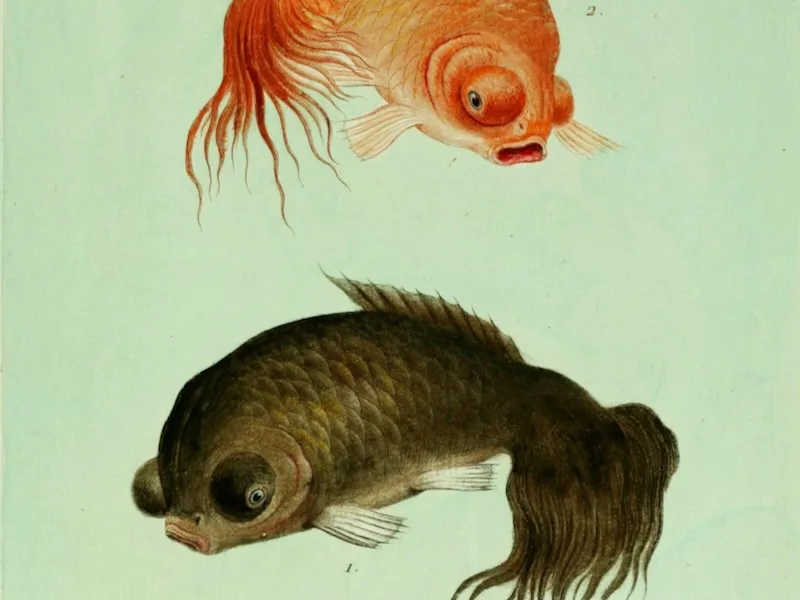
Illustrations from Histoire naturelle des dorades de la Chine (1780.) The dorades in the title refers not to sea bream but the fish’s gilded appearance. This illustrated book was the first monograph on goldfish published in Europe, from a time when the fish were still bound up with Eastern exoticism in the Western imagination. (via Public Domain Review at https://publicdomainreview.org/collection/chinese-fishes/)