After everything fell apart, I moved into a place called New Hope Vistas. I’m not sure what the “vistas” meant, seeing as these buildings—six of them, each holding twelve apartments—overlooked no river, lake, mountain, or plains. My view out of the front room showed I-26, north to Asheville, south to, I don’t know, another interstate that eventually hit Savannah or Charleston. As for “New Hope,” well, you know, there’s no such thing. Maybe some of my neighbors were optimists, but I doubt it, judging from the cars in the parking lot. These apartments—all brick, each with one window facing outward—weren’t but one step above government-subsidized housing. The only reason our town’s average rent ran at fifteen-hundred or whatever, is because New Hope Vista’s monthly charge came in at $700 a month, which, if you ask me, is still about four hundred dollars beyond what it should be. Climb cement steps, walk in the door, see the kitchen/den, go past the bathroom, enter one bedroom that, if it had a window, would overlook a kudzu field holding old tires and filled Hefty bags. No pool, gym, tennis courts, basketball court, fishing pond and such that the more spectacular apartment complexes offered. Back behind the kudzu patch there was a green algae-ridden sewage pond of sorts where, I imagined, many a stray cat ended up. My particular apartment held two bullet holes in the wall, and a red stain on the floor that bleach couldn’t eradicate. But I didn’t have cockroaches.
“Hey, man, I’m Joey,” my new neighbor said to me as I drug a mattress up there on the first day. He might’ve been sixty years old, a slightly overweight guy whose bellybutton poked out from his t-shirt. I couldn’t tell if he had a Mohawk hairstyle on purpose, or if he suffered a strange balding pattern. I looked down to see that he wore old school flip flops, like the kind worn only in public showers these days. “Joey.”
He lived in 2B. I said, “Hey. Guy.”
I’d never met another Joey in my life, I thought later. It didn’t seem to be a right name for a sixty-year-old man. Joe, maybe, but not Joey. He said, “What’s your name?”
I said, “Guy.” I guess he thought I said “Guy” in a way that meant I might end a conversation with Bubba, Cuz, Brother, Man, whatever.
He said, “Here we are, man. Sorry. I hope you don’t have to stay long.”
I wondered if my face read My Wife Just Told Me Things Weren’t Working Out and I’m Awaiting Some Kind of Divorce Proceedings. I wondered if my face read This Is Not How I Foresaw Things to Come. I said, “Hard to say, Joey.”
“You the fifth person I’ve seen rent that apartment since I’ve been here,” he said. “I’ve been here for two year.”
I nodded. I tried to wrangle the mattress—I’d not bought box springs—from flopping over toward him. Joey said, “When you get done, come on over for a beer. I just walked back from the QT with a twelve-pack.” He pointed over his shoulder with his thumb. I’d not been in that direction yet, so I didn’t know if he walked next door or a mile away. I said, “That’s nice. I appreciate the offer. I’m allergic to beer, though.”
It wasn’t true. I’d just gotten to the point where I hated the stuff. I had two bottles of Jim Beam in the back of my pick-up. Joey said, “Last four people lived in 2C drunk with me every night. I could afford it. It ain’t like I ain’t got a job no more.”
I tried to follow his sentence. I wondered if he taught English, maybe on the middle school level, and tried to trick me into parsing a sentence. I said, “I tell you what, man. I’ll come over if you have any Coke, Pepsi, or ginger ale. I don’t drink beer, but I drink bourbon.”
Joey smiled and stuck out his hand. I still held my thin mattress—so thin that I could’ve used it as a yoga mat, practically—under my right armpit. He said, “I make enough to provide mixers, if that’s what you saying.”
I said, “That’s what I’m saying until I figure out where the QT is.”
“I’ll be right across the way,” Joey said. “I’m probably taking tonight off. Tuesdays are slow anyway.”
I didn’t want to ask what he did for a living. I wanted to know, sure, but more than anything I needed to get inside and eventually lock my door.
After the mattress, I hauled up one floor lamp, one card table, two folding chairs, and a box of mismatched silverware I’d gotten for five dollars at the Goodwill in town. I brought up a box with two plates, two glasses, and a slew of ketchup, mustard, barbecue sauce, and horseradish packs I’d purloined from an Arby’s. I brought in the two surface bolt locks I planned to affix to the door frame so I could sleep at ease. I opened the refrigerator—mistake—and smelled what might’ve been on par with that sewage pond out back.
I tried not to think about how it was not only my thirty-eighth birthday, but also the eve of my tenth wedding anniversary.
I ran the tap for about ten minutes before filling one of my glasses half-full, staring at the water to make sure it wasn’t a different color than clear, and poured in the bourbon. I opened the blinds and set a chair in front of the window in order to watch regular people driving one way or another on the interstate, making up stories about these drivers’ destinations. Every eighteen-wheeler, in my mind, drove toward Asheville, then took a left on I-40, and ended up in the Mojave Desert a few days later. Every Subaru ended up in Asheville. Every Dodge Omni—well, there was only one—ended up at the closest mechanic’s shop. I thought about how I needed to buy some good binoculars at some point.
And I thought about how I’d tell this story later, and be truthful: I’d come home early from out on a job interview, and find Bethany in our bed with a guy who ended up being her tennis instructor over at the YMCA. She later told me how it’d been going on for a year, that she felt unfulfilled, that she couldn’t respect what I’d done for a living before getting laid off.
I guess I had the right to tell her to leave, but I wouldn’t give her the satisfaction of moving in with Jonas, or Joaquin, or whatever the tennis guy’s name happened to be. For some reason I thought it necessary to start over on my own, and begin at the bottom. I guess I could’ve gone out and bought a two-man tent and lived in campgrounds, but KOAs had gotten so middle-class over the years that it didn’t seem good enough. Or bad enough. She couldn’t respect what I did for a living? Bethany worked for a place called Consumer Pulse of the Carolinas. She looked over a phone bank of college students who called random numbers and asked people if they liked McDonald’s over Burger King, or Tylenol over Advil, or Kraft macaroni and cheese over Velveeta Mac and cheese. Then she found ways to massage the numbers so, later, her client could put out a big ad campaign. “More Carolinians Like Libby’s Vienna Sausages Over Armour!” Stuff like that. She’d gotten a degree in Marketing, and I guess that gave her the right to such a job. Me, I majored in Hospitality after changing from History, English, Philosophy, and Psychology—all of which I gathered only a B-/C+ average—then took on a job with Marriott, then got laid off when too many vacationers chose VRBOs and Airbnbs. Or KOA campgrounds, probably.
In time, I knew, I’d cave in, break into my own house, and get back my TV, maybe the clock radio, some linens. I’d get the fan, my books, the microwave, the art work I’d kind of stolen from a couple rooms at the Marriott. I’d write out a long letter to Bethany saying how I wouldn’t be averse to splitting things fifty-fifty so that she and I could sell the house where we still had a mortgage, then both of us move to at least condominiums now available in old cotton mills in town, nice places with high ceilings and linseed-smelling wooden floors. I don’t want to brag but I might’ve had the largest collection in America when it came to books that involved motels and hotels. I owned first-edition hardbacks of The Shining and Pyscho.
Anyway, I watched traffic. In my mind I crossed off where I’d been applying for jobs in the last few weeks within a sixty-mile radius: Holiday Inn, Sheraton, Ramada Inn, Hilton, Hyatt, Hampton, Super 8, Comfort Inn, Quality Inn, Sleep Inn, Econo-Lodge, Red Roof, even a twenty-room one-story place called Park and Squat that had reviews that involved bedbugs and cockroaches. Nothing. I began to wonder if I chose the wrong major in college, that maybe I’d’ve done better sticking with History and maybe acquiring work at, I don’t know, one of the numerous lackluster Civil War museums in the area.
Unfortunately, I started thinking about driving over to the Y, sitting in the parking lot, waiting for Bethany to show up for her “lessons,” then sticking an ice pick in her left front tire, seeing as I’d found one of those things in my box of inharmonious Goodwill silverware. I got up to make a second bourbon when someone knocked on my door, and Joey bellowed out, “It’s about time for some action, Guy.”
I opened the door to find Joey standing there with his twelve-pack, now diminished to six, wearing the same clothes he’d worn before, with a captain’s hat added. He did not look unlike the Skipper, from Gilligan’s Island. I said, “Ahoy,” of course. I almost said, “Welcome aboard to the S.S. Disaster,” but chose to step aside and let him in. He lifted a plastic bottle of mixer.
We sat across from each other at the card table. Normally I’d’ve been uncomfortable—or at least a normal person would’ve been uncomfortable—but I’d accidentally walked into people’s rooms at the Marriott before they’d checked out. I’d walked into at least three people in the middle of de-licing their heads. Like I said, I caught Bethany with that guy showing her how to return a serve. Joey opened up a can of beer and said, “Well, I spoke too soon.”
I said, “Hey, do you know if someone shot another person in this apartment at some point?” I pointed at the wall.
He drank half the can. He said, “I thought I’d get off work, but everyone’s calling in sick. Or at least my buddies are all telling me they ain’t going in tonight.” He looked at his empty wrist, as if checking a watch. He said, “It’s never stopped me before, but I better pace myself.”
The interstate traffic came to a halt. “What line of work you in these days?”
“DoorDash,” he said. “It’s a good deal. Things don’t turning up for you soon, you might want to sign up. You got that truck? You might be a perfect fit for delivering groceries to the homebound or paranoid.”
I imagined Joey stumbling out of his car carrying a bag of McDonald’s offerings to the front door in a gated community. I foresaw his yelling at the GPS. In my mind, I wondered how he acted when the tips didn’t add up to at least ten percent. I wondered if he reached in and ate French fries, if he kept an extra straw and partook of people’s gigantic Cokes. I wondered if he wore that captain’s hat, maybe stuck a five-dollar bill in the miniature twined rope across the top, like some kind of subliminal thing. As an aside, I underwent a slew of flashbacks that concerned female escorts walking into the Marriott, all wearing mini-skirts and too much make-up, carrying fast food bags or boxes, saying they had a delivery for whatever room occupied by a single male occupant.
I said, “I’ll keep that in mind. I could use a good reference, Joey,” because the bourbon took effect, I guess. I poured another two jiggers in my glass, and reached over for the two-liter Dr. Perky Joey’d brought over—a generic Dr. Pepper knock-off—which wasn’t all that bad a mixer. I’d had worse. For what it’s worth, Great Value Fruit Punch doesn’t work.
“I mostly do pizzas, you know. I can’t get the smell out of my car.” Joey said, “I drive an old VW bus, so I guess it could be worse. I got enough smells in that thing, from previous owners.” He pointed toward the parking lot. I craned my neck, but couldn’t spot the thing. Bethany’s tennis-teaching boyfriend drove a VW Jetta. I wondered if it smelled like a freshly-opened can of yellow Wilson balls, or Odor Eaters, or Bethany’s cheap-ass Charlie perfume.
I said, “I bet,” though I didn’t know what Joey meant. He started flapping one of those flip-flops against the sole of his right foot, maybe a nervous tic. Or he had palsy. I’m talking he slapped so much that his real or accidental Mohawk shimmered across from me at the table.
Joey said, “I don’t know what happened to you, but I ended up here after I lost about everything due to a Ponzi scheme and not having health insurance. That’s what happened to me.”
“Bad marriage,” I said. “That’s what happened to me. And getting laid off.” I said, “You don’t hear enough about people losing money to a Ponzi scheme these days, at least not in the South. Up in New York, maybe. And I’m sorry to hear about your health.”
Joey opened up two beers at one time. He said, “Yeah. I made the mistake of investing in carbon paper. Somehow I got talked into how it was making a comeback. It didn’t. Bunch of survivalists out in Montana or someplace talked me into how computers would end up failing, and we’d all be back to using typewriters. Then right about the time all that happened, I got the cancer and had to undergo, I don’t know, a million chemo treatments, which worked about halfway good.” He pointed at his head. “No one ever talks about cancer of the keratin.”
I’d not noticed. This might be because I didn’t major in history, or anything other than Hospitality. Joey offered his hands toward me to prove that he didn’t own fingernails. He kept clicking that one flip-flop so I leaned over and looked to see that he didn’t have toenails, either. I said, “I guess it might be uncomfortable wearing regular wing-tips,” though in my mind I wondered if I might dry heave. I said, “You probably have to be careful not to stub your toes, or strum your fingers on hard surfaces.”
Joey nodded. He said, “On a positive note, I think I get better tips for DoorDash when I make sure my clients see my predicament. I make a big point of letting them see my fingers when I hand over a stromboli or calzone.”
The sun continued to lower. The YMCA’s outdoor tennis courts’ lights would be flickering on. Why couldn’t my wife’s boyfriend succumb to cancer of the keratin? I thought. I thought, Would anyone running a cancer ward be interested in hiring out a person with experience in hospitality.
An hour later, of course, Joey’s VW bus wouldn’t start. I stood at my window and looked off to the left where the parking lot held a slight slope. I guess he parked there for such occasions, when he could get the thing rolling and pop the clutch. He tried this maneuver, and it didn’t work. He blocked a few beat-up heaps. Someone down the breezeway started yelling about not having any milk, and then I heard the unmistakable sound of a cereal bowl hitting a wall. Who eats Frosted Flakes for supper? I thought. Then I heard “I didn’t sign up for this,” which could’ve been the personal mantra of New Hope Vistas. I’d not brought along any of my tools from home, and wondered if I could attach those bolt locks using a butter knife after poking holes with the ice pick.
I looked back down toward Joey. Unfortunately, he looked straight back at me. He doffed his cap with his right hand, and waved with his left. I stood back. I went into the bathroom and washed off my face, brushed my teeth. I knew what would occur presently.
Joey didn’t knock. He opened the door—which happened to be locked—and said, “I know this is a lot to ask of you, seeing as we just met. You don’t even know my middle name! But is there any way you could drive me around doing my deliveries tonight?”
I said, “I’m not driving around. I’ve had at least a pint of bourbon.”
Joey shook his head side to side. He said, “I can’t tell. You ain’t slurring your speech or wobbling. Plus, no cop pulls over a person with a DELIVERY sign lit up on his roof. I ordered one specifically for these occasions.” Joey pointed out the window. He said, “I just haven’t attached it yet to the bus.”
I shook my head. It’s not like I looked down on such a profession, but I foresaw nothing but trouble should I agree to drive Joey around. I said, “I don’t know.”
He said, “I’ll split the tips with you. You could put that money toward, I don’t know, an air purifier or something. A TV.”
I did need some cash, I figured. I said, “Be honest with me, man. How much do you typically make a night?”
“Anywhere from fifty to a hundred. My record’s one-sixty, but that’s because I delivered to a Super Bowl party last year at halftime when the dude’d already run out of chicken wings. My all-time low was thirteen dollars. That happened to be on election night. No one tipped for their shit sandwiches, har har har.”
Joey might’ve been smarter and quicker than I judged. I said, “You have to put gas in my truck, too.”
He said, “Let me get my GPS out of the bus. Wait—you need to help me push it back to where it was, too. I can’t block everybody, in case somebody gets a winning scratch-off at the QT and can afford a tire inflator.”
I changed shoes. Joey didn’t.
Joey sat shotgun, staring at his cell phone. He said, “We need to stop by Squeaky’s and get two pizzas, then deliver them out on Fernwood.” I didn’t need the GPS for Squeaky’s. I drove into downtown, took a left on Main, and floored it. It seemed to me that’s what a DoorDash driver might do. There had to be a difference in tips when it came to a twenty-minute delivery as opposed to an hour. But then I passed what may have been the first Howard Johnson’s in the South. I’m serious! I didn’t even know they still existed, much less in my own town. How did I miss this place when looking for a new job? I took a left turn into the parking lot without saying anything to Joey.
He said, “This isn’t where Squeaky’s is, my man.”
It’s like I drove back to the early 1960s—this particular Howard Johnson’s still had an ice cream shop attached to the side, you know, that one with 28 flavors. The hotel wasn’t but two stories, and held that strange, multi-angular orange roof, the green sign half lit outside. I don’t know if it was on purpose, but most of the lights remained unlit so it read only HO JOHN. For what it’s worth, the parking lot appeared to be filled with the same kinds of heaps at new Hope Vista. I wondered if people paid weekly for their rooms, if it happened to be a crack motel, if it held the same escorts who showed up at my old Marriott. I said, “I just need to run in and get a job application.”
Joey grabbed the steering wheel and said, “No.”
I hit the brakes, put my truck in park, and jumped out.
I wasn’t thinking. I got inside and rang a ding-bell at the front desk for, I don’t know, five minutes before this boy came out of a room sleepily and said, “We’re filled up tonight.”
I said, “Hey, are you the manager?”
“Assistant manager,” he said. He might’ve been nineteen years old. He wore a name tag that showed GLENN. Glenn wore a buzz cut. He said, “We’re filled up tonight,” again.
Out of the corner of my eye I watched as Joey exited his side of the truck, walked around the back of it, opened my door, then drove away. I ran outside and yelled, “Hey! Hey, hey, hey!” like that. He exited the back side, onto whatever street crossed Main. And he took off, as if he’d been accustomed to my truck all along.
I tried to think of my license plate number, so when I called cops I could tell them. I had no clue. I remembered how my mother and father used to get gas, check into hotels, whatever, and easily tell the clerk what their license plate read. Same went for telephone numbers. Nowadays, I couldn’t tell you anyone’s phone number off the top of my head. I didn’t even remember my own childhood number. I could barely remember 911.
I didn’t know what to say. “Well,” I said, “I have a regular bachelor’s degree in Hospitality, and I think I’d be perfect for a job here.” In my mind, I envisioned myself as the manager, at least. I didn’t see myself as some kind of night shift reservation desk jockey, not that I look down on people like Glenn. The one thing I learned in Hospitality 101 class was that no one should appear uppity—not toward the pool cleaner, the people who take care of the waffle irons in the morning, the housekeepers, and so on.
Glenn said, “I don’t know what to tell you. Well, yeah, I know what to tell you. It’s about time.”
I said, “Did you, also, attain a degree in Hospitality? ‘Cause that’s one of the things my old professor said a real hotel employee should always say—‘I don’t know what to tell you.’ Genius!”
Glenn said, “I’m in a band. That’s all I care about.”
I noticed that Glenn sported a tattoo on his arm that read THE WORLD IS MY IDEA. I’d never come across such a quote in Hospitality, but it made some sense. I said, “Anyway, my ride just left me. Do you know when your manager will be here? Will he be here in the morning? Or she? Will he or she be back in the morning?”
Glenn said, “You can ask him yourself,” reached into his pocket, and handed me keys. He didn’t say what they unlocked. And then he walked around the reservation desk and left.
Well of course I walked over and locked the glass door. I thought about figuring out how to open the cash register and taking out the money, for I knew this was the kind of place where people paid in cash in order to hide their wayward behaviors from spouses. But I didn’t. I turned the TV off FOX News and watched a regular station that told the truth about inflation, egg prices, unvetted and stupid Cabinet picks, an idiot president who blamed everyone but himself for ongoing struggles, and so on. Man, I thought I had it bad having to move into New Hope Vistas, but there were people out there—even worse off than Glenn or Joey—unsure if they’d be able to use their insurance at the ER.
I opened the drawer to a printer and puled out one piece of typing paper. I opened another drawer and found a Magic Marker and half a roll of Scotch tape. I wrote NO VACANCY and placed it on the door. Hospitality 101.
Joey woke me up at one in the morning. I’d fallen asleep on the floor, back behind the reservation desk. He banged and banged on the door. He wore that captain’s hat backwards on his head for some reason. He held out what ended up being forty dollars in fives and ones. My truck remained running, there beneath the covered entrance where, at a real hotel, valets and bellhops would congregate. He yelled at me, “My shift’s over, man!” And waved that money. “Sorry to have hijacked your truck, but I just kept getting orders one after another.”
I didn’t know what to do. I wanted to wait around until morning, for I thought I had a good chance of gaining employment. I unlocked the door and Joey entered. He said, “What’d you do, kill the night clerk?” He looked around. He said, “Hey, is there any coffee in that urn?”
I looked up high at the four corners of the room, again. If there’d been security cameras, I might’ve acted otherwise. I said, “No. Come on. You owe me,” and we left. I kept the keys, and left the place unlocked, which might’ve gotten Glenn in trouble later. But he was young, I figured, and had years to make up for stupid moves on his own part.
The inside of the truck’s cab smelled like a mixture of barbecue and fish sticks. I figured he’d been to Little Pigs and Long John Silver’s, maybe more than once. There’s no telling what people wanted delivered late at night.
Joey said, “I made eighty dollars, so here’s your half.” He placed folded up money in my console. He said, “I had three women show up wearing negligees you could see through. That’s not the record, but it was a good night.”
I tried to imagine how I’d act if a woman showed up in pajamas. Then I started thinking about a husband with a gun. If I took a DoorDash job, that would be my luck, delivering to NRA members solely. I turned the radio Volume knob up to find that the station I normally keep on—believe it or not, NPR—had been changed to one of those contemporary Christian channels. I looked over at Joey and said, “This is what you like to listen to?”
He said, “You can’t have enough Jesus in your life when you’re looking for good tips around here. I crank it, and leave the door open so it can be heard at the front door.”
I drove fast. I said, “Get your bus fixed.” I said, “This isn’t going to happen again.” I looked at my wristwatch. “I need to set my phone alarm and go back to Howard Johnson’s in a few hours.”
For some reason I wanted to call Bethany and tell her about my first day at New Hope Vistas. She always seemed to like stories about when failure appeared in my life. One time a woman got her high heel stuck on the accelerator and she crashed through the entrance to the Marriott. Another time I rode the elevator and it stopped working between floors two and three, so long that I had to pee in the corner. Somehow I got food poisoning at the breakfast bar, probably from bad butter on my waffle. Bethany always laughed and laughed at such stories. I’d be willing to bet that she wouldn’t’ve left me for that tennis pro if I had a daily malady. I wondered how that guy would make her laugh. Maybe he had a slew of twisted ankles on drop shot stories.
Joey reached into his shirt pocket and pulled out two mini-bottles of tequila. He handed one to me. He said, “Nightcap, amigo?”
I shook my head. I took a turn far from our apartment building. Joey said nothing. He rolled down his window somewhat and lit a cigarette. Normally I would’ve minded, but maybe, I thought, it would take some of the smell out of my truck.
I drove to my old house and pulled over. Bethany’s car was there, but not another one. Joey said, “Where are we?”
“I used to live here,” I said. “This is, technically, my house.”
He nodded. He opened the second mini-bottle but didn’t drink from it. He said, “That’s a njce house. What you got there, a half-acre? Two thousand square feet?”
I said, “A little less, but mostly.”
“We get done here, I want to show you where I used to live. It ain’t but a mile away.” He pointed behind us with his thumb. “You ain’t got no restraining order, do you? One of those ‘stay five hundred feet away’ things.”
I shook my head. I said, “I never did anything wrong.”
“You ought to steal something, then. I can pull that mailbox out of the ground if you want.”
I imagined my new apartment with a mailbox leaned up against the wall. To be honest, I wished that I’d brought along a shovel in order to dig up at least one of the azaleas I’d planted some years ago, maybe replant it on the other side of I-26 so I could view it each day until I found some luck and moved out. I thought about how I couldn’t go to any more class reunions unless I wanted former Hospitality majors to keep asking me if I was a Host of the Highway—Howard Johnson’s old motto.
Then I put my truck in reverse and drove that way until we reached Joey’s house, which happened to be in a gated community. The guard let us in because of that DELIVERY sign on my roof. If that didn’t work, I’d planned to tell him it was my birthday.
George Singleton has published nine collections of stories, two novels, a book of writing advice, and, most recently, the collection of essays Asides: Occasional Essays on Dogs, Food, Restaurants, Bars, Hangovers, Jobs, Music, Family Trees, Robbery, Relationships, Being Brought Up Questionably, Etc., from EastOver Press. His short stories have appeared in the Atlantic Monthly, Harper’s, One Story, Story, the Georgia Review, Oxford American, and elsewhere. His nonfiction has appeared in Oxford American, Garden and Gun, Bark, Gravy, and elsewhere. He lives in Spartanburg, South Carolina.
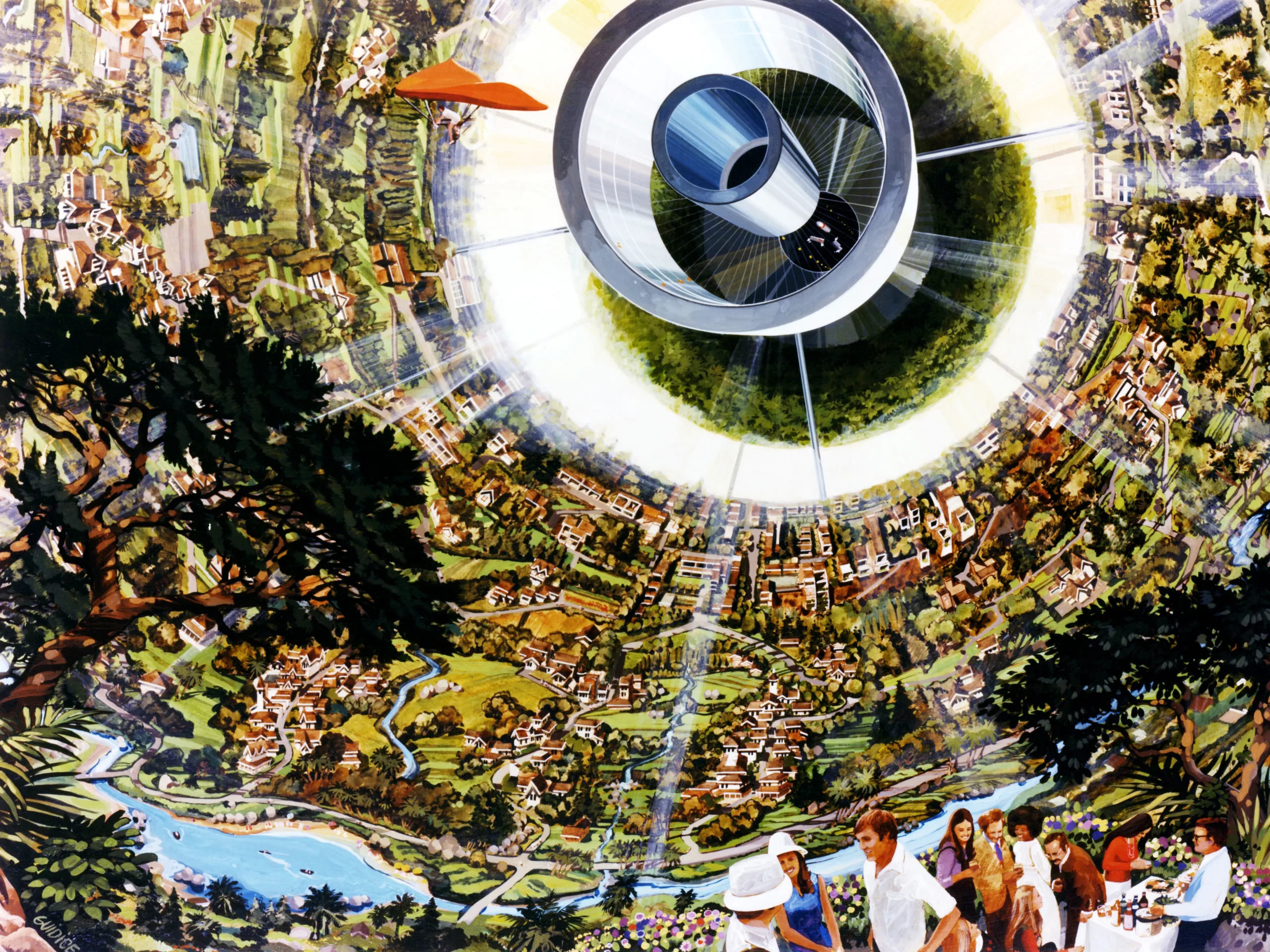
The images gathered below were created in the mid-1970s during O’Neill’s summer research programs on space colonization held at NASA’s Ames Research Center. The artists include Don Davis, who would later help design the visuals for Carl Sagan’s Cosmos series, and Rick Guidice, who illustrated space projects for NASA across fifteen years. In an interview about the project, Davis discusses how his images of O’Neill’s ideas still have a “freshness”, for they continue to embody “the aspirations people have had ever since the space age began”. While this is certainly true — and the artists’ visions of artificial cylindrical worlds have had an outsized influence on science fiction — these psychedelic vistas populated by high-tech homes and cocktail-sipping residents were also a product of their cultural climate.
Image sourced from the Public Domain Image Archive / NASA