When I was in college, my mom called me every afternoon. Eleven thirty or noon, sometimes one if my morning schedule that semester was full. Eighteen and never a particularly dutiful daughter, I tried ignoring her at first—hung up on calls and let my phone buzz through dining hall conversations, turned it off altogether for the entirety of a glorious afternoon I spent exploring the inside of my roommate’s mouth. But my mother was persistent, and she had eighteen years of parenting to guilt me with. Eventually, as always, I gave in.
“Chi fan le me?” Have you eaten, even during those days she knew I took lunch late. To which I, undutiful but not yet heartless, would reply, “yes, I have,”followed by a recitation of what it was I’d eaten: a six-inch steak and cheese from Subway, apple on the side; fish tacos and nopalitos from the food truck parked in front of the econ building; the dining hall’s attempt at kung pao chicken, spiced to white people palates; peanut butter and banana on leftover challah. If it was a particularly bad day and all I’d just had time to guzzle was an iced coffee between classes, a convenient lie about soup and salad. There was always a protein present and something green.
The daily check-ins were a nuisance, but I indulged her. As a child, I’d been a fickle eater—no pickles or preserves, sandwiches only on white bread and with the crusts off, a whole year of refusing anything with tomatoes. At dim sum restaurants, I survived on sesame balls and lotus paste buns, picked the shrimp and mushrooms out of shumai before deigning to eat the eviscerated remains. Adolescence saw my dietary habits level out into something resembling health, but the moment I started living on my own, my mother seemed convinced I would regress to my childhood ways. For years, I tried to convince her otherwise—that I may have been a difficult child, but I was an adult now, with a job and a savings account and the ability to take care of myself. But she never believed me, and after a while, I simply stopped going home.
Then my mother died in the middle of a Friday evening, lying on a flowered sofa while her Bible study group discussed Job in the next room, and there was no more time for trying.
Or so I thought. I should have known that even in my death, my mother would find a way to make her opinions known.
The haunting started slowly: a favorite pen I’d given up as lost suddenly appearing on the kitchen counter, an extra box of tea emerging from the depths of a cabinet just when I was starting to run low, the phone alarms that stubbornly refused to be silenced in the mornings. My temperamental heater, the one that creaked and complained like a tomcat in mating season, settled for possibly the first time in its life into soft, purring warmth.
Still, these were small things, the type of detail you can brush away with little concern. Serendipity, ordinary as finding a penny on the sidewalk or a good cup of coffee. At most, it was a string of good luck, and God knew I was due for a spell of that.
It was only when I began coming home to plates of cut-up fruit and glasses of orange juice that I started to suspect something was afoot.
The first thing I did after I realized I was being haunted was to buy a Ouija board, selecting same-day shipping to expedite its arrival.
Are you my mother? I asked that evening, crumbled packing paper strewn across my floor. Counted to ten while I waited for the planchette to move, yes or no or some sequence of numbers that would mean, hello daughter, I have come back to you at last.
No answer. I’d hardly expected one, but it was difficult to not feel disappointed. There was a lesson in there somewhere, something about placing such high hopes on a children’s toy, but it was getting late and I had too much grading to do to try to extract a moral from my situation.
Morning found me still in the previous night’s clothes, a crick in my neck from sleeping on the couch. There was a bowl of oatmeal on the kitchen table, still steaming, but I barely noticed it as I tugged on fresh jeans and searched for my keys before rushing to catch the bus.
When I finally got home, tired from a day of lectures and marking student essays, there was a message waiting for me. On the fridge, written in my mother’s neat script next to my reminders to call Jay and buy espresso beans, were the words, stop skipping breakfast.
The troubles started when Jay came back from Vermont.
In the weeks since realizing I was haunted, we fell into a routine, my mother and I. In the morning, I set my alarm for two hours before morning classes; if I tried to sleep in, my mother was there to tug the blankets back and flicker the lights on-and-off until I stumbled my way to the kitchen, where fresh eggs and cereal would be waiting. The walk to the train was filled with her wary voice in my ear, nudging me to avoid stepping in dog poop and chiding me when I chose to stop by Starbucks for my morning espresso. At the Asian grocery store, I let her guide me through the aisles towards the best brands of curry roux and soy sauce; at H&M, she whispered her disapproval of short hemlines and bright patterns, tried to pull me discretely towards solid black dresses that reached my ankles. At night, when I settled in to turn off my brain with reality TV, she gave a running commentary. Katie should have better sense than to be with that Ben boy; what was Allison doing wearing that dress, it made her look like a prostitute; is that white man really eating butter and noodles for dinner? No seasonings, no vegetables?
Sometimes, I argued back. She shouldn’t blame Marie for being attracted to Ian, not when her husband yelled at her if his shirts weren’t perfectly ironed, and yes, Mom, it was perfectly fine for a young woman to wear pants to a wedding. Mostly, I basked in the novel experience of being in my mother’s company and hearing her judgment directed at someone else.
When Jay came back on a Sunday afternoon, fresh from several weeks in the woods of Vermont with a fresh tan and arms studded with mosquito bites, it’d been almost two months since we last saw each other. We had called and video chatted when his connection was well enough for that, but for the six weeks of the Blue Spruce Artist Residency, I had mostly kept to myself. My mother’s ghost had been decent company—surprising, given how often we’d fought in life—but it was no replacement for physical companionship, the weight and smell and touch of another person against you.
He arrived at my apartment in a button-down and good jeans, a bouquet of flowers in one hand and a bottle of red in the other. Our fingers brushed as I took the flowers from him, the cellophane crinkling between us. Our eyes met, and for a moment, it was just the two of us, shadows long in the hallway light.
When I closed the door, there were two mugs of tea on the kitchen table. It was a small thing—a welcoming gesture, if anything—but it made me abruptly aware of my mother’s presence.
In the face of Jay’s smiling ignorance, there was nothing to do but pretend otherwise.
It was a good night. We ate dinner standing up in the kitchen, plates laden with pumpkin ravioli from Trader Joe’s. He told me about Blue Spruce, the struggle to get a single bar of phone service and communal dinners with the cast of eccentrics that inevitably populate any artists’ residency—the painter who made his own ink from local roots and berries, the performance artist who refused to use deodorant because it “dulled her aura.” I nodded along, not particularly familiar with any of the visiting writers Jay gushed over but eager to soak in his experience. My own writing had always taken place on the margins of spare time, poems scribbled during bus rides and creative writing classes squeezed in between general ed requirements. Jay, though—Jay had majored in creative writing then gone straight to an MFA, and from there on a series of year-long fellowships before he landed a teaching position. There had been hard years, months when all the submissions came back with form rejections and he struggled to pay rent, but in the end, they had paid off—all the logged failures adding up to something larger, the trials and tribulations giving way to success. Here he was, Associate Professor Jasper Wilson, a real writer at last.
The sun set as we talked. Fortified by sweet wine, we sank into my couch together, kissing as our bodies wound together. The first two buttons on his shirt were already open; I moved down, intent on undoing the next one with my teeth. One hand tangled itself in my hair while the other crept under my shirt, cool fingers a shock as he touched my stomach. Then lower, lower, fingers brushing over the elastic of my underwear—
All the lights went out.
“My apartment’s been having some issues lately.” This was a lie. Ever since my mother’s haunting had begun, all my old complaints with the unit—the creaky heater, the unreliable hot water, the unstable internet that had me resetting my modem and router at midnight—had disappeared.
“Dark is okay, too,” Jay assured me. “More romantic, if you think about it. We could light some candles if you want, for ambiance.” His fingers traced over the back of my hand, slow and gentle. “No reason for us to stop, not if you still want—”
The crash of the wine bottle made us jump away from each other.
“Holy shit,” Jay said, laughing a little once our heartbeats had slowed down. The lights flickered back on, displaying a mosaic of glittering glass on the kitchen tile. “This is just not our night, is it?”
“I guess not,” I conceded, kissing him on the cheek. “Next time at yours, maybe?”
When Jay’s silhouette had faded into the distance, I walked around my apartment, turning on every faucet in the kitchen and bathroom. For good measure, I turned on the TV as well, set it to stream a fantasy series my mom hated because the characters kept decapitating each other and sleeping with their sisters.
“Well?” I asked, standing in the middle of my apartment as Joffrey Lannister sneered and strutted behind me. “Is there anything you want to tell me?”
The TV clicked off, the faucets shut off all at once, and my mother said nothing.
It was late September when my mother died, autumn just starting to darken the days; it was early November when Jay and I broke up, not quite the end of the semester but certainly the beginning of it. There were midterm assignments to grade, letters of recommendation to write, and meetings with panicked students to discuss final projects. I could throw myself into work, and when I did, I did not have to think about anything else.
Don’t get me wrong. I had liked Jay well enough, but it was hardly heartbreak. When Jay suggested, after three interrupted dates, that we take a break from each other, there was sadness, yes, but primarily I was irritated—and not with Jay, but with my mother.
I know. It sounds awful, doesn’t it? After years of distance, I had been gifted with my mother’s presence once again, and here I was, ready to spurn all that for the sake of a man I had liked but never loved. I wish I could explain it better, paint myself in a better light, someone less petty and selfish.
But nostalgia is an odd thing. It smooths over memory, makes you forget all those small, tiny irritations that made you leave in the first place. Living with my mother’s ghost so soon after her death, there had been a transitory period, the beginning of vacation when the novelty of seeing each other means everyone is on their best behavior. The peace cannot last, but in the moment, the familiar comforts of home almost make you believe it could. Your mother’s cooking, the flowered covers of your childhood bed, the chemistry flashcards in your desk drawer—they fool you, lull you into viewing the past through rose-colored glasses, thinking that this time, maybe, we wouldn’t fight. This time, maybe, would be different.
Maybe if I’d brought home boyfriends during high school or college, I would have been better prepared for how my mother reacted to Jay. Maybe if Jay hadn’t constituted the only semblance of a social life I had, my other colleagues were friendly but firmly work friends—conference and reading group friends, not mornings at the farmers’ market and late-night horror movie marathons friends. Maybe if I hadn’t been living on my own for so long when my mother died, if I had a roommate or visited home more, just enough to be reminded of all the small irritations of sharing space with someone else.
But I hadn’t, and so her response to Jay caught me off guard. Left me angry, really, that I could have ever thought things could go differently. Of course my mother wouldn’t approve; of course she would never say it out loud, instead showing it through a thousand tiny gestures. It was all so typical—the passive aggressiveness, the quiet disapproval, that stubborn belief that of course she knew best. Why had I expected anything else?
As the days got darker and the weather colder, I found myself avoiding my apartment, spending almost all my time on campus. At home, my mother could conjure up hot meals and wreak havoc on my building’s plumbing when she was upset; in my office, with its ugly beige carpeting and the painted over cracks in the ceiling, her presence was weaker, a faint tinnitus I could tune out with headphones and punk rock. There, I could finally concentrate, free of the susurrus of opinions about what I was doing and eating; I could finally breathe.
If my colleagues found my sudden fondness for the office odd, none of them said anything. Anne, who taught theater, invited me for after-hours drinks, but I declined, citing a nonexistent novel project—the characters were finally starting to come together but there was just some research on Surrealist photography I needed to do first so I could pin down the setting. Anne listened politely, then put a hand on my shoulder and told me that she understood, but that if I had time, I had an open invitation to her house for Thanksgiving. Her wife, Laura, had worked in catering before doing art full-time, and there would be plenty of food to go around.
I told Anne that she was too kind, and that while I would probably be busy then, I would certainly keep her in mind. Then, clutching my coffee mug to my chest, I scuttled back to my office—back to bare white walls and the glowing screen of my laptop, to lecture notes and grant applications and endless lists of submissions.
On Thanksgiving, after an afternoon spent typing in a nearby Starbucks, I came home to two bags of groceries sat on the kitchen counter.
Organic Fuji apples, a sleeve of bell peppers, orange juice fortified with calcium and vitamin D. No coffee but two boxes of Raisin Bran and a six-pack of vanilla yogurt. A whole rotisserie chicken, still warm, a carton of roasted potatoes, and a side of salad. Fresh, filling food. No artificial colors or flavoring, USDA organic.
I should have been touched. A better, proper daughter would have sat down and gratefully ate the meal her mother had provided for her, accepting this gift as the gesture of care it was meant as.
But, staring at the containers of vanilla yogurt and boxes of whole wheat raisin bran, the only message I could receive was mother knows best. The summer writing camp I had to turn down because I would be spending three weeks away from her, the years I couldn’t go trick-or-treating with my friends because she had read an article about candy being laced with fentanyl—all those childhood frustrations came bubbling back up again, a thousand tiny resentments I thought I had long since buried.
My mother was worried about my eating? Fine. I would eat.
The next hours blurred together.
I ate. I threw up. I ate. Threw up again, bile dribbling down my shirt before I could reach the toilet. Took the shirt off and ate again, standing in the kitchen in my bra with my vomit on my hair as I fished the last noodles from the saucepan. Stuck my fingers down my throat to heave the half-digested spaghetti up again, then stumbled my way into a long, hot shower, head dizzy and throbbing before beginning the cycle all over again.
The lights flickered, the pans and utensils shaking as I stirred together flour and yeast, kneaded, and set the oven to 350 degrees. The gas suddenly shut off, the tap turning on full force and splashing me with ice cold water. Sudden winds gusted through the kitchen, but I continued eating, hunching over my plate like a starved wolf protecting its kill. She had wanted me to eat, hadn’t she? Here I was, doing that—eating, eating, eating.
When it was over—when I came back to myself, crumpled snack wrappers and cardboard pizza boxes strewn around my apartment—my mother was gone.
When I was eleven, I spent two weeks in the children’s section of an eating disorder ward.
I began starving myself almost by accident, a few months right after the divorce. Newly a single parent, my mother soon found that alimony was not enough to raise a growing child on. Through talking with others at the Chinese American community center, she found a white couple willing to hire her as a nanny, thinking it would be nice for their adopted three-year-old to feel connected to her culture. The job helped, but my mom longed for the stability that came with health care and insurance. Between looking after baby Anna and night classes at the community college to improve her English and her interview skills, my mother was soon rarely at home.
For an eleven-year-old, there were advantages that came with this arrangement. With no parent hovering over my shoulder, I could leave my Kumon homework until the day it was due, skip violin practice, and watch TV for hours, even previously forbidden shows like South Park. For a notoriously picky eater, however, my mother’s prolonged absence was less fortuitous. When she was a stay-at-home mom, my mother devoted hours to her cooking, taking pride in her fluffy pineapple bread and rich, red hong shao rou which she’d simmered for hours in rice wine and soy sauce. “No need to go to a restaurant,” she would say as she presented us with bowls of hand-pulled noodles swimming in broth and vegetables picked from our garden, not when we had everything just as good at home.
The divorce meant an end to those painstaking, elaborate meals. With time at a premium, my mother settled for simple, filling recipes—egg fried rice and Hong Kong style macaroni and ham soup, made in large batches and frozen for days. Foods I generally liked, yes, but eating the same meals for days on end made even comfort food unappealing. When my mother was at work and the only leftovers in the fridge were yogurt and cold noodles, I often settled for scrounging up a bag of chips from the pantry or not eating at all. My mother, getting home at nine or ten, hardly had enough energy to heat up her own dinner and shower before bed; if there was an extra Tupperware container in the freezer, she would hardly notice.
School was a similar story. With the free lunch program giving me the option between doughy pizza or gummy hamburger patties between squished buns, I chose to stay in library instead, reading my way through stacks of books about secret owl societies and warring cat clans. Sometimes, the librarian would sneak me a book, Stephen King or Dan Brown or some other thrilling, illicit adult author our middle school library did not stock.
In summer, there was a game I used to play at the pool with my friends, all of us ducking under to see who could hold their breath the longest. Hunger was a little like that. Not eating ached, left me lightheaded and dizzy whenever I stood up too quickly, but there was also a clarity to it. Hungry, the world narrowed down into one hard focal point, time and space lost to the sensation of deprivation. Stay with it long enough, and even the hunger will fade away.
The tipping point came during gym class. We were in the middle of our biannual fitness tests, and for the first time I found myself looking forward to the evaluations. Starvation had not improved my prowess as an athlete, but it had strengthened my ability to push past limits, to ignore the body in pursuit of a higher cause. “No pain, no gain,” our teaches always yelled at us, and I was a master by now at pushing aside the body and its needs.
It happened very quickly. One moment I was panting, vision spotty, and lungs burning as I sprinted from one side of the gym to the other at the sound of timed beeps; the next, I was waking up in the nurse’s office, blinking against the fluorescent lights. Fifteen minutes later, my mother arrived, clothes rumpled and eyes wild. Two hours later, I was in a therapist’s office, being told to empty my pockets and take off my shoes before stepping on a scale; and by the time the sun had set, I was lying in a hospital bed, wires hooked up under a thin hospital gown beeping out my heart rate.
After changing into fresh clothes and brushing my teeth to get the taste of bile out, the first thing I did was clean.
I picked the chip bags and plastic wrap off the ground, opened the windows to let in fresh air. My apartment was soon ice cold, but it was better than marinating in the smell of stale grease and old vomit. Most of the food I had eaten straight out of the packaging, but there were still plates and bowls scattered everywhere, a pan with burnt egg stuck to the bottom, and a pot filled with cloudy water on the stove. I collected dishes and chopsticks from the kitchen and living room, setting the pan to soak as I focused on the simple task of scrubbing, rinsing, drying.
I did not cry. I was cold and tired and had a headache blooming, probably dehydration from all the vomiting, but I would not cry. I put on plastic gloves and a face mask and focused on the ground in front of me, spraying Clorox on stains and scrubbing until my knuckles were red. I needed to order food for the week, buy paper towels and more bathroom cleaner, do laundry so I could have clean clothes to wear on Monday. I needed a shower.
In a bathroom smelling of bleach and the lemon air freshener, I splashed cold water on my face to keep myself awake. When I looked into the mirror, for a moment I saw someone I did not recognize: dry, brittle hair and dark eye bags, winter chapped lips and sharp, jutting cheekbones. The woman in the mirror reached a hand towards her forehead, where a bruise was blossoming, and the pain startled me back into myself. I must have hit it against something, at some time I did not remember.
In the eating disorder ward, they gave us thirty minutes to eat meals, a nurse watching to make sure no one tried to hide bread crusts under the tray or scrap butter off into the napkins. When they let me go home, my mother hovered over me during each meal, making sure I ate every bite. At school, she insisted I eat lunch in the teacher’s lounge, with a counselor calling her during fifth period to corroborate the contents of the food diary my therapist made me keep. For years afterwards, well after I gained the weight back and graduated from outpatient treatment, my mother worried—calling my teachers during field trips to make sure I was eating, demanding before-and-after photos of my school lunches, refusing to let me attend sleepovers unless I ate dinner at home beforehand. Fifteen, sixteen, seventeen, I resented it, a deep, bitter anger that settled in like a stone. I was better now, past my fit of childish foolishness. I could take care of myself.
Staring at myself now—the sunken cheeks, sweatpants falling loose on my hips, the inexplicable purple bruise across my brow—I searched for that familiar resentment, that hard sharp core of proud self-reliance, and found nothing there.
The world moved on, much as it had the first time I lost my mother.
Thanksgiving break ended, and the harried stretch before final grades began. Winter followed soon after, the wind leaving my skin dry and scoured with tiny cuts. With every Christmas song about love or family or the joy of being home for the holidays, I found myself itching for a finger down my throat and the sharp edge of hunger to whet myself against. But I forced myself to eat breakfast each morning, lunch six hours later and then dinner six hours after. I set alarms on my phone for each meal, and downloaded a food tracker app so I could check them off one-by-one.
Christmas came. After an adulthood spent trying to get away from my mother’s voice, it was now too quiet without her, my studio apartment suddenly too large and impossibly empty. I took my mother’s urn out of storage and waited for plates of steaming fish and golden spring rolls to appear on the table. Perhaps there would be tangyuan, filled with sugared sesame and served in a broth of osmanthus flowers and sweet rice wine, and she would kiss my forehead the way she always did when I was sick. Like a child hoping to catch Santa Claus, I fell asleep on the couch waiting for my mother to appear. Like Santa, she never did.
On New Year’s Eve, I took the bus to Anne’s house with a bottle of wine. I intended to stay an hour to be polite; I ended up getting home at three. In the safety of her home, Anne bloomed into someone sharper, more daring—never scathing, but dryly amused, as though we were all characters from one of the Molière plays she taught. We commiserated about budget cuts, laughed about the icebreakers Jenny insisted on doing before each meeting and the invited scholar who got drunk on reception wine right before his guest lecture. For the first time in weeks, I found myself enjoying my food instead of simply eating out of duty, going for seconds of stuffed mushrooms and bacon-wrapped scallops as I listened to Laura talk about her plans to incorporate native birdsong into her next installation piece.
It was warm in Anne and Laura’s kitchen with its aged oak cabinets and Le Creuset pans, puff pastry rising in the oven as the jangle of holiday music filtered in from another room. As Laura talked, my gaze drifted to the window above her head. The fireworks had not started yet, and in the clear night sky, the moon shone like a worn memory of home.
These days, I skip breakfast more often than not, but I keep a jar of biscotti at my office desk, something to nibble at with my morning coffee. Twice a week I go to yoga, setting my alarm early so I can walk to the studio in the dawning morning dark; once a month, I get brunch with Anne and Laura, the two of them slowly introducing me to all the cafes in their neighborhood. Jay and I are tentatively talking again, and we meet on weekends at our favorite café to complain about teaching loads and make up stories about passersby. On late nights, I look scroll through profiles of shelter pets, lingering over senior dogs and kittens with names like Eggplant and Meowy Shelley. One day, perhaps.
My mother’s urn sits on the top of my bookshelf, though the Ouija board is still somewhere in my closet. Perhaps one day I will take it out again and try to reach my mother in the afterlife. Until then, there is the tin of Tiger Balm in the bathroom and the sourdough starter that lives in the back of my fridge, the jade jewelry in my drawer, and the boxes of loose leaf tea in the pantry, gifts from distant relatives that my mother regifted to me. How I walk, the way I hold my chopsticks, my need to double-check the stove is turned off before leaving the house—in a thousand small actions and unconscious gestures, my mother’s ghost ripples under my skin, guiding me as I check fruit for bruises or dip my finger to measure water for rice.
When Anne and Laura invite me to dinner parties, I bring dumplings, made with my mother’s old recipe. The filling is simple but labor intensive, small mountains of minced green onion and shiitake mixed with ground pork, sesame oil, an egg to bind it all together. Each time I make them, I can feel her hands ghosting over mine, pressing down as I pinch the edges of each wrapper tight.
Cynthia Zhang is a part-time writer, occasional academic, and full-time dog lover currently based in Los Angeles. Her novel, After the Dragons, was published with Stelliform Press in 2021, and was shortlisted for the 2022 Ursula K. LeGuin Award in Fiction as well as the 2022 Utopia Awards in the category of Utopian Novella. Their work has appeared in Translunar Travelers Lounge, PseudoPod, Kaleidotrope, On Spec, Phantom Drift, and other venues. They can be found online at cz_writes on Twitter or czwrites on Bluesky.
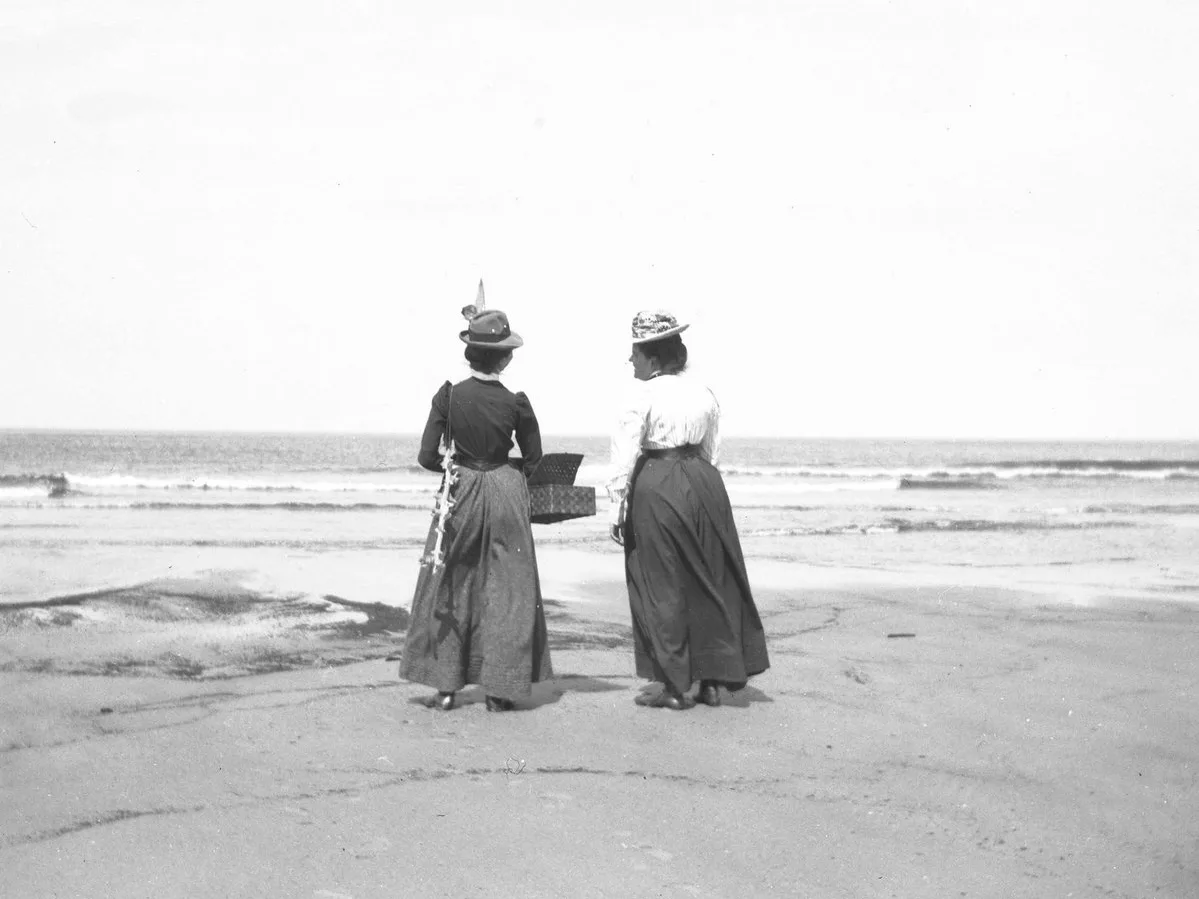
Photographing the harbor and hills of Camden, Maine, at the turn of the twentieth century, Theresa Babb (1868–1948) recorded both the intimacies of social life and her hometown’s industrial and seafaring traditions. What stands out most about Babb’s images is how they let us glimpse into a personal world of female friendship, captured in such a way that seems both timeless and strikingly modern. From Public Domain Review.