Pianos and Stuff
|

In this issue, Barrett Warner explores memorable plans for eternity in “Pianos and Stuff.”
Russell Green questions the deft deployment of the dreaded adverb and why some writers argue that we should eliminate their use altogether in “Notoriously Abused.”
And Clara Strong reveals how to cut the sheep—and perhaps the self—out of the sheep’s wool in “Shearing Season” and other poems.
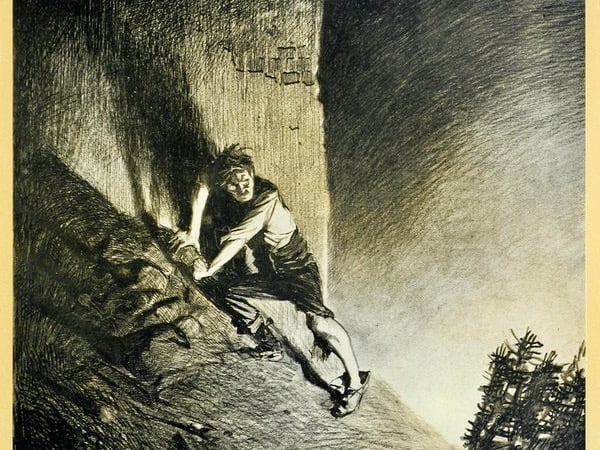
The illustrations in this issue are from the 1906 French edition of H. G. Wells’ The War of the Worlds by Brazilian artist Henrique Alvim Corrêa. Wells said that Corrêa “did more for my work with his brush than I with my pen.”
These illustrations for the 1906 French edition of H. G. Wells’ The War of the Worlds are by Brazilian artist Henrique Alvim Corrêa. Not a great deal is known about Corrêa, who died of tuberculosis at age thirty-four, only a few years after the illustrations featured here were published. During the first decade of the twentieth century, as The History Blog puts it, Corrêa “developed a style of strong contrasts and dynamic movement in both drawing and painting,” returning again and again to themes of “eroticism and violence individually and in combination”. Reading The War of the Worlds in 1903, Corrêa saw a work perfectly suited to his talents and obsessions. He did several illustrations of the book “on spec” and traveled to London to show them to Wells, who was apparently so impressed he invited him to illustrate the new Belgian edition of Davray’s translation. “Alvim Corrêa”, Wells said after the artist had died, “did more for my work with his brush than I with my pen”. See The History Blog at http://www.thehistoryblog.com/archives/36376 and The Public Domain Review at https://publicdomainreview.org/collection/henrique-alvim-correa-war-of-the-worlds