The man waved to me from the bench near the pavilion in the town’s center, flanked by shipwrecked cannons and a semi-circle of war memorials. I recognized him from the inn’s pub the night before. Billy Williams. Side by side, we played the slot machines for a couple hours, me sipping on one glass of Strongbow cider, him downing Blue Star beer at an amazing rate. He commented on the Irishness of my red hair and porcelain complexion and called me Cousin, although I told him my name was Ashleigh at least a dozen times. Like his own dear Mam come from away, he said, identical cousins. We parted with a handshake and he stumbled out the door as I climbed the stairs to my room on the second floor of the inn.
The glare of morning sunlight reflected off the calm waters of the bay. A thick-leafed maple tree shaded the bench and a breeze ruffled the canopy. Billy’s hand waved in time to the sway of a thin branch over his head. I lifted my own hand in salute.
“Good morning.” I called up the grassy incline to the plaza. “Nice to see you again so soon.”
He made no response, but continued to wave. I smiled at him. He wore the same scruffy jeans and baggy gray zip-front hoodie over his thin frame that he had on the night before. Unruly tufts of gray hair poked from under the knit fisherman cap pulled down to his ears. A glint of sunlight streaked from something over his head, blinding me for an instant. I squinted and moved two steps closer onto the grass. A sudden gust blew the branch upward and Billy’s arm shot into the air, only to flop back down when the wind stilled.
I scowled and tiptoed toward the pavilion, sneakers quiet across the flagstones. A squirrel jumped from inside the tree onto the end of the branch over Billy’s head, and his hand erupted in a convulsive flurry of flapping fingers. The next leap placed the squirrel square in his lap. Billy didn’t flinch.
I took the last few tentative steps. The man was perched in the corner, leaned in such a way to keep him upright. A length of fishing line, fifty pound braid for cod I’d learned, was tied one end around his wrist and the other to the wayward branch overhead, its waving position secured. His eyes were wide open, his lips fallen slack. My hand flew to cover my mouth as I gasped.
Billy Williams was unmistakably dead.
No one else was around in the open plaza. I took three steps backward, then turned and ran across the grass toward the parking lot shared with the Bully Bay Municipal Center. I got to the double glass doors and glanced back. Billy waved at me from the bench. I grabbed the big silver door handles and pulled, pulled again, shaking the door in its metal frame. Locked. Of course.
It was six-thirty when I left the inn for a morning walk along the bay shore. Though it seemed hours, it was only six-fifty according to my phone when I pulled it out of my pocket. Both the visitor and employee sections of the parking lot were empty. My hands shook as I zoomed in with the phone and snapped a photo of Billy on the bench. I took a deep breath and dialed, hoping Canada used the same system as back home in the states.
A deep female voice answered after only one ring. “This is the 9-1-1 emergency line. Do you need police, fire, or ambulance?”
“Uh, police?” My voice shook as much as my hands.
“Where are you located?”
“Bully Bay.”
“That will be the RCMP B Division in St. John’s. I’ll connect you now.”
The line clicked to a faint background hum. I bounced on my toes as I waited, not taking my eyes off the bench and Billy’s still-waving hand.
A younger female voice startled me. “Emergency line, RCMP B Division, St. John’s. Your call is being recorded. How can I help you?”
“Hi. Um. I was going for a walk and I found somebody dead on a bench.”
“Are you sure the person is deceased?”
“Yes. Pretty sure.”
“Is anyone in need of emergency medical care?”
“I don’t think so.”
“What is your name and where are you located?”
“Ashleigh O’Brien. I’m in Bully Bay. On vacation.”
“Is the deceased in Bully Bay also?”
“Yes. At the memorial plaza in the center of town.”
“Is anyone else nearby?”
“No. There’s only some men on the docks about a half-mile away.”
“Do you know the deceased?”
“His name’s Billy Williams. We’re related.”
“All right, Ms. O’Brien. I’ll send a car and ambulance right over. They should be there in twenty minutes or less. Can you stay near the plaza and wait for them?”
“Yes.”
“Thank you, Ms. O’Brien. Please wait for the officers to arrive and call back at this number if needed.”
I shoved the phone in my pocket and wrapped my arms around myself as I looked out over the bay. The town seemed too quiet even for this time of the morning. There wasn’t a moving vehicle in either direction. One fishing boat headed out into the open bay. A dog barked from somewhere up the hill.
I’d come to love this quiet town a half hour south of St. John’s, on the east coast of Newfoundland’s Avalon Peninsula. Despite being hidden away between rugged rock-face cliffs, Bully Bay had a claim, home to the largest puffin colony in North America. Images of the cute bird with the colorful beak were everywhere. My grandparents were born in Bully Bay and I came to see the place that was home before they emigrated to Boston. From the time I was old enough to sit upright on her lap, Great-Aunt Ethel Williams, my grandmother’s spinster sister, regaled me with tales of their younger years in this fishing village. I’d been here for a month and discovered I was related to at least half the town’s population of fifteen hundred, at least every O’Brien and all the “old” Williamses.
A jeep pulled into the lot and shattered my distracting reverie. It was time to deal with Billy Williams again. Arlene Puddister, the town manager, parked in her reserved spot and got out with a smile.
“How ya getting’ on, ducky? What’re you doing here so early?”
I didn’t trust myself to speak and pointed toward the pavilion instead.
Arlene shaded her eyes with her hand. “Who’s that? Billy Williams? What in God’s name’s he doing over there? Why’s he keep waving like that?”
Just then, I heard the faint whine of sirens coming from the direction of the highway. Arlene must have heard them too. She cocked her head to the right and listened.
“Sirens so early. Not a good sign.”
“They’re for Billy.” My voice was just above a whisper.
“For Billy? What do you…” Her voice trailed off, her head poked forward, and she peered in the direction of the plaza. “Oh, sweet Jesus. Is he…?”
I nodded. She cupped her hand over her mouth as another car drove into the lot. We both stared as the mayor, Wayne Ryan, got out and grabbed his briefcase from the back seat of his old Ford Bronco. The sirens were getting closer.
“Whaddayat, ladies? Enjoying the morning air?”
Arlene shook her head. I pointed. The mayor glanced in the direction of the memorials.
“Is that Billy Williams? What’s he doing over there?”
“He’s dead,” Arlene spurted out.
“Dead? What, b’y?”
“Those sirens are for him.” Her head bobbed with a definitive nod.
Wayne looked at me and opened his mouth to speak but closed it again. A big white pickup turned into the parking lot and stopped beside us. The window rolled down and Gus Wilson, the owner of the Granite Goose Restaurant up on the corner, stuck his head out. His wife Nancy was in the passenger seat.
“What’s going on here? A convention?” Gus chuckled.
“Billy Williams’s dead. Over there.” The mayor pointed toward the pavilion.
I heard Nancy sputter, “They’re going to think it was you,” as she grabbed onto her husband’s arm.
“I didn’t do anything to Billy,” Gus snarled at his wife and yanked his arm away. “Lord tunderin’ Jesus!”
“What’d you say?” Wayne asked.
“Billy and I had an argument at the Goose yesterday. He was cracked. We were in the office and I guess customers heard us. But I didn’t do anything to him.”
“What’d you argue about?”
Gus took a deep breath and frowned at Nancy before he answered the mayor. “I’ve been trying for months to get him to sell me the land where the Goose is along with the lot next door. I thought we had a deal when I signed the lease to open the restaurant, but now he’s trying to say there was no such thing and he doesn’t want to sell.”
Wayne shook his head and turned to Arlene. “Maybe you should go call Trudy.”
Trudy Williams was Billy’s twin sister, and the two of them shared the house on South Shore Road, the John Williams homestead. They were born there, lived there all their lives, more than seventy years. That’s the way it was in this small town. My own grandmother’s family lived in the next house down the road, the Michael Williams homestead. She and Billy’s father were first cousins. Billy was my second cousin once removed.
Gus got out of the truck and whispered with the mayor a few feet away. The sirens were a bit louder now, probably turned onto Irishtown Road. Arlene tapped at her phone and put it up to her ear for a full minute before she tapped the screen again. She sighed deeply as she pushed it back in her bag with another glance over at Billy Williams. She hurried over to Mayor Ryan and tugged on his sleeve.
“There’s no answer at Trudy’s. Now I’m worried about her, too.”
He sighed. “I’m sure she’s fine. Call Carrie and have her stop at the John house on her way here.”
Arlene nodded and took out her phone again. Carrie Pack was the Town Clerk and reliably the last to arrive to work at the town offices every morning.
“Morning, Carrie. It’s Arlene … It’s fine, not to worry … Yeah … Listen, we need you to do a favor. Stop by Trudy Williams’s and tell her to come down here quick as she can …”
More people began to make their way over as they noticed the commotion and heard the sirens in the distance. They parked along the road or in the dirt lot of the marina across the street or wandered with their neighbors to the municipal building. I found myself surrounded by the locals, many of whom I’d been introduced to once or twice, their names careening around my brain waiting to be assigned to a face.
The ever-expanding group surrounded and engulfed me. “Whaddayat” and “Hiya” bounced from mouth to mouth. Fingers pointed in Billy’s direction. Heads shook and chins bobbed. The sirens approached the center of town and the news spread. The crowd gushed from the pavement onto the grass, like water from an overfilled glass, only to surge apart to let Carrie pull into her parking place. She got out of the car in a rush.
“Arlene!” she called across the lot. “Trudy’s not home. Billy’s not there either. What’s all these people doing here?”
Arlene was about to answer when the siren hit an ear-splitting crescendo. A white SUV with the RCMP insignia on the sides screamed around the curve and into the driveway of the municipal building, screeching to a stop at the edge of the lot. The crowd took a collective step backwards. Mayor Ryan adopted a somber frown and sauntered to the cruiser door as the RCMP emerged, putting on his black hat with the wide gold band. They shook hands and exchanged a few words.
The officer peered at Billy Williams on the bench, grabbed a clipboard from the car, and walked toward the pavilion. The mayor followed for a few steps until the officer turned and asked him to stay where he was. The crowd inched closer to the cruiser, sweeping me along with it. We all watched as he crossed the lawn and stood in front of Billy. He lifted Billy’s untied hand and felt for a pulse. He studied the fishing line tied to Billy’s wrist and his clothes starting at the hat and working down to the scuffed sneakers on his feet. The officer walked in a slow circle around the bench, one hand holding the clipboard behind his back, staring at the ground.
Another siren sounded in the distance and every head turned in the direction of Irishtown Road. The group clotted closer together as the officer marched back across the grass. When he reached the cruiser, he glanced at the paper on the clipboard.
“Ashleigh O’Brien. Is Ashleigh O’Brien here?”
I glanced around and raised my hand. “Excuse me … Excuse me … Excuse me …” I made my way toward the officer, jostling my way through until I broke free of the pats on the shoulder and nudges forward. I lifted my chin to look up at his face, shaded by the bill of his hat. “I’m Ashleigh O’Brien.”
He gestured toward the grass and I followed him to a spot far enough away that we wouldn’t be overheard. “Ms. O’Brien, I’m Sergeant Norman Boudreau, RCMP. You’re the one who found Mr. Williams over there?”
“Yes, sir. I was taking my morning walk along the South Shore Road and I noticed him sitting there, waving at me, but he wasn’t really waving. The wind was blowing his hand around.”
“Yes, I saw it was tied to the tree branch. Is that how you found it?”
I nodded.
“What time was it when you saw him?”
“About quarter to seven.”
“Did you see anyone else around the area?”
“No.”
As we talked, the sirens got louder. I looked toward the street where an ambulance followed by a RCMP van raced around the corner and up the driveway, stopping in a line behind the cruiser.
“Stay here. I’ll be right back,” Officer Boudreau said to me.
I waited while he spoke to the two paramedics as they gathered gear from the ambulance. The RCMP exchanged words with the two police technicians who got out of the van. They unloaded equipment as the officer walked back to me. He opened his mouth to speak but we were interrupted by Arlene running down the driveway toward the South Shore Road, waving both arms at a slowly approaching blue Toyota. The driver slowed more, if that was possible, barmping the horn at the wildly flailing woman. Finally the old Corolla stopped at the end of the driveway.
“Trudy!” Arlene yelled. “Come up here.”
“What for?” the old woman called back.
“Just come up here and I’ll tell you,” Arlene screamed.
Trudy ground the gears and tromped on the gas, sending gravel flying as she lurched backwards. Just as quickly she shifted again, tires squealing as she turned the corner and flew up the driveway. The car lunged to a stop between the ambulance and Arlene, who sighed and walked over to the driver’s window. I couldn’t hear the words but the conversation between the two was lively, with gestures and pointing at Billy Williams on the bench. Officer Boudreau and I stood and watched along with the rest of the populace of Bully Bay.
“Yes b’y!” Trudy yelled as she got out and slammed the car door. “He ain’t no deader than me. Hey you, over there, wait.”
The paramedics and technicians stopped part way to Billy at Trudy’s command. She scuttled across the grass to catch up and Officer Boudreau headed off on an intercepting track. The crowd inched up behind and caught me in their surge, a coordinated body with a hundred legs, skittering across the pavement like a centipede, not to be left out of the bizarre goings-on.
“But Trudy…” Arlene jogged after the older woman as she trudged across the lawn toward the pavilion.
“He ain’t dead, I’m telling you,” Trudy continued to rave, arms flapping, as she trudged across the grass.
“Ma’am, please stop,” Officer Boudreau called out.
“Can’t. I’ll show you he ain’t dead. I oughta know. I gave him the drops and brought him here to sleep it off. Tied up his damn hand to make him look as stupid as he is.” She stomped her foot. “Came home middle of the night, three sheets to the wind, all rotted on that feller from the restaurant wants to buy the property.” She turned around and wagged her finger at the officer. “I wanted to sell that land six months ago when the man signed the lease. But, no-no-no. Stubborn old fool.”
Boudreau caught up to her and gently cupped her elbow with his hand, guiding her to the side. “Ma’am, are you related to the man over there on the bench?”
“Well, of course we’re related. He’s my twin brother.”
The paramedics reached the pavilion and began to check Billy over, one strapping on a blood pressure cuff and the other positioning a stethoscope on his chest. A technician snapped photos of the area while his partner searched the ground for clues. Trudy jerked her arm away from the officer and hurried over to the bench. She pushed one paramedic out of the way.
“G’wan b’y. You think I’d do in my own brother? Hah! Just wanted to put some sense into him. Knocked him out with those old drops our Mam kept hidden away in the bathroom, just ’til I go see that nice Mr. Wilson at the restaurant this morning and sign the papers to sell the land.” She pointed her thumb at her brother. “Land I own just as rightly as him.”
Trudy waved away the paramedics and technicians and stood in front of Billy with her hands on her hips. Officer Boudreau stepped up beside her.
“Ms. Williams, I have to ask you to please …” he began.
Before he could finish, Trudy pulled back her arm and punched Billy right in the chest, hard as she could. The crowd gasped in unison. Boudreau reached for her arm, but not quick enough to stop her from landing a second blow directly on Billy’s sternum.
“Come on, you old fool. Don’t you play possum with me.” She crossed her arms over her chest and glared at her brother.
Five seconds passed. The crowd held its collective breath. I peered at Billy and thought I saw the slightest rise at the front of his hoodie. A hiss of air was followed by a hiccup and a full-on cough.
“Hmph!” Trudy flipped her head to one side. “Told you so.”
Billy coughed again. His head lolled back, then fell chin to chest. His eyelids fluttered and finally opened all the way, while his head shot straight up. He peered directly at Trudy.
“What’dya do that for? I was sleeping right peaceful.”
The townsfolk gave up a cheer. I let go the breath I’d been holding. My shoulders relaxed and a smile whipped across my face, aimed at my cousins.
Billy Williams was unmistakably alive.
Susan E. Rogers lives in sunny St. Pete Beach, Florida, transplanted several years ago from Massachusetts. Her move was the catalyst to focus on her life-long ambition to write. Her interests include genealogy and psychic spirituality, and she often twists these into her writing. She’s published two speculative non-fiction books and three thriller/horror novels with small presses. A fourth novel, a thriller, will be released in Jan. 2027. Her short fiction has been published in numerous literary and genre magazines as well as anthologies and podcasts. She recently won the 2026 Florida Authors & Publishers President’s Gold Medal for her novel The One-in-the-Noose. A complete listing of her work is available at www.susanerogers.com.
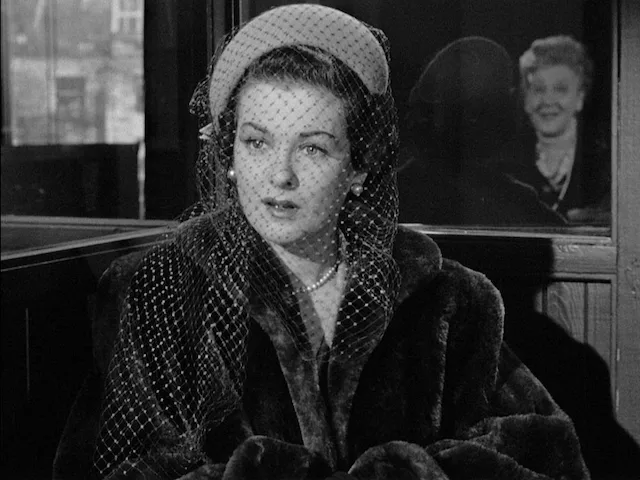
Image stills from The Reckless Moment, a 1949 American film directed by Max Ophüls and starring James Mason and Joan Bennett. The film is based on The Blank Wall (1947), a novel written by Elisabeth Sanxay Holding.