She was swimming with her father, in an ocean. It must have been Ocean City, one of their family trips to the seaside town in Maryland, before the family broke apart, before she stopped talking to him at eighteen, before sitting in the pews of a loved one’s funeral, resigned to staring at her father, daring him to break their sixteen-year estrangement. Her father invited her to swim out past where her feet could touch the sand. Past the curling waves and out to the smooth, rolling water behind. She swam a modified breaststroke, keeping her head above the water so that she could remember every moment of the bright view.
She couldn’t remember what prompted her father’s suggestion. They were to swim out to touch the buoy that marked where open ocean began. She had never been this far from a shore before, but she trusted him, and kept going. It was only a tug at first, like someone pulling at a sweater sleeve. Her small body lurched forward, toward open ocean, quicker than she was swimming. Then again and again. Her father noticed too and stopped. She turned around and fear electrified her: the tan shoreline was barely visible and shrinking with every wave. The buoy was nowhere in sight.
They tried to swim back. She kicked and pulled with all of her might. She even tried the dreaded freestyle stroke–her least favorite. She squeezed her fingers together to create a seal against the water as she sliced her hands into the waves. Exhausted, she stopped and looked up. She was no closer to shore than before.
“It’s the undertow,” her father said, addressing the confusion in her eyes. “It’s pulling us out.” He bobbed up and down in the water, straining his neck to assess their distance. “I’m going to call for help, Jacqueline. I can’t pull you back with me.” He stuck his hand in the air as high as he could, waving half-circles against the clouds.
How could anyone see them, one man and a small girl, in the whole, wide sea? Her legs ached from kicking and her heart beat so fast she was certain it would make ripples if it weren’t for the waves.
It occurred to her that no one would come. Her mother didn’t even know she was back in the water. Swim class safety kicked in and she resigned her body to floating, letting herself rise and fall. She accepted the current’s control and let go of the sight of the beach. She would float, which saved energy, she remembered a teacher saying. Water lapped in her ears and salt spray stung her eyes. “For our swim back,” she heard her father’s voice say, muffled by the water cupping her face. “Save your strength.”
When the lifeguard finally came, removing the red floatation strapped diagonally across his tanned back, she remembered how her father grasped at it. How exhausted he was. How his breath was quicker than hers. Then, the lifeguard reached for her, told her to put her arms around her father’s neck. Like a line of tin cans trailing a car, the lifeguard pulled them in together, slowly, each stroke fighting against the current. Only when the beach became near enough that she knew she could make it on her own did her heart finally calm. The lifeguard stood and checked his cargo, the water only coming up to his knees. She allowed her legs to drop and absorb the safety that was firm, unmoving sand beneath her.
On the wide beach, still dripping with water, her father thanked the lifeguard who dismissed the gratitude with a smile. The shadow of the lifeguard grew smaller as he returned to his post. Finally, she turned to face her father. They stared into each other’s eyes. She understood that she was never to speak of the day again. When reunited with her mother, she listened to her father calmly state that they had been swimming. She supposed, in a way, that it was true.
Jackie Sizemore has worked over thirty jobs, from gas station night attendant to English professor. Her work has been published in Iron Horse Literary Review, Heavy Feather Review, Mikrokosmos/Mojo, Crab Orchard Review, and elsewhere. Currently, she is studying for a MSc in History of Science, Medicine, and Technology at the University of Oxford.
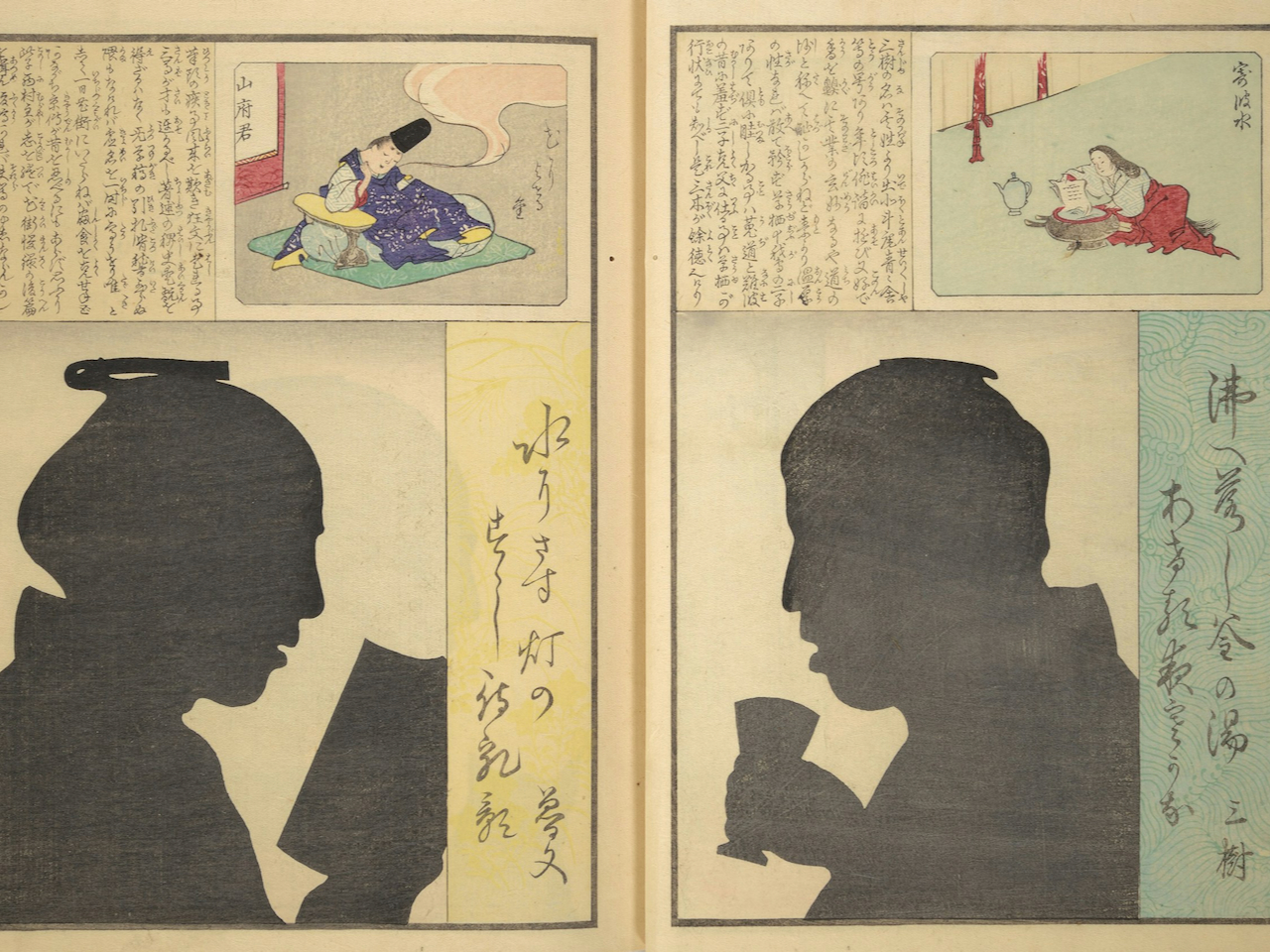
Clear Shadows (Kumanaki kage, 1867) is a compilation of silhouette portraits depicting members of the kyōga-awase club by the artist Ochiai Yoshiiku (1833–1904), which includes short biographies, picture riddles, and poems. [via Public Domain Review https://publicdomainreview.org/collection/kumanaki-kage/]