Our five-year-old son asks us for forgiveness. He apologizes for what he did this morning. He hangs his head and paces before our TV, even with his favorite show on, Spidey Something or Other, which is difficult to watch for the hundred-and-eleventh time. I’m sorry, I’m sorry, I’m sorry, he says, for something his mother and I don’t remember him doing in the first place.
My parents say that means he’s a good kid, not that they’d say he’s anything else. It’s one of those things we wouldn’t debate—whether he’s good or not. He’s ours, so how could he be anything but? Yet, we feel the need to remind ourselves, as if it’s worth discussing.
Still, my parents insist. Not everyone’s kids are good. Some do bad things and don’t feel sorry about it later. But the kids who want to apologize—they’re sure to grow up good.
I’d like to know what my parents think it means to grow up good.
My father would probably say it means to not have any arm tattoos.
And my mother would say it’s to be kind, even to strangers.
But my sister would probably say it’s to be true to yourself, as corny as that may sound.
My sister’s sense of being true to herself is to do whatever she wants. She wants to move to LA, so she can break into the studio design industry. I think of people who move to LA as wanting to be on stage, in front of the camera, but she wants to be behind it. I wonder why LA is the place to go, if she doesn’t want to be seen. She could do that just about anywhere.
Still, she goes, and we wish her goodbye. We help her gather her things, her clothes, her electronics. We corral her cat and coax it into a crate, which the cat has always hated.
Our son asks if she’ll ever come back, and my sister begins to cry.
I’ll be back, she says, and we wait for her car to disappear beyond my parents’ home, where it will take her days to reach LA. Then our son plays with something in the garden, which, given the time of year, is nothing but a mound of soil and dirt.
When we watch TV with our son, we’re sure to explain who’s good and who’s bad, so he knows which characters he should admire. We didn’t think we’d have to do this. But then he watched The Incredibles and pretended to be the blonde-haired punk who grows up to kill the superheroes he once loved. IncrediBoy, I think his name is.
Our son started using some of his lines, pretended to fire at us, with something on his arms. We had to sit him down, explain what he was missing.
He cried that night when he went to bed. We told him it’s okay.
My sister calls us when she gets to LA, and my son holds the phone to see her on FaceTime. He isn’t aware of how best to hold the screen, so all my sister can see is his chin and his nose and the ceiling above his head.
Aunty Kels, he asks. Did you leave because you’re not happy here?
I assume by here, he means this sliver of the east coast, where we could see her whenever we wanted.
But to get to LA, we explain, means crossing mountains and rivers, deserts and forests, how all of these things lie between where we are and where she’s gone.
We shouldn’t have made it sound so vast. We could have simply said, we’ll fly to her someday, but he wants to know what she saw along the way.
Do you forgive me? my sister asks when my son says he’s still mad at her.
He shakes his head and hands me back the phone.
But before we hang up, he tells her he loves her and can’t wait to see her soon.
When our son was just twenty-six days old, we moved him to Gettysburg, Pennsylvania, where his mom and I teach at the college. On weekends, we take him for walks around the battlefields, where statues of soldiers with muskets and bayonets, some on horseback, aim their weapons at long-dead men in the distance. We explain bad things happened here, but that doesn’t make the soldiers bad. We walk past busses with tourists, around places called Devil’s Den and the Bloody Wheat Field. In old farmhouses, cannonballs and bullet holes remain. We tell him we’ll talk about these things when he’s older, that sometimes it’s hard to settle what’s good and what’s bad in the real world. Occasionally, he climbs on top of a cannon, his legs hanging from either side, and we stop to take his picture.
There’s a picture we’ve come to know by living here. It’s from the 1913 Gettysburg reunion, when soldiers from the North and South came to honor the battle’s fiftieth anniversary. In it, the men, now old, stand on opposite sides of what looks like a bush and shake hands as a kind of acknowledgment they’re no longer divided. Our son studies the men’s faces, their long white beards and funny hats. It’s hard to know what the men are thinking; their faces don’t reveal much. I imagine most people who look at this picture wonder what the men discussed, if they got along, if they set aside their differences. But our son points to a man in the background, whose back is turned, who does not bother to look at them. Our son thinks about this man more than the soldiers who’ve come together. Why isn’t he looking? he asks. And when I study it through his eyes, I wonder if that’s what this picture is about: the man who’d rather notice the open fields than what the soldiers might have called forgiveness.
When my sister comes home for the holidays, my son wraps his arms around her legs so she can’t escape. She sits down to play a game he calls turtle wrestling—where the bigger person forms a “shell,” and from underneath, he tries to wrestle his way out. My sister takes him by the feet until finally, he gets away. He scurries across the room, breathing heavily, smiling. They play for what feels like hours, as the rest of us drink wine in our parents’ house, eating hors d’oeuvres on fancy plates we use just once each year. When my son is too tired to go on, he curls up on the couch, plays with my sister’s hair. He pulls it back, braiding it the way children do, so it’s messy and tangled and it falls this way and that. I’m so happy you’re back, Aunty Kels, he says, and in his voice, we all hear it: that he believes she’s not only back, but that she’s back for good.
There’s a difference, we tell him, between coming home to visit and coming home to live. That she’s simply here to see us—not to make a life back here again.
I don’t get it, he says and burrows in a corner of my parents’ house, the “shell” now his own, his arms draped over his knees.
My sister bends down to sit with him.
Why aren’t you happy here? he asks.
I am, she says.
Then why don’t you stay?
My sister takes a moment, smooths her hair so it’s straight again.
Maybe it’s not happiness I’m looking for, she says.
My son considers this, as if there’s something worth more than happiness.
Then what is it? he asks.
My sister shakes her head. That’s why I’m looking, she says. And for a moment, I think he understands this. Like the man in the picture, who turned to look at the empty fields.
Just promise you’ll come back, he says. A lot and a lot and a lot.
I promise.
At least three times each month, he says.
My sister smiles.
Or make it four, he says and extends his hand to seal the deal.
My sister takes it, but only to pull him back down, where he pretends—if only for a second—that this time she has him pinned.
Matt Barrett holds an MFA in Fiction from UNC-Greensboro, and his writing has appeared or is forthcoming in The Threepenny Review, The Sun, TriQuarterly, West Branch, The Cincinnati Review, The Baltimore Review, SmokeLong Quarterly, Wigleaf, Cutleaf, Best Microfiction, and Best Small Fictions. He teaches creative writing at Gettysburg College and lives in central PA with his family.
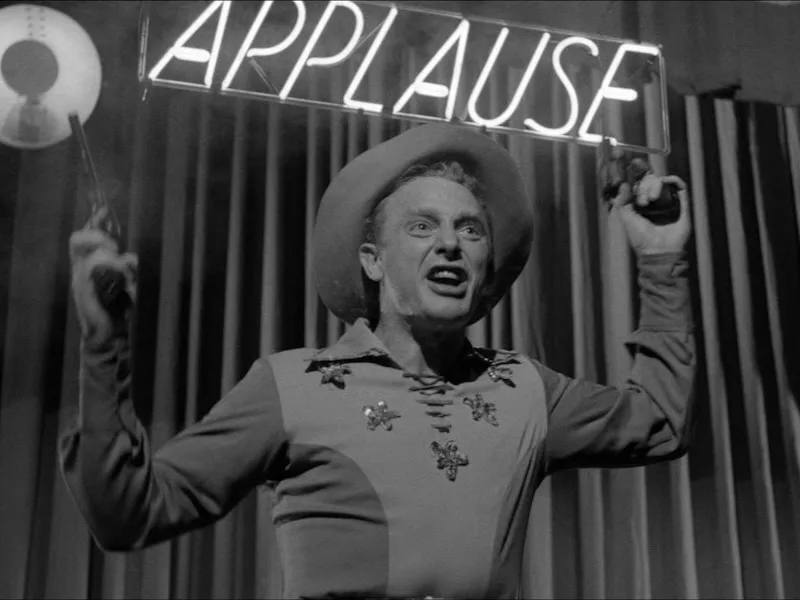
Images from “A Face in the Crowd”, directed by Elia Kazan, 1957, starring Andy Griffith and Patricia Neal.