Christmas was the season when my parents switched the radio off and went hunting through the basement for the shoebox filled with cassette tapes. All the tapes were twenty years old, dating back to when my dad was a college radio DJ and my mom wanted him to impress her. There were the Beatles, Jefferson Airplane, Coltrane and Charles Mingus. That was our Christmas music. This is what Jesus was for me, a Jewish kid stuck in the Catholic ghetto in Philly. It was the equivalent of having a father with a Playboy subscription: Something that you were simultaneously intrigued by, scared of, and not supposed to know about.
I was scared of Jesus, maybe. The pictures I’d seen made him look unscrupulous, dangerous, long-haired. Not too different from the Moses pictures in my Hebrew School books, but with a weird color scheme, brown and white and sky blue, as though he couldn’t make up his mind whether to be Biblical or not. Also, he was young. He was supposed to be all wise or ancient or whatever, but his beard wasn’t even white. Weren’t young people dangerous?
Or at the very least—in my experience, as a young person forced to attend school alongside hundreds of other young people—they were undependable. Give me a big-bearded wrathful-old-man G-d over a long-haired hippy kid any day of the week. I trusted authority. I liked being told what to do. As a child, I would set to work happily on the most senseless assignments, Write the letter D fifty times over, first capital, then lowercase, then when I had finished—always before anyone else in class was done, always—I took out my notebook and doodled. Out of the lines, sometimes abstract, sometimes just monsters wrecking the downtown Philly skyline. I had my controlled anarchy. The Jewish outlook perfectly suited my own particular brand of anal retentiveness:
Most of this understanding was based in an Orthodox Jewish youth group I joined at thirteen and then dropped out of the next year, once I’d started high school. Youth Group was about a dozen of us, all hanging out and awkwardly socializing in those horrible months of our voices changing and our developing awareness of our developing parts. We planned activities—ice skating, movie nights, going to restaurants, even, once, a dance—but they were structured mostly around trying to prevent us from doing things we weren’t allowed to, like eating non-kosher food or touching people of the opposite sex.
My friend Cameron from Hebrew School brought me to my first Youth Group event. Cameron was brilliant—not just nerd-brilliant, but evil genius-brilliant. While he was around, you tended to watch your pockets and the secrets that they shared. In school, he was a human punching bag. In Youth Group he hit his stride as a social demon. He even had a girlfriend.
“It’s Saturday night!” he told me on the phone. “You’ll come! It’ll be stellar!”
“But what kind of event is it?” I said, and he wouldn’t tell me. I came anyway. It turned out to be a dance.
The idea of a dance at an Orthodox youth group was basically a sham. Cameron might have a girlfriend, but I knew for a fact that, being Orthodox, they weren’t even allowed to touch. There was a frosted-glass partition in the middle of the dance floor, cutting off guys from girls. No touching. No dancing. I asked Cameron why we were here.
Nobody on the guys’ side was dancing. Nobody would talk to us. Youth Group was just like school, the kids who were too popular to notice us, the kids who tried to pretend they didn’t notice us so they could be popular, too.
In any case, nobody was dancing. The dim silhouettes through the partition suggested that the ladies’ side agreed with us. The DJ, too, seemed to be totally baffled. For most of the night, we listened to an 8-song Disco Bar Mitzvah on repeat.
“This is ridiculous,” I said to Cameron. “Just because you’re not allowed to dance with girls means you can’t even see them?”
“It’s why you have fences around the laws,” said Cameron. “It keeps the laws safe.”
“Safe? Safe from what?”
“I don’t know?” he said. “Maybe from us?”
The other guys had the snacks table surrounded, downing greasy handfuls of BBQ-flavored potato chips, bright orange even in the dim mood lighting. They were talking about football. I watched the way their hands mimed tackles. There was nothing in life I wanted to talk about less than football.
“You don’t want to be there any more than I do, Matt,” he said. “Come with me. Let’s make our own party.”
His hand leeched onto my arm, shoving me along, dipping me inside the partition and over to the girls’ section. It felt at once dangerous and sexy. Here we were, nerd explorers, the lowest rung in the social food chain, defying the odds and going where no man had gone before. Two things hit me at once.
First, there was a girl waiting for us right where we’d surfaced.
Second, their snacks table had better food than ours did.
“Matt,” said Cameron, “this is Judy,” as if I couldn’t tell. As if I hadn’t suspected. The furtive way Cameron checked his watch as we crossed over, how he behaved so uncharacteristically confident, how their fingers wound together as soon as we were over there like a slug family reunion.
“Cameron,” I hissed, “you are holding hands.”
“Well, yeah,” he whispered back. “I mean, we’re not having sex.”
Superiority burned in the shadows of his face. Judy drew closer to him, looking as though she’d just won something. Just the word of it—-sex—was enough to hammer the details at me: He had a girlfriend and I did not; he knew his way around being Orthodox, and here, I was still clueless.
“I can see that,” I shot back. “I mean, even you Orthodox people must know what sex is.”
And then, once my eyes came unstuck and I stopped trying to absorb everything at once. I saw Judy’s friend, a stranger to Youth Group, staring at us like lepers infiltrating a hospital. “It wasn’t my idea,” I stammered defensively, even though I didn’t know her.
“I can tell.” She nodded past me, over my shoulder, to where Judy and Cameron were holding hands and doing something sketchy with their eyes, like back-and-forth hypnosis. “I’m Mandy. I’m new here.”
“My name is Matt.” The uncomfortable awareness sat between us that our names sounded alike. Even more uncomfortable: I stuck out my hand. She looked it over worriedly, unsure what she should do with it.
“Sorry about that,” I said. “I just get nervous when, uh. Pretty much always.”
“That’s okay.” She was smiling. “I thought it was a test.”
“How do you know Judy?”
“Through orchestra. We both play violin.”
“Violin!” I shouted it like bingo. “I play violin too!”
She fluttered a weak smile back, as if to remind me that she wasn’t deaf, or maybe to remind me that there were literally thousands of other people on Earth who also play violin, and it wasn’t that big a coincidence.
“We should hang out.” said Judy, back on Earth. She snatched Mandy’s forearm and began to gravitate away. “With other people.”
Mandy looked at me helplessly. She had rusty orange hair, lots of freckles, a mouth that, when she wasn’t talking, hung slightly open in an expression of perpetual surprise. Her hands always rested on her hips, giving her an in-control vibe, sort of like the Baroness in G.I. Joe. It scared me and excited me.
The “Siman Tov” song started up again, then clicked to a halt.
“Sorry, guys. I can’t do this anymore,” said the DJ over the speaker system. “No offense to your people, but that song sucks. I’ll try not to play anything too dancey or seductive.”
He clicked off.
A new sound started. First there were voices singing in a chorus. Then a piano. Then an accordion. Conspiratorial grins split Judy and Cameron’s faces in half. “‘Bohemian Rhapsody’!” yelped Cameron, even though we all recognized the song already. It wasn’t a yelp of recognition. It was a yelp of approval.
There wasn’t anything inherently geeky about the song, or about the band, Queen, who were British (vote in favor) but were on mainstream radio (first vote against) and sang songs like “We Are the Champions” (possibly sports-related? Second vote against) and were in a big summer movie (automatic fail), except that—here, in the lion’s den of Jewish jocks, “Bohemian Rhapsody,” with its accordions and references to the Devil and renaissance French people, possessed a quality of salvation, a subversive brilliance.
“Chair car,” announced Cameron.
We each grabbed a chair. We arranged them in a setup like a car, two in front, three in the back—one for each of us, plus one for Soda Can Davis, who’d somehow materialized on this side of the boundary. “Front or back?” I asked Mandy, turning to her and accidentally bumping into the greater-than sign of her arm, folded on her hip like a default. She smiled, flattered to be asked. Or, possibly, dumb-ified at the lameness of the question. “Back seat?” she said.
The world stopped. Back seat.
We climbed in. We were still in time for most of the song. It was a long song. But not long enough, as we lip-synced to the falsettos and breakdowns and rock-outs, our body motions getting rowdier at each transition, until finally we were headbanging the final stanzas. Mandy didn’t know what she was doing. Her hair just sort of shook instead of flying. My own hair was too short to do anything.
The next song was “Mr. Wendal” and then R.E.M.’s “Losing My Religion.” I think that finally pushed the party limits, though, because suddenly, right in the space where our front engine was supposed to be, Yaakov was glaring at us.
“What are you doing on this side of the boundary?” he squawked. “Where is the boundary? Respect the boundary!”
Like most youth leaders, Yaakov had no idea what sort of monsters he was introducing to the world, of course, and his cry of “respect the boundary” became an instant motto, not only for us, but for everyone who overheard, and anyone who heard that phrase repeated, and for years to come, “Respect the boundary!” was what we said when we needed personal space, when we wanted to violate someone else’s personal space, when one of us needed a password for something, before jumping off a diving board at summer camp, or in the throes of a dramatic hook-up situation. Although that didn’t come until much, much later.
We didn’t see each other again until the end of the night. We all stood on the sidewalk and outside the synagogue like a bar after last call, waiting for our parents to show up and pluck us home, one carpool at a time. She was standing with Judy and a bunch of girls. I came up to her, not sure what to offer in the way of conversation. She started, not me. “Sorry if I got you in trouble,” she said.
“You didn’t,” I said. “Not really. Anyway, I’d go to jail for you whenever.” It just tumbled out. At least twenty years passed before her reaction. She smiled.
“That’s nice,” she told me. “I’d come visit.”
“See you on the outside?” I said. “I hope?”
“Matt,” said Judy, “I’m not sure that’s a good idea,” and I turned to her and said, “Look, Judy, I don’t know what sort of girl hypnosis you’ve put on Cameron, but he really seems to like it and I’d appreciate it if one day Mandy decided to put me under the same spell, so please stop encouraging her to ignore me.” Or that’s what I would have said to her, anyway, if I had a lot more courage and if Mandy’s parents hadn’t pulled up just then, rendering the whole thing useless to talk about, because she was gone and I didn’t have her phone number or anything.
“Sure I can get you her phone number,” said Cameron later. “I’m in Judy’s room all the time. She has a big neon file with everyone’s phone numbers inside. But you don’t want it.”
“Why not?” He hadn’t seen the inside of every single dream I’d had that week. He didn’t know that the only path to happiness in my life lay in spending every available minute of time I had with Mandy.
“Because,” he said, as calmly as if he were answering a question about nuclear physics or Star Wars continuity. “She isn’t Jewish.”
I don’t know why I’m telling you this. Years after the fact, this shouldn’t matter at all. Mandy, whose name is not Mandy at all but whose real name still resembles mine, probably doesn’t remember any of this. She wouldn’t even deny it; these events, a couple of nights picked at random from an arbitrary year filled with three hundred of them, have in all likelihood blurred into a thousand other nights.
It’s not like I liked her that much. I’m saying that because, since I’ve known her and then stopped knowing her, there are girls I’ve melted much more dramatically over, people who’ve meant more to me, people who’ve treated me much shittier and people who I’ve treated much more shittily. It might be a formative experience, except that neither of us experienced much.
It’s just, when I think of the past, this is what I think of.
The next weeks were a haze. Nothing existed, except for my interactions with Cameron and Soda Can Davis. They went to a different public school than I did—the same school, my brain was quick to footnote, as Mandy—and we only had physical contact on Sundays and Wednesdays, in Hebrew School, and during the weeks when there was a Youth Group event. Whenever we did hang out, or when we spoke on the phone, the conversation ran the same.
“You can’t date her,” they warned me. “You have to stop.”
They weren’t telling me this because they were trying to force me not to date her. Years forward from that moment, they would both be exactly where I was then. One would lose his virginity, years before the rest of us, to a similarly-Irishly-named girl, whose suffix -ys and dangling O’s in her name should have spelled danger enough; the other would move in with, and then subsequently break up with, a non-Jewish girl who fervently studied our religion, knew as much about it as any of the rest of us, yet would refuse to discuss or entertain the possibility of conversion. And his parents liked her.
At that moment, though, they weren’t persuading me out of disagreement or spite, but from the simple fact of impossibility. We had been raised with ideas that Jews and non-Jews simply weren’t capable of dating. Oh, we heard rumors, a renegade older sister, somebody’s father who grew up Christian. But divorce inevitably followed, and there were other factors. They didn’t understand our culture or speak our language. For all we knew, our reproductive organs didn’t match up. Better not to find out at all than to find out too late.
I called. Too much time had passed, and I sounded like a stranger on the phone. So did she—her voice cut too high, and there was a gravelliness to it, this unsure quality that smacked of heresy. Where was the too-confident girl in the tartan skirt? Where were the Bonne de Beugny hips? I couldn’t see them, of course. But I prayed to G-d they still existed.
“How’s your violin?” I asked.
She said nothing. I was an idiot. How was a violin expected to be?
We made plans. Summer was coming up, and we both had summer birthdays. Mine came first, the day after school let out, and I gave her my home address. Hers was two weeks later.
Inviting her meant that I had to invite other girls, too. I snapped into emergency recon mode. There was no chance I was inviting anyone from my school. They’d all seen me in too many compromising situations. My only friend Patrick was invited, but he had no friends either; besides, he’d been out of commission all year after a car accident. I wished I had an excuse like that.
So I called the girls from Youth Group. Judy was first, a cynic. “You want us to make you look more plausible?” she said. “So that Mandy will think you’re normal and date you?”
“Yes,” I said.
My plan sounded better, I decided just then, coming out of a guy’s mouth.
She came anyway. They all did. I convinced my parents to let me have the party in our basement, which hadn’t been touched since my parents bought the house two years before I was born, in the height of the 1970s, with shaggy dog carpeting and wood panels on the walls. I always wanted them to give me permission to move my bedroom down here. It felt like a secret bunker. They never did. This party was my consolation prize. Having my party in the basement meant that I could avoid my parents, to party unobserved by adults.#
Two hours in, and it was already a success. We ate pizza off paper plates while sitting on the couches. “Weird Al” Yankovic was on the stereo, and nobody was complaining. This is how you do it, Matt, I thought. Choose your friends, and they will choose you right back. They didn’t mind my weirdness. They were okay with it.
I don’t know how the limbo game started. I know it couldn’t have been my idea. I hated competitions; hated physical activity. I was afraid of falling on my face in general. I didn’t need to play a game that made it basically impossible to avoid. I sat there, quietly dreading the conversation between those in favor of playing and those opposed. When it was decided, I announced at once that I would be the judge. Either because everyone present were my friends, or because it was my birthday and they were feeling charitable, nobody said anything.
I held one side of the bar. Patrick (who’d come, but was incapacitated) held the other. Mandy made it to the final two, but Judy won. She was tiny. It was sort of a joke. In any case, Mandy took defeat nobly. She shook hands and let Judy choose what songs we played on the radio for the next half hour. The next night, on the phone, Judy vented.
“I can’t believe Mandy,” she said. “She knows she’s not supposed to be chasing you.”
“She was chasing me?”
“She was basically throwing herself at you.”
The whole night, she’d been entirely unresponsive. I hadn’t even been able to shoot her an apologetic smile after the limbo. Null sphere, zero beats per minute. If communication between us was a human being, it would have been a cadaver. No pulse. If she were throwing herself at me, you think I would’ve caught her. Or at least gotten hit by her.
“Sure she was. During limbo, the way she dove under the pole. She was all ‘I-must-increase-my-bust’.”
“She was?”
I felt awful. Like when someone gives you a present and you forget to say thank you. Worse. I had little to no conception of busts, only that they were something that girls had and boys somehow lacked, and that they were meant to be private and sacred. I wondered if she felt spurned. I wondered if I was an ass, or gay.
“Matt, you’re ridiculous.” Judy was mocking me, but something in our talk had turned serious, and ugly. “You don’t notice things when they’re right in front of you. You need to think of other people and not just yourself.” She got off the phone quickly. I didn’t understand what I’d done wrong, and she wouldn’t explain. I thought I’d been doing Mandy a favor by trying not to look at her chest, her body. That was her territory. I didn’t want to be an invader. I asked Cameron. First I asked if Judy was mad at me. Then I asked what doing I-must-increase-my-bust meant.
“Girls want you to notice that stuff, Matt,” he said. “That’s why they have that stuff in the first place, we’re supposed to notice. It’s a compliment if you do.”
I was convinced. I would never, ever stare at a girl’s chest, and doubly so, especially not Mandy’s. Even though it was a biological imperative. Even though my eyes, like a tiny boat in a riptide, seemed to drift toward the chest of every girl in the vicinity of their own accord, independently of what I wanted. Breasts came in every shape. The breasts of individual girls would change overnight, from week to week. One Shabbos Judy’s were sharp, pointed, prickly. The next they were full, round ovals. I fathomed the possibility of her stuffing her bra. That was even more disturbingly arousing.
I had a brilliant idea. I would call Mandy. We would date each other, but we would never see each other in person. We would only talk over the phone. That way I would never offend her, and we wouldn’t have to deal with those pesky, physical intrusions.
Two weeks later we pulled up at the record store. My father idled the car and let me run inside. Being alone in a store was a pretty big deal. The choices and the responsibility. My own money, in my pocket, clipped inside the loose Velcro of a never-used wallet. So many aisles of so many CDs. It was impossible to imagine that many bands existing, that many singers. Between my entire school, everyone only listened to about six different albums.
I didn’t want to get Mandy one of those albums. I didn’t want her to think I was like everybody else, just a conformist, someone who didn’t take her into consideration and what kind of CD she would like. The only hitch was, I didn’t really know anything about her. I knew she played violin. I knew she was Christian.
I thought harder. I must increase my bust. That nervous laugh at the dance. What did it all mean? What kind of person was she? Ten thousand CDs stared at me, daring me to pick one.
I reached forward and claimed it.
Her party was a pool party. It was incredibly nerve-wracking, the worst situation for a 14-year-old birthday party that anyone could imagine. Most guys my age had short pot bellies, a fact that I’d learned from the locker room before gym. I had the opposite problem. I was skinny and had protrusive ribs. They stuck out more than you’d expect, not because of any weight problem except that I just didn’t eat much. Once in the locker room Jim Gornick said to me in front of everyone, Your body looks like you were in a concentration camp. I’d corrected him. “You mean a work camp,” I said. “The people in concentration camps didn’t have time to get thin. They just got killed right away.” The gym teacher, who’d heard us, came in to see what was going on. He knew it was racial; he just couldn’t figure out if it was more strategic for him to get involved or sit this one out. I thought I’d done pretty well on my own. The people in the work camps were the strong ones, after all.
So today should be no problem. I scoped out the territory. Picnic tables next to the parking lot. Then a gated-off area that enclosed the pool; beyond that, the changing rooms. I just had to get from the changing room to the pool shirtless. After that, I’d be safely underwater. A total distance of 15 feet, maybe 20. You just had to hope Mandy wasn’t looking at me during that interval.
I ran into Soda Can in the change room, peeing. The urinals were open. I slipped into a stall. “Hey, you don’t need to change in here. Just peel off your shirt—”
I shut the door to the stall on him. I locked myself in and stripped.
Cameron sat at the edge of the pool, complaining about the temperature. He was doing it the hard way—feet first, then his knees, his waist. I only caught a few words. I cannonballed. So cold I couldn’t speak, but I was in. I was in.
“Yikes, Matt!” Mandy’s head popped out of the water next to me. “Did that hurt?”
“Nah, no. Not at all. I’m fine. I like to get it over with.” My butt stung. Something icy and painful. Water went up my sphincter, floating around my intestinal coil. Medically there shouldn’t be anything wrong with that, I thought, since we were already seventy percent water, but this was pool water. It was probably chlorinated. Did my butt just rupture? Was it even possible to rupture your butt? I needed to focus. This was our third real-life conversation, and I was shirtless and treading water.
“I’m totally fine,” I smiled at her. “But thanks for worrying. That was really cool of you.”
“You shouldn’t do that. It’s not safe.” She shrugged and swam off.
The people at the party were divided into two distinct subsets: Her public-school friends, which included a bunch of people from Youth Group, and most of whom were Jewish; and a group of taller, more athletic-looking kids. They swam very little, preferring instead to take dramatic and well-choreographed dives off the board, swim up from the depths where they’d landed, then pop out of the pool and repeat the process. “Nice dive,” I told one tall kid with a six-pack stomach. “Where do you know Mandy from?”
“Oh, from church dive team,” he said. “We practice here.” He kicked away toward the catwalk.
Over the course of the afternoon, several new facts emerged. One of them was Mandy’s personality—more from secondhand accounts of her friends, as well as the way the church divers seemed to treat everyone who was not a church diver, rather than from personal interaction between Mandy and myself, since she seemed to be studiously avoiding me. By pizza and ice-cream cake time, I’d learned two more important things about her:
Kenny Ostroff was Jewish (that was easy to deduce; all my contacts knew him) but not involved in, or interested in, Youth Group (also easy, since I didn’t know him personally). Kenny was there that day. He was a dumb-looking, well-built guy with a crew cut who had no detectable qualms about walking around with no shirt on, even though everyone else put theirs back on (including, I should point out, the Catholic divers)
After ice-cream cake was gone, and everyone’d shuffled off to the pay phone line to call their parents, I caught sight of him on the other end of the chain-link boundary of the swim club. He was standing near the street, smoking a cigarette. I immediately reported it to Cameron. “There’s no way she’ll go for him,” I said. “People hate kissing smokers. It’s a fact. I would never go out with a smoker.”
“I don’t know how to tell you this, Matt,” said Cameron with a deadpan that was nothing short of brave. “Mandy smokes, too.”
There was no way. In our brief interactions, she’d seemed so cool. So funny and demure and good. I refused to believe it. I sorted through my memory, trying to remember what her breath smelled like. The first time, root beer and potato chips. In the pool, she’d just smelled like chlorine.
I decided to leave the decision up to her. She had my phone number. If she wanted to call and thank me for her present, well, there was the phone. I was home most nights and we had call waiting. If not—if she didn’t think I was worth thanking, or, perish the thought, if she didn’t think that the original orchestral soundtrack to Star Trek VI: The Undiscovered Country was a cool enough gift, that it didn’t even merit a call back, then that would be okay. I could wait.
Matthue Roth was, for one afternoon, in charge of all the Smithsonian’s collection of human skeletal remains. He has also, unrelatedly, worked as a secretary at a morgue and a baker in a restaurant adjacent to a cemetery in Prague. His work has been published in Ploughshares, Tin House, the Saturday Evening Post, and the Kenyon Review. His book My First Kafka was called “eerie and imaginative” by The New Yorker. He is a single father in Brooklyn with four daughters and by day, is a writer at Google.
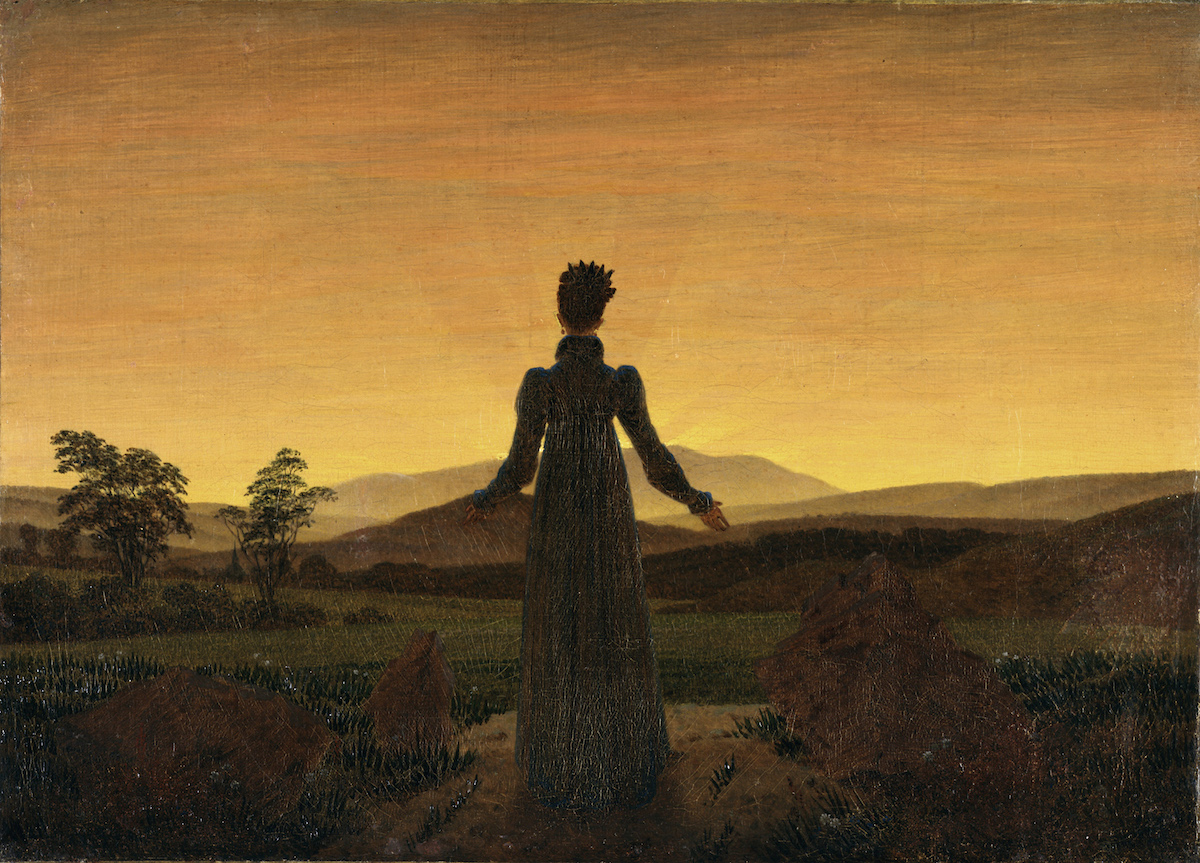
Three 19th century paintings of Rückenfiguren or “back figures” by Caspar David Friedrich. [via The Public Domain Review, https://publicdomainreview.org/collection/ruckenfigur/]