I have yet to open it
because the day it was inserted
in my mailbox I was reading
something else I’m still not at the end of.
Carl Jung’s Man and His Symbols lies
beneath a lamp not twenty inches
from my head when I’m in bed.

I dream a lot about interiors of buildings,
structures, probably because I feel confined,
financially, romantically—I could go on—
or, when the dream’s about exteriors,
it’s probably because I feel excluded
from the mysteries inside.

Anyway, in real life, I could not care less
about buildings, structures, but a big one
played a prominent role in what I think
was the leadoff dream last night.
I woke and blinked up at the darkness.
Then I told myself, Start dreaming
of the woods, of plants and animals
who will confirm what you suspect already
to be true, and I fell back to sleep
immediately, which never happens.

This time I was on a ladder so high
that the laws that govern when a ladder
will or won’t collapse did not apply, so high
that the features down below were so unreal
that in the dream I couldn’t reconcile
how they didn’t seem like features I could fall to
with the fear I felt of falling.

The dream didn’t help. I’m still upset
about two mourning doves I saw two days ago:
one whose head was devastated by a car
most likely and the other huddled,
bowing over the body of the dead one
on the margin of the road in an embrace
that made me so sad I pulled over
and approached to see if there was anything
that I could do. The live dove stepped away
three body lengths, or four.
A car rolled through the stop sign,
passed behind me, and I wondered at that lightly
trafficked three-way intersection
about coincidence, indifference, whether
my compassion interrupted a communion
my departure wouldn’t be enough
to let the mourning dove return to and conclude.
Twelve years ago no porch was here,
no porch beam made of sistered
two-by-sixes painted forest green,
though the surrounding forest
by and large is of a lighter hue.

In May, when people forty years my junior
asked what I’ll be up to for the summer,
I replied that I’ll retire to my camp,
which has no running water,
no connection to the grid.
They asked what I will do there,
and I told them I’ll take care of business.
But will I hunt or fish or navigate
an off-road vehicle at reckless speed
through woods inhabited diversely?
I repeated, I’ll take care of business.
That is all they know on earth,
and all they need to know.

Now that I’m here I’ll tell you
that this late in June I wrestle
with the ethics of intrusion.
For the first two days I’m here,
the phoebe nesting on the porch beam
acts as though we’ve never met
or, worse, as though last year I weaponized
the frazzled broom and sent her offspring flying.

Sometimes in my head a voice assures me
there would be no beam to nest on,
no rafter for the nest to nestle
flush against, no roof to thwart the rainfall
if it hadn’t been for me.

A prop plane flies low overhead,
and in the distance someone’s doing
something unrelenting with a tractor.

When the porch door opens and I step outside
to wash a spoon and get a beer,
the phoebe watches, peering, listening,
her brood beneath her, and I step
as lightly as I can on this,
the third day, no presumptuous
approaches, no disturbing movements,
and it’s like she has remembered
that at least I am no bluejay.
I hesitate to castigate the bluejay.
I myself have eaten many eggs.
The fatherly advice that Atticus imparted
to his children sounded sound
at first: don’t kill a mockingbird
with those two firearms I gave you
since a mockingbird’s exclusive purpose
is to fill the world with sonic beauty.

Then, however, he declares that they can shoot
as many bluejays as they want
as though the bluejay’s not a songbird, too,
as though the bluejay’s not a bird
who has to make a living in the world
according to the inborn skill set,
as though Jem and Scout won’t graduate
to other troublesome birds
as they pursue his line of reasoning
to its inevitable conclusion, trailed
as they will be by dead crows, goshawks,
grackles, blackbirds, eagles even,
a cascade of avian corpses all
because a narrow standard of utility and beauty
was articulated by a lawyer otherwise
preoccupied with saving someone’s life.
All those people swept away last night
in a Texas flood, and here am I at fifty-seven,
crouching in the gravel driveway, picking up
a yellow slug whom I relocate to the grass
before my wife backs down and drives to work.

My father died at sixty-one, a good run
had he died a hundred years ago.
When I tell people I have four years left,
they think I’m joking and remind me
of my general fitness and my steady habits
as if I were fishing for assurances.

Some part of me is probably performing
what it thinks is counter to a jinx.

I saw the branches of a tree once
in a drop of water, a portrayal,
Jung says, of the world’s beginning.

Once upon a time, I saw my neighbor,
once a warrior in World War II,
swat down with his bare hands an airborne
June bug larger than the average split log,
and I still don’t know if there’s an archetype
that explicates what I still think I saw.

He died at eighty-seven with a cigarette
in one hand and a brandy in the other.
When the topic of demises comes up,
I’m inclined to seriously declare
that is the way I’d like to go,
but I can’t know that prior to the going.

Once upon a time, my father said
if he could do the whole thing over
he’d forego the chemotherapy and radiation,
let the forces take their course,
but even so close to the end I don’t think
there was any way he could have known.

I saved a friendly German shepherd yesterday
from maybe dying in the road,
but that was yesterday. There is another
slug I’d like to get to and another
probably because this dream I have
of saving everybody in the force field
of my savior powers never ends.
John Popielaski is the author of the poetry collection That Special Something (Sheila-Na-Gig Editions) as well as the novel Attuning (Broken Tribe Press). His poems have recently appeared in such journals as Canary, Common Ground Review, and Gramercy Review.
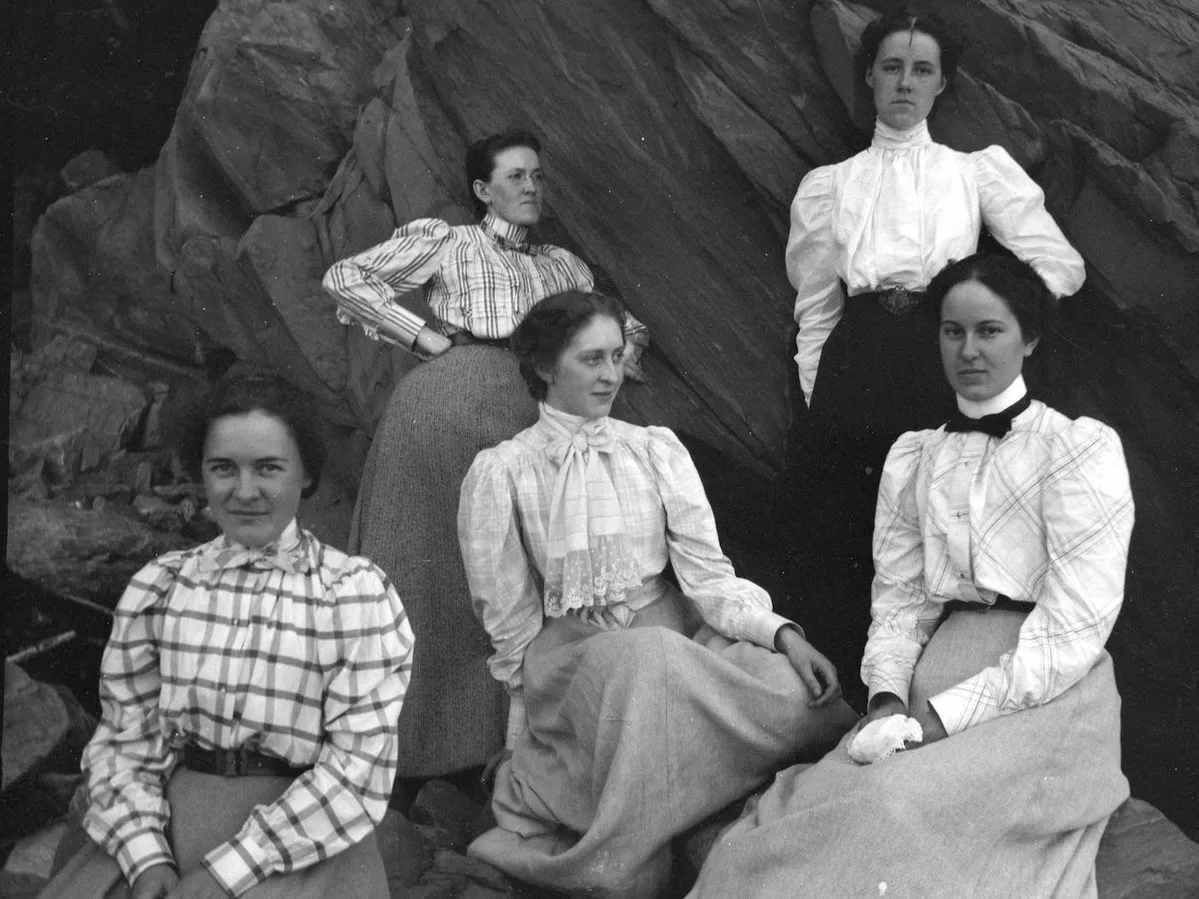
Photographing the harbor and hills of Camden, Maine, at the turn of the twentieth century, Theresa Babb (1868–1948) recorded both the intimacies of social life and her hometown’s industrial and seafaring traditions. What stands out most about Babb’s images is how they let us glimpse into a personal world of female friendship, captured in such a way that seems both timeless and strikingly modern. From Public Domain Review.