Pomegranate seeds, red little fish eyes,
as startling as menarche.

And a thin shadow cast by a porcelain
bowl in morning light.

Ancient, the theme of outcast. A woman
made to stay each month

in a hut with a small fire, the company
of her own blood.

Exiled, she spends seven days—or years—
plotting travel elsewhere,

what she will demand from the next man
or woman who says,

in pressing their mouth to hers, here is a bed,
a table with fruit, a day-moon

in the window: a tableau where we can make
or brave our daily love.
We didn't belong—living
in the one ramshackle
house with bamboo shoots
and briar thickets in the yard,
squirrel warrens in the eaves,
the front doorknob poking
out like an unsocketed eye

in an otherwise pristine
neighborhood of measured
lawns and privacy hedges,
the height of a grown man's
forehead. Birdbaths, mums,
and modest variations on
the Victorian and Colonial.

We slid down the rickety
banister like songsters
in a Broadway musical,
knowing the simple fact
of our six selves tumbling
from a maroon plumbing
van must have seemed,

to neighbors, indulgent:
a failure of sobriety,
family planning, or
Keynesian principle.
We were girls, we were
scandal. So when a bird
beak pecked its staccato

punctum through the
soft horsehair plaster
and pink fringed paisley
of our bedroom wall,
we stared, bridled
fright, and calculated
its dim arrival, draping

the mirror and sash in
a bedsheet and towel.
Prying wide the rusted
metal mouth of a storm
window to rumor and
winter air as we waited
for the bloodied head

to crown the hole of
its own hammering.
And with the forceful
plea of its throbbing
body, wrest its dust
coated wings from
wall. And swoop,

in parenthesis of
our stunned silence,
toward the clear cold
of night sky. Old house,
harbor and weir, field
and its dark harrow—
we were the thin

nestlings who waited
and fed until we sensed
danger's hour, the stern
prick of horror, and
with a steadied eye
on each other, warred
for our release.

the mirror and sash in
a bedsheet and towel.
Prying wide the rusted
metal mouth of a storm
window to rumor and
winter air as we waited
for the bloodied head

to crown the hole of
its own hammering.
And with the forceful
plea of its throbbing
body, wrest its dust
coated wings from
wall. And swoop,

in parenthesis of
our stunned silence,
toward the clear cold
of night sky. Old house,
harbor and weir, field
and its dark harrow—
we were the thin

nestlings who waited
and fed until we sensed
danger's hour, the stern
prick of horror, and
with a steadied eye
on each other, warred
for our release.
Riding home with the windows down, I know what I’m missing.
The picnic and wine moms’ chardonnay. Micro-brews and frisbee.
Or a grill of charred meat, chilled rosé. A sweet little kid sneaking
a brownie as big as her head. We offer one last salute to summer
before the hurried business that is September: school, slowly
narrowed to the end run of commerce.

And like a cartoon or cosmic joke, I’m the feminist professor stuck
behind a truck named for a mythic woman warrior—or the world’s
largest river. This ‘optimized delivery service’ threads subdued
streets with the stealthy ease of a hearse, making its almost silent
doorstop annunciations. At least I’m not late for a barbecue,
where I’d calculate the potato salad’s bacterial load

and wonder if my sleeves’ toxic spray might hold blood-hungry bugs
at bay. So goes the romance of nature, which does not care for anyone
in its rude force. What we try to weed and bed, fence off and fertilize.
What I sensed was sad charade, watching my father aerate the tired
lawn with soccer cleats and pitchfork. As a kid, at ritual
gatherings, I’d slip off when the cousins got peevish

and listen to adults posture about politics. These days, it is still more
work than leisure to eat a neighbor’s hamburger and chat about safaris
or market rallies. Seven stages of kitchen renovation. Junior’s ukulele.
I think of the women in my family, preparing each feast, working
the second shift, wearing seasonal cheer. On their collective
behalf, I drive straight home—where I won’t count

napkin rings or iron a tablecloth, salve an insult or spare the sauce.
I know it’s of no general concern whether I spent the summer
writing (and unwriting) a book and hoping my lover isn’t audible
over the air conditioner that rattles, bleats, sweats, and purrs,
undeterred. I have no daughter, no son, some might say
no sum to show for my days’ math.

How I’ve sought to add or, just as carefully, subtract. There is license
in a life that appears less, its deepest cares never turned to work,
with a lover who is not my c0-investor or delivery service. So I wave,
to be friendly, at the block party rave and seek out my beloved
who sits reading at dusk, awaiting the company of my lust,
patient as a myth or river, ambling south.
Heather Treseler is the author of the forthcoming book Auguries & Divinations (Bauhan, 2024), which received the May Sarton New Hampshire Prize. Her collection Parturition received the Munster Literature Centre of Ireland’s international chapbook prize. Her poems appear in Kenyon Review, Harvard Review, The Iowa Review, Narrative, JAMA, and The American Scholar and have received the W. B. Yeats Prize (2021) and the Missouri Review’s Editors’ Prize (2019). Her essays appear in LARB, PN Review, Boston Review, and in eight books about poetry. She is professor of English at Worcester State University and a resident scholar at the Brandeis Women’s Studies Research Center.
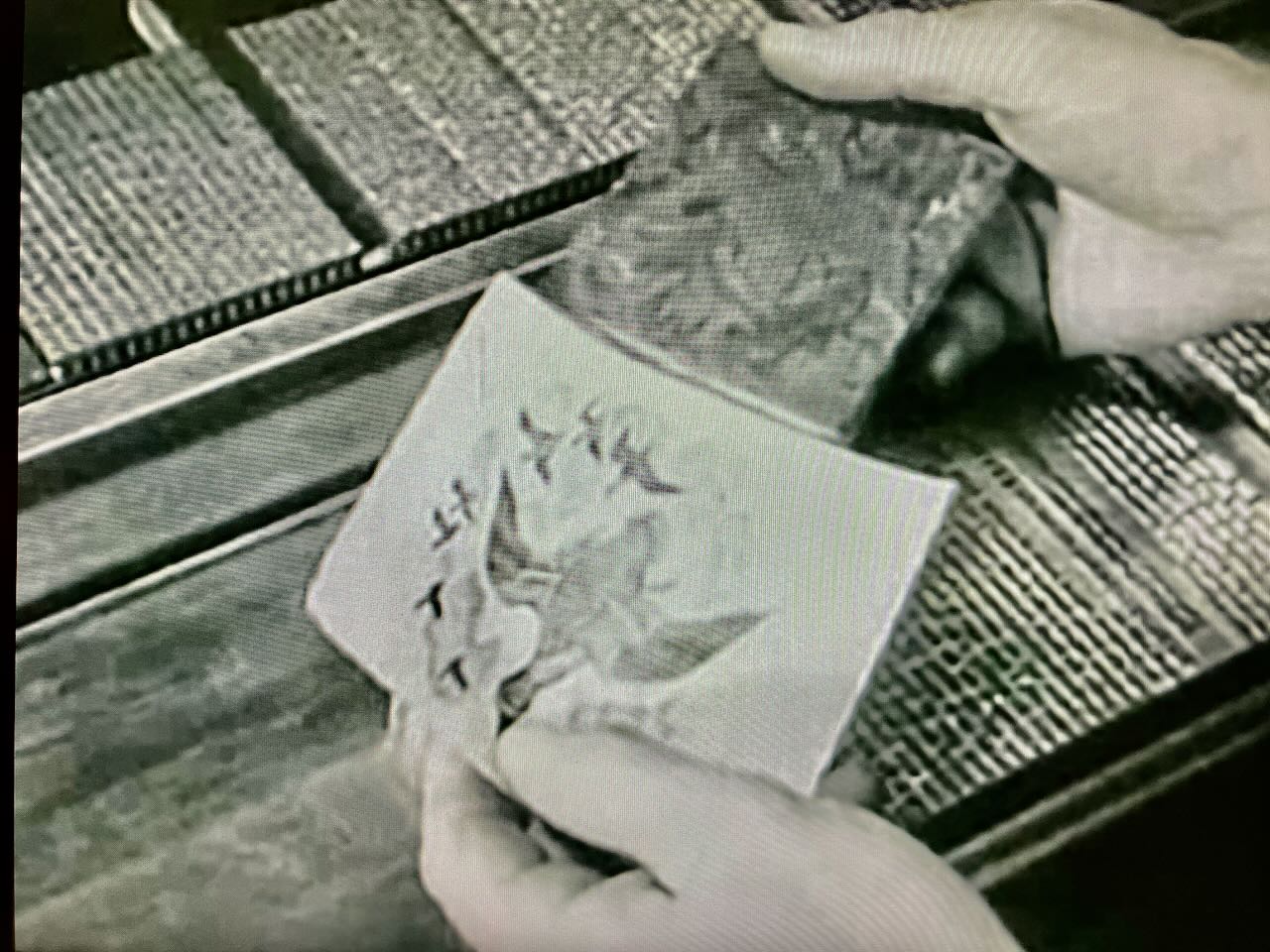
The Making of Books (stills)
by Encyclopaedia Britannica Films 1947