Every day I see a big black beetle carcass on the floor, and every day I realize it is just some string or lint or clump of fabric, and every day I’m relieved and I step over it, and every day I think about picking it up, and every day there will be the next day where I see a big black beetle carcass on the floor.
When I tell Alice this at lunch, she says, Grab gloves and get on with it! It’s not that simple, clearly. Alice is stupid. Sometimes I really wish she wasn’t, but for the most part I’m okay with how she can ask the world for no olives on her salad and talk about the game. You know, the one that’s on—always on.
When Alice smiles sweetly, like she’s solved all my problems, I take a bite of my black bean burger and tell her I’ll move the string tonight. She changes the subject to a Boys Night Out T-shirt her brother handed down to her, a shirt she’s going to cut up in seven different ways.
I get home. I head to bed. I walk past the beetle-string, and this time the rush of fear-joy makes me pause. I wonder how I ever lived without it. Little permanent secrets in the form of a gloppy string pointing fourteen different ways. Alice’s delicate pink tongue pressed between her front teeth when she smiles.
I have this thing, you see, where once something is in my house, it doesn’t leave. My mom’s ex had this rule about dogs, too, and everyone thought it was admirable because no matter how badly behaved the dog was, he refused to abandon it. No one ever said, hey, that could be dangerous. That dog has teeth. Its teeth are in its name.
The carcass-not-carcass, co-inhibitor, permanent fixture in my hallway—I told someone about it, and got told to handle it, throw the body away with a layer of rubber and talc between me and it. Instead, it’d be so easy to put it inside that jar of stuffed olives Alice left on my counter when she found out she didn’t like olives—a fiasco involving her thinking the green, bulging kind were correct for topping homemade pizza. They weren’t. I tried toothpicking them raw but Alice didn’t like them that way either. That jar still sits in my fridge, top shelf, left side. My food collection grows and wanes around this permanent fixture every week. That’s who I am. A beetle-string. An invisible olive jar.
If Alice knew anything, she’d know that. But she’s not concerned with who I am. Hell, she’s not even concerned with who she is. She’d have ripped the teeth out of that dog so fast, no name would ever fit the mutt again.
Yesterday I thought about why, but that went the wrong way quick. So, I am trying the opposite of thinking today. I’m playing a game—okay, so it’s Wii bowling. But when my mom’s ex calls, I pick up. He’s in my house still, you know. Even his old piano book is sitting next to the disconnected landline, and I certainly don’t have a piano. But I pick up the phone and say hi. There will never be a moment in one of his cycles of “caring” where I mention the book, the invisible olive, the beetle-string. He’s doing most of the talking. I’m the reason he left mom, when you think about it. I’m the reason there’s leaving—a lot, actually, when I dare to think about it.
The ex drones on. I swear I see the string slither. I swear I smell Alice’s hair—tea-tree leave-in conditioner and lemon juice. Slathered. He wants cash. Of course, he wants cash. You saw that coming, right? That is what they always want, and this is a typical story in the end, really, I promise.
I don’t give it to him. I turn off my phone. I watch the string squirm. I think I see it leaking vinegar. I think.
M. M. Porter is the poetry editor for storySouth and New Ohio Review. She is currently attending Ohio University to pursue her PhD in English with an emphasis in Poetry. She is a graduate of the MFA poetry program at the University of North Carolina, Greensboro. She has been published in Epiphany, The Shore, and others and has been nominated for a Pushcart Prize. You can find her work at mm-porter.com.
Amanda Ellard is a teacher, writer, editor, folklorist, and artist currently working toward her PhD and teaching writing and literature at Ohio University. She’s the Prose Editor for Quarter After Eight literary journal and a Guest Editor for The Masters Review. She achieved an MA in Folklore Studies and an MFA in Creative Writing. Her work (anellard.wordpress.com) has been published on ebook platforms, across literary journals, and in the Smithsonian Center for Folklife and Cultural Heritage’s Folklife Magazine.
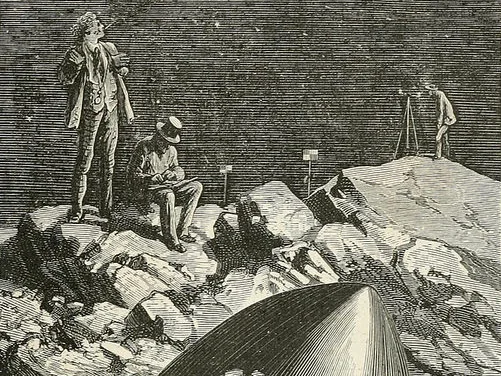
Readers of Jules Verne’s early science-fiction classic From the Earth to the Moon (1870) — which left the Baltimore Gun Club’s bullet-shaped projectile, along with its three passengers and dog, hurtling through space — had to wait a whole five years before learning the fate of its heroes. Not only were they rewarded for their patience by a fine continuation of the space adventure (which we won’t spoil by describing here), but also with the addition of a superb series of wood engravings to illustrate the tale. The set of images — arguably the very first to depict space travel on a scientific basis — were the work of the French illustrator Émile-Antoine Bayard. From the Public Domain Image Archive. See more at https://publicdomainreview.org/collection/emile-antoine-bayard-s-illustrations-for-around-the-moon-by-jules-verne-1870/