rue du fouarre
rue de l’abbé de l’épée
avenue de l’observatoire
rue cujas
rue barbet de jouy
So this is creative non-fiction. Non-fiction means no fiction: nothing has been made up. This suggests what follows is an objective truth. But is there such a thing? This is where the word creative comes in, slipping underneath everything, allowing for playing with the facts. Since I like playing with facts (facts, illusions, whatever; after all I am a fiction writer) I feel permitted to indulge in a few days of nostalgia, when I knew a certain Luzia—her real name of course, a matter of fact. It was late summer 2019. The places, talks, even the touching of arms, are as accurate as can be without consulting notebooks, of which there are none—I say no notebooks, but the above list of places I have still. If I lift the back leaf of my Cartes Taride, and look under the maps that are glued there, there they are, as I wrote them.
I was thinking about a set of streets, a kind of route about the city, and here we are: a café, a gift shop, a doorway: so compact, the rue du fouarre is easily overlooked.
We try the café with its fake-shabby blue paintwork, a table at the window, deux crèmes. I show Luzia my ancient little book of street maps, the blood-red Cartes Taride, and explain this itinerary I’ve devised. Got it, she says. Got what? Well the addresses, where they are. As she returns the cups to the counter, I catch sight of something else. Luzia has it.
The anatomical snuffbox, also known as the tabatière anatomique, is a triangular depression found on the radial side of the wrist, best seen when the thumb is splayed, away from the hand. The name comes from the use of this declivity for placing and then sniffing powdered tobacco. If pronounced as a feature, it suggests nimbleness and sensitivity. Expect intelligence, a fine touch. There is no truer measure of a person’s beauty.
The rue du fouarre is a stub of a street, and yet, Luzia reads off her phone, it was once “the most illustrious street in Paris” (The Interdiction, Balzac). We stand before number 6. Illustrious? What to do with this information? Bus horns blare. We try the vague mutual encouragement of a smile. We are new to each other. Like most smiles between us so far it comes with a flicker, a trembling moment. The place it occupies is puzzling, between joyful and vacant. I catch sight again of her wrist, yes Luzia has it.
Number 6 still houses language classes, forty years after my young self first entered those double doors. Then, then, I had pale boyish cheeks and dark hair falling easily, but I keep that to myself, the cheeks and hair, as I do the scarf that belonged to the time, the cheap wrist-ware, a bracelet. On the metro I was enraptured by Colette, missing stops in thrall to her Claudine novels. I was so young then.
Luzia is studying the inscriptions on the walls, the date of construction, 1815. Others would fail to look, distracted by Notre Dame, so close by (Luzia seems very Notre Dame, high-aiming, I suspect she has a gothic soul), while still others might be diverted by the little park that leads to Shakespeare and Company (a very Hemingway bookshop, it’s said, but Hemingway never entered those premises, with their room for no more than cigarette smoke, no bullfights there, no drunken brawls). Equally she could be distracted by some passing sound, by the hydraulics of the 47 bus, en route to Chatelet, but she’s not. She stands nimbly, focused, waiting.
I tell her what I remember of the place, the improbable golden plaits of the teacher piled on her head, roped around in circles, like the princess in Star Wars. I have memories of the thick yellow textbook, where paragraphs by Rabelais appeared, as if the words had come up through the earth, re-emerged after centuries. I remember other faint images, of the old flooring, the ceiling rose, of student friends, the speech laboratory. For the English speaker the onne of personne is difficult to hear, difficult to pronounce. Bonne, Sorbonne. How do you say it, Luzia? Instead of speaking, Luzia makes it come up on her phone. Personne.
A few streets from her hotel, we were yesterday in the avenue Parmentier, in the tenth district. Over wine and in a low light that blotted out the fine lines of expressions—that turned faint the pencilled figures on the bill—Luzia confessed she was prone to making the wrong choices, going for the wrong man. This was new territory in our young relationship. Downing full, fast glasses of wine, she confessed good looks and smart talking had so far seduced her when she should have hesitated, first gone further, deeper. I wanted to say there was not only making the choice for the wrong person, there was not choosing the right person. I held back saying this, of course. What help would it be. Luzia held out her glass, as if to make a toast. I’ve never been in love, she added.
The rue du fouarre was actually written about by Rabelais himself, by Dante, so Luzia reads from her phone. This is too much to follow up, our time together could so easily submerge under endless tales. And yet—looking up at the cheery faces of young people sitting casually at the open windows—I tell her a tale about the teacher, who was an actress too, a film starlet at the weekends. Her director boyfriend broke her nose (he may have been avant-garde in film-making, but was old-school in violence). His angry fist, her defiant stance, what had they said, was it some jealousy? Was it the film, the directing, the performance? Immediately the teacher held her lessons at the rue du fouarre as usual. The director was likely conferring with Godard or Truffaut, leaving the teacher with broad white bandages that crisscrossed her face, like a coat of arms, a religious statement.
Over the next carafe Luzia said she there was so much sand in her childhood. She knew Cairo. Alexandria. What else? she asked herself. Last year she had swum between two islands. I drank, she drank, I listened. She had been inside the White House. This was all admirable but … we were stumbling. I dared to delve. I was fishing. What might this mean for the man you … might be looking for … can you enlighten? Oh yes of course I can enlighten. Well? Well? I suppose … Suppose? I suppose it would work best, maybe, if he had big ideas, thought and acted big. Was big. We moved to smiling in the candlelight. Notre Dame, I thought—huge, reaching skywards, the gothic soul. Relations will work, may work, as long as I can build a Notre Dame.
I tell Luzia this illustrious street is a good starting point for this tour, to the places I had access to forty years before, keys in my pocket and codes on slips of paper. Kindly lent, these fine apartments were where I wrote several pieces—ah, already more stories. Or were they stories? Wisdom says real lives haven’t the shape of stories. Perhaps there are no stories, only endless details. Stand in one spot and out they come: the teacher, the nose, a swathe of films from the nouvelle vague, Shakespeare and Company and not just Hemingway but, if my memory serves me, the original bookshop premises in the rue de l’Odeon. Out comes Notre Dame, the rose windows in plain sight of the rue du fouarre, the laboratory with the fellow students and their own stories, the world as they know it—Steve, Yildiz, Kazuko Takemi, Dorris from Quebec, or was it Maureen, in those days Victor the draft dodger, after the classes we would go up the hill to drink milky coffees at a café on the rue Monge, all except Hans who was from Gothenburg and preferred to go back and take another shower, Hans who had us all pronouncing Gothenburg, Yerterborg, all badly. Any one of us would step forward, any time, catch our attention with tales of an accident, slings that slipped around a piano, a scream at midday, on it could go, a foghorn on the Scheldt, a blue swimming pool, Juliette Binoche. So many stories. Take a little squib of a street like the rue du fouarre: how they rush in.
I sketch the tour on the Cartes Taride with a finger. I say the house numbers, Luzia says the numbers of the arrondisements. Cinquième, quatorzième, septième.
20 rue de l’abbé de l’épée (V)
30 avenue de l’observatoire (XIV)
2 rue Cujas (V)
24 rue Barbet de Jouy (VII)
The last address is where I’m staying tonight, the same place after all the years. The tour itself began by heading for the nearest apartment I’d been lent, decades before. The rue de l’abbé de l’épée. The poet Rainer Maria Rilke had lived in this street, said Luzia, as had the photographer Helmut Newton. They’ve left no trace, I said. Luzia immediately: and you? No, nor I. Luzia thinks it important to leave a trace, make an impact, so she said on the way to her hotel, looking straight ahead, in the night light by the Seine, beside that black and restless water.
Paris. In Paris I dreamed of Paris. The debris of food and bread and red wine spots on paper tablecloths. The flower market. Rue Mouffetard. Colette. Walking up the stone paths of Père Lachaise, leaves blowing. The Tuileries. The métro flying over Mirabeau, welcome smells of boulangeries. Enchanted by delightful Brigitte in the Bois de Boulogne. Manet. Up a side street a great tricolour being waved. Coq au vin.
After the Saint-Jacques church we turn into the rue de l’abbé de l’épée, unchanged over time, its slow curve dropping to the boulevard St Michel. At a dark expansive desk on the first floor, in a week I wrote Loving, Mardi gras, Shirelles. I flashed them down, I don’t know what got into me. A story of love and trepidation, Loving was set mainly on a plane flying to Caracas. Luzia has a query, but immediately a phone message interrupts. As she holds her phone by her cheek, the sight of that hollow, that dimple of the wrist throws me. Will she want me tonight, tomorrow, I’m guessing, I’m doubting. Mardi gras? she says. Mardi gras happened here in Paris, in the Luxembourg gardens. A sort of student drama, chalk and flour everywhere, paint and coloured streamers shooting out of toy guns with a bang. In Shirelles a woman danced alone to Will You Love Me Tomorrow.
In the rue Parmentier and visibly drunk, even in the dim light, she went on about the desert. The sand and its steel reflections. The desert makes gestures of eternity, she said. We were at the final spoonfuls of crème caramel. It was reputed the young Ho Chi Minh had done the washing up at this restaurant. We tried to mine the fact but soon were stuttering. Where was this going?
In a few steps from the l’abbé de l’épée with its tales of loving and dancing, we come to the avenue de l’observatoire, its massive buildings. On this avenue Francois Mitterand feigned having been the subject of an assassination attempt, a famous case. Yet another story, it will be left at the wayside. Otherwise, the avenue de l’observatoire meant a clanking Parisian lift with concertina scissor doors, and stairs that echoed. The panelled apartment doors were grand. The table to write at was at the end of a long thin corridor, the floor throughout a checkerboard of tiles, black and white and laid diagonally. We have to imagine these details because we can’t see them, we haven’t the code for entry. It’s like this at each step of the tour. I recall the features to Luzia as we stand outside. Here? she says. Up there, I point, I wrote a piece called The most serene republic.
The most serene republic was about two love affairs, two couples. Venice? says Luzia, you? Oh no, all made up. Four very different people, I couldn’t be them all. But real? she asks. I suppose so, I say, real. She kisses me, a shock. So. We move on, down the boulevard St Michel to the rue Cujas. It’s Luzia telling me now—the itinerary, the house numbers and the arrondisements. I told you, she says, I remember stuff. Remember what? I say. Oh phone numbers, card numbers, birthdays. She skips in the street, she’s done this a few times. Remembering numbers, that’s really something, I say automatically. I’m no longer thinking, I’m admitting to myself I could be falling in love, I’m in love with the shapes at her wrists. I tell her about the apartment in the rue Cujas, with its African plants, the big painting of a cow, the views from the second floor, but I stop, as again I catch sight of her tabatière, so beautiful.
With her I share a memory I have of the library opposite, the green desk lights glowing in the night. Here I wrote the piece Freewheeling. Freewheeling was full of tenderness and desire. This is how I would like Luzia.
Where then is the story, what is the story? Shakespeare (and company), Hemingway, Rabelais, Dante, Balzac, Godard, Truffaut, Venice, Cairo, Hans, Yildiz, Steve, Kazuko Takemi, Dorris from Quebec, or was it Maureen, Victor, Cujas, the Shirelles, Mitterand. Gothenburg, pronounced Yerterborg. I suppose that could be the real story, told in great long volumes, but was that even possible?
I suggest to Luzia we go to the rue Barbet de Jouy, to the tiny room I have use of. It’s a trek to get there, I add, but not exactly the Sahara. We pass the hotel Gabriel García Márquez lived in. From the crest of the rue Jacob, in the vista that sweeps down to the Seine and up the far bank, we glimpse the white of Sacre Coeur in a haze. I should have a plan, but Barbet de Jouy isn’t a plan, it’s more a suggestion. I’ll see how it is as we climb the stairs. I picture the single bed, the curtain across the sink, the skylight. But I needn’t describe the place this time, I tell Luzia, we can see for ourselves, it’s where I’m staying. It was once the quarters of a maid, a chambre de bonne, I say struggling at the pronunciation. You mean bonne, she says, I think you mean bonne.
Luzia clearly had the more musical ear. She has since married and lives in Chelsea in London. I visited just the once, early one morning. As to the facts in my record of our time in Paris, I’ve yet to consult her.
John Saul is the author of the collections of short fiction Call It Tender, The Most Serene Republic, and As Rivers Flow, as well as the novels Heron and Quin and Seventeen. With stories appearing in publications throughout the UK and internationally, he has had work in Dalkey Archive’s Best European Fiction 2018 anthology and Best British Short Stories 2016. He lives in west London.
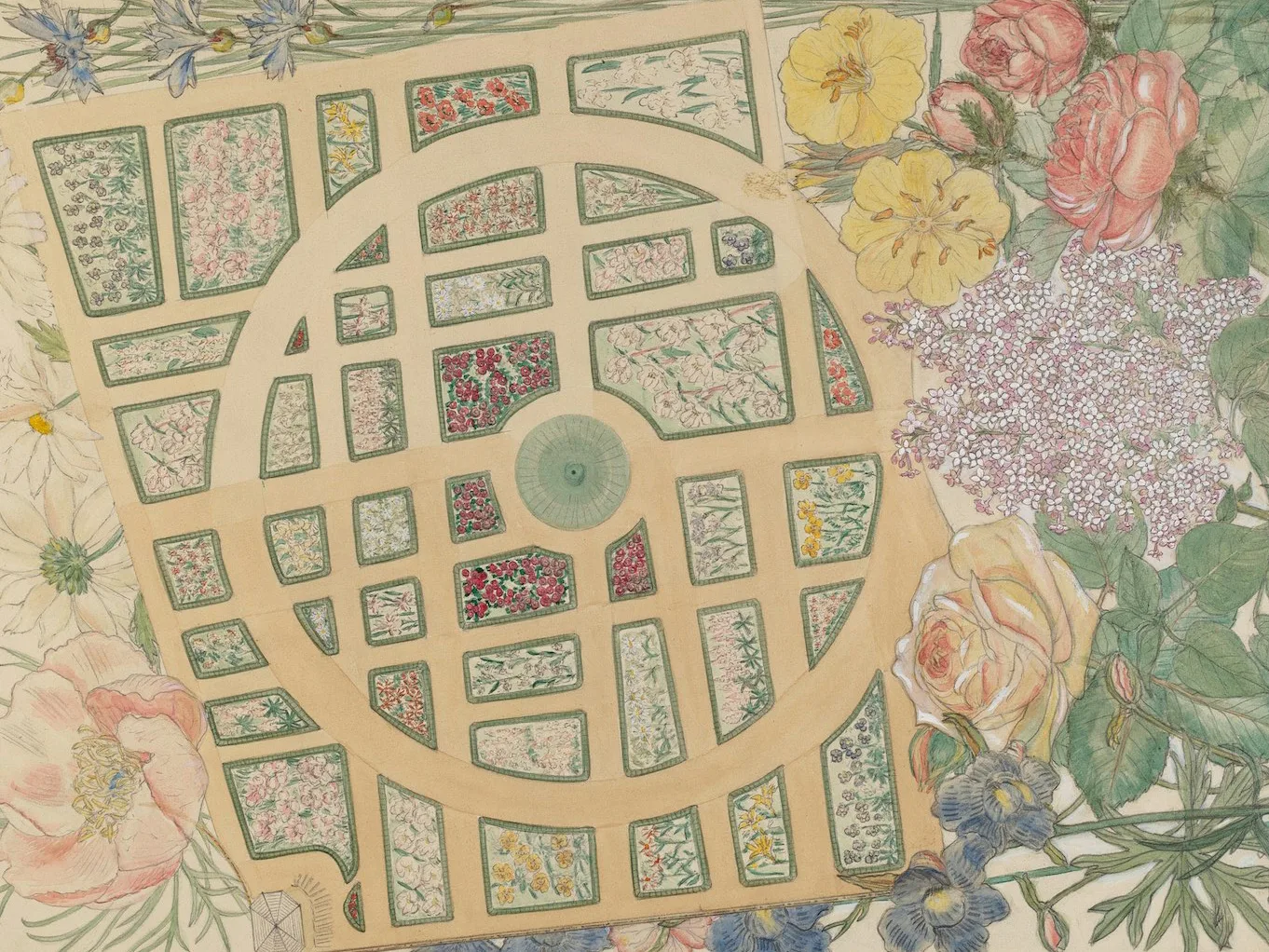
Madame Jumel’s Garden, c. 1936. Drawings included in the Index of American Design, 1946. [Via Public Domain Review and the National Gallery of Art.]