Two words for horror: light, and lighter-than-light. I can’t imagine other emotions. Someone once threw a book on the floor and ran after me and said, “Lighter than light is absence.” Red splotches bloomed on his face. He was screaming.
I ran down the porch stairs, shading my brow and not rubbing the rail. “Not absence!” I said.
I’ve heard stories about people trapped in relationships.
Trapped?
Those people are mostly grateful at first. Then the scurrying. Sounds like tapping or scratching inside a beam. “Did you hear that?”
“Here?”
Not, I heard something. More like, I heard voices.
This is what happened to my Tommy. He began with black. He traced every definition until he came to the description for white. There were hundreds in between.
“Hundreds,” he said, gripping my elbow exactly where a ligament came out of a little hole in my bone.
A few spoons of cold rice. A mist of Tabasco. I sit on the floor hunched over my snack. I use three fingers to make a ladle. A mole frantically hustles across the tiles but he is hardly moving. No traction. Now Tommy again: “Put on some clothes. Come to bed.”
Traction?
Blue and white checkered shorts, a blue and white checkered shirt. He is in bed with a glass of water. Inside the glass, a single cut flower. A black-eyed Susan, the kind with a dark hairy cone immersed in yellow. He spins it slowly with his crooked finger.
“And what do you call that little number?”
“My sleeping costume.”
“Open sesame,” he says.
Something light carries me at the beach, smoking under an umbrella, while the naked porpoise I travel with breaches and dives and clicks and whistles.
Absence?
“I got a flounder,” Tommy says. Its eyes are on one side of its body.
We both sort of know I am somehow expected to cook it. That I would have to touch it and clean it while it blinked. That I would roll it in flour and shake it by the fluke. That I would spit into the hot oil to sweeten it.
“I thought you wanted to go to a nude beach,” Tommy says.
“No.”
“And be innocent. Be children,” he says. He scratches his fork at the fish. Will not look at me and then won’t look anywhere except at me and then would look away.
“I saved the scales,” I say. “In case you wanted them.”
I prefer plates with triangles inside them so different food doesn’t have to touch. Roads with ramps rather than intersections. Tommy likes the news at seven, followed by a little weather and maybe a nice baseball catch. “Go Orioles,” he says. Outside the stadium there is a factory that makes sugar. A big orange light flashes Domino.
I don’t mind being deaf on the right side of my head. I lean down and forward to talk to someone. It bothers Tommy to watch me bend like that.
“For you,” he says.
The ear trumpet hangs from a leather cord around my neck. When I close my eyes I hear some conversation in my right ear, the way language might sound if it consisted of bird calls.
“At no time have I ever known anyone named Marius,” I pretend.
“Marry us?” Tommy says.
Oh Tommy, no, don’t say that.
The news anchor is beside himself with five dollar words: atrocious, true evil.
Marius lives in South Carolina on the second level of a house divided into five apartments. There are bullet holes in the floor. The man downstairs arrives home and 60-watt bars of light stab the upstairs space from below. Mister sometimes covers Mozart on a steely guitar. Marius rocks softly into a dream of heading north, or further west.
“Police helicopters are searching the Savannah River Site,” the anchor says. The newsman wears glasses so people watching won’t notice his hair, a 3.5 tapered to 2.5 around the ears and scissored up top.
I hear the tenor of all the possibilities of color and colorless. Light and lighter-than-light. The music has a glowing, velvety feel. An impenetrable brilliance. Domino.
There is a car. It makes a grinding noise now and then, and to make it seem as if nothing were wrong Marius turns up the radio or opens windows. So great, that hitting wind. Coming to a bridge Marius parks and walks to the stream. Sees a heron. It’s flying around and three crows go after it, spoiling its glide.
“Marius,” Tommy says. He drums his hand on the bed. “I need you.”
Need is just living through old sadness. Want is different. “Do you want me?” I say.
My secret light and my lighter-than-light I put in purse pockets with the blue stones of not knowing anything. At the coffee place I put a xeroxed photo of myself covered in flounder scales on the community board. Under my face, it says “Missing.”
There are a few kids and a lot of single people and everyone is eating or drinking something with sugar in it. Turning, I drill down to pay a barista for my hot milk. She has dark eyes and charcoal lips. I put a rock on the counter, shaking my head, sorry. I haven’t got anything smaller than my never having enough words to describe my sins.
She breaks the rock to make change and hands back a few smaller stones and some sea glass.
“Merci,” I say.
Barrett Warner is the author of Why Is It So Hard to Kill You? (Somondoco, 2016) and My Friend Ken Harvey (Publishing Genius, 2014). His fiction has appeared in Phoebe, Gargoyle, Oxford Magazine, Quarter after Eight, Berkeley Fiction Review, Crescent Review and other places. Find out less about him at https://barrettwarner.com/
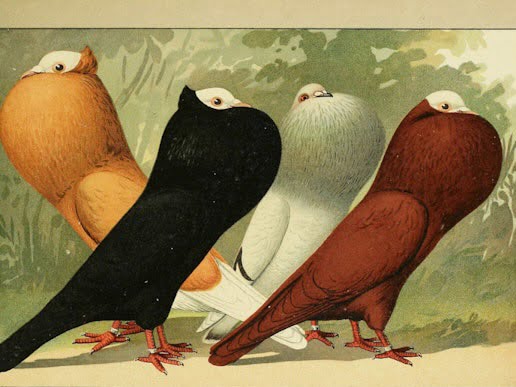
Images from Edward Bliss Foote’s Plain Home Talk About the Human System—the Habits of Men and Women—the Cause and Prevention of Disease—Our Sexual Relations and Social Natures (New York: Murray Hill, 1896. (via Public Domain Review)