Suborna and I lived in the same apartment complex, on Braes Bayou. We were both newly married, with new, milk-scented babies – mine was a year old when I saw Suborna first, and hers was a screaming infant. My husband and I had heard that another Bangladeshi family had moved in, and we went to see them, holding our daughter between us. Suborna opened the door, dressed in a loose, shapeless maxi that fell to her ankles. She was very pretty in a soft and fluffy way–round face, plump cheeks, pointed chin, and very bright eyes.
As soon as I laid eyes on her, I realized that this was not the first time I was seeing her! I had seen her once before, from a distance. That is, I had seen her, but she had not seen me. She had been standing tall beside her long, stooped husband in front of their Toyota sedan, under the apartment’s covered parking. Both of them were dressed professionally, in Western clothes, going off to work, he in a buttoned white shirt and loose dress pants over polished, pointed shoes and she looking prim in a long skirt and ruffled blouse, a large, yellow handbag hanging from her elbow. Her belly had been full and round and protruding and obviously pregnant. I guessed she had had the baby since then, because there it was, crawling on the living room carpet and screaming its head off. We tried to have a conversation over the baby’s howls.
“What do you do, Apa?” she asked me.
I told her that I was a graduate student in Physics, and my husband, who had graduated already, had a job with an IT company.
Suborna’s husband was an engineer, and Suborna was a doctor, like the two other Bangladeshi women living in our apartment complex. The other Bangladeshi were actually housewives now, keeping home while their husbands studied for their licenses to practice medicine in America. One of them, hard and skinny Naila Apa, came to our apartment on a balmy evening with no breeze, sat on our faded, secondhand couch, and wailed that she dreamed of her patients in Bangladesh. The other was always frantically reading her old textbooks when I walked to her apartment with my daughter. “I am a doctor!” she would shout aggressively, as she threw down a cup of microwaved tea on the coffee table. “I am forgetting all my training. I try to look at my medical books, but I cannot understand a thing.” Those two could not stand each other and they never came to our apartment together, as if they could not stand another doctor seeing them in their current, humiliating state. But Suborna was not like the other two at all. She told me that she was busy, taking Kaplan classes and studying to pass her USMLE, one exam after another.
Although we walked over to each other’s apartments often, thrown together by the need to keep each other company while raising young kids, we became truly close after a Bangladeshi community party at Maharaja Restaurant. The restaurant was packed to the brim with Bangladeshi men and women and children dressed in their best attire. All the men wore shiny blazers and the women wore heavy saris and big jewelry. Even the children were dressed in formal clothes like little adults, the girls in party dresses and the boys in miniature blazers like their fathers. The children were batted down next to the adults at the circular tables, forbidden from running around. Actually, the men were off at tables of their own, while the women were stuck with the bored, loud, squirming children who ducked under the table and pulled the white tablecloth, threatening to bring down foam cups brimming with Coca Cola and other more threateningly colorful drinks.
The women had dressed up with their hair stuck in buns or falling luxuriously on their napes, but now they were hot and sticky from the children, their foreheads and cheeks set in anxious creases, and their lips quivering uncertainly under cakes of paint. Suborna and I sat at the same table, pawed by our sniveling daughters, their crying faces in our faces. It was my first party at the restaurant and I hated it. I felt as if I was drowning in the din and my ears buzzed till I felt lightheaded and unbalanced.
A few days after the party, Suborna called me and asked me to drive her to Dacoma to get her social security card. We packed our babies in my car, a great, big, used Honda Odyssey of uncertain color, perhaps beige or silver, a mommy car. “The babies look cute!“ we cried, admiring them strapped neatly in their car seats. Suborna’s baby slept with fat arms folded on either side of her head, but my little girl stared back at us through black eyes and curly black hair that made my heart drop, made me gasp, is this all really mine, is this heaven, except when she cried and screamed and refused to eat or sleep. Suborna and I buckled ourselves in front and the great, big lumbering mommy car hurtled onto the highway.
“I hated that party! It was like a fish market!” I complained.
Suborna cupped her nail-polish tipped fingers over her round, rosy cheeks and giggled. “I wouldn’t say it was a fish market. You seem to have really disliked it. I didn’t find it as bad.” Her voice was musical and silky, undulating, like a woman with a curvaceous body, which we both were at the time–young women with curvaceous bodies, and round faces framed by thick, luxurious hair.
We exited on Dacoma and reached the DPS office. We had to wait for a long time, sitting on plastic tub chairs with the babies on our knees, feeding them and giving them sips of water from their lidded plastic cups, brushing back their wet hairs over their little ears, and cooing to them, till, finally, it was Suborna’s turn. She stood up triumphantly, leaving the baby in the car seat, and walked up to the desk.
After she obtained her social security card and her driver’s license, Suborna passed her USMLE and applied to residencies all over the country. If she got in, she planned to move on her own while her husband took care of her daughter. He loved the child, and he was a doting father, feeding his daughter and carrying her high in his arms. Once, when I walked over to Suborna’s apartment, crossing the iron-hot courtyard with my daughter in her plastic, frilly flip-flops topped with glitter, and a lacy cotton dress, Suborna let me know that she had just been talking on the phone with another Bangladeshi lady doctor, her senior from the same medical college in Bangladesh, who had become a housewife in America. This woman had said to Suborna, “When you go so hard on your career, you will see in the end, you will have nothing left of your family. You will lose your husband and child.”
Suborna was really upset about what the woman had said. She kept talking about it as she darted about the kitchen, boiling milk for tea and throwing in a fistful of tea leaves on top. “Why did she say that? What do you think?” She kept cupping her cheeks with her palms. Her face was very animated and hot.
We sat down on her sofa with our cups of tea and a plate of biscuits, which my daughter scooped up in her dirty fists. The kids played on the carpet at our feet beside a mountain of dirty plastic toys, while we sat considering that senior Apa’s words.
“She’s just jealous,” I said.
“But what did she mean?” she wailed.
“Forget her,” I said. “Don’t think about it at all.”
That summer, after my semester ended, I traveled to Dhaka with my daughter to visit my parents. Suborna sent a package with me for her mother. My parents rented a flat on the fourth floor of a building in Uttara. The building did not have a lift.
When Suborna’s mother called from downstairs, I said, “Sorry, Auntie, there is no lift. You will have to take the stairs.”
My mother and I opened the door and waited for her to come up. Suborna’s mother broke the stairs one at a time, puffing at every step. We could hear her from the landing. At last, she emerged on the last flight of steps, holding her sari in two hands on either side, her small head bobbing. As soon as my mother and Suborna’s mother saw each other across the stairs, they yelled out in recognition. Apparently, they had known each other when they were students at Home Economics College in Dhaka, where women are taught how to cook and how to keep a clean home and maintain good nutrition for their families.
“Isn’t it Rashida?” Suborna’s mother cried out.
“Ai! Are you Marium?” My mother screamed back.
At last, when the Suborna’s mother reached the top of the stairs, the two women held each other and leaning back to better see each other. They both had the same puffy, loose faces with small ears, gray glasses slipping down their sweaty noses, and black hair tied in untidy buns.
“You didn’t have a problem taking the stairs?”
“No, no,” panted Suborna’s mother, pausing for breath.
I say they were old women, but they must have been about fifty, their bodies already spent, their backs bent, and their knees weak, as was evident from the difficulty Suborna’s mother had had taking the stairs. She sank down on the sofa, extending her arm to receive the glass of cold water my mother advanced.
“Auntie, how is Suborna?” I asked, although I had just seen her a month ago.
Suborna’s mother told us that Suborna had just gained admission to a prestigious residency program in Philadelphia!
“Oh!” I exclaimed. I clapped my hands in excitement. But then I asked, under the whirring ceiling fan, “What will she do about the child?”
“Why, I will help her. I will go to America and live with my daughter so that she can become a big doctor.” Her mother spoke with determination. Her cheeks folded like soft blankets.
I relaxed and my mother agreed loudly, “Right you are. Rightly so. You must support your daughter.”
By the time I returned to Houston in the fall, Suborna had already left for her residency program. She had left her daughter behind with her husband. In a few weeks, her mother arrived to help as promised. Sometimes, I would stop and visit her mother and the baby. And whenever Suborna came to Houston, we saw each other, and chatted honestly and intimately, talking forever and ever like before. Only once, Suborna bent her head and said to me in a lowered voice that it was hard, a lot of pressure, and that she had been bullied by the other students and professors. But she spoke rapidly and the kids must have upset the small fish tank we had bought, because I never heard the rest of the story.
In three years, Suborna completed her residency. During that time, her husband took time off from his job and flew to Philadelphia with their daughter, or her mother came to stay in Houston for extended periods of time. Afterward, she moved to Slidell for her first job, then to New York with a promotion. Her career had taken off, careening like a fast car on the freeway. Her husband quit his job in Houston and followed her to Slidell.
We went to visit them once in Slidell. The house was big, with a large, airy kitchen that let in lots of light. Her daughter was a toddler now with two pigtails and fast words.
“We’re so proud of you, a Bangladeshi woman doctor in America,” I gushed as we stole a few moments in her kitchen, preparing dinner.
That was when she told me how unhappy she was, how much she hated everything. Her husband sat at home and did nothing, just watched TV all day, unable to get a good job, and they fought and argued all day, in tears.
Her parents had been staying with her. Before leaving, they had advised her to keep studying, to specialize, so she wouldn’t waste away as just a lowly PCP.
“But look at you. Look at all you have accomplished.”
But she was inconsolable. The whole time we were alone in the kitchen, she kept fretting, moving her fingers, telling me how everything was falling apart, going downhill, down the drain.
I tried to knock some sense into her. “Look at this beautiful house and your beautiful daughter, and your wonderful husband. You don’t want to lose all this,” I said, reminding her of what that jealous woman had said. “Don’t lose sight of what you have.” I tried to play a mother’s part with her.
The next morning, she came down in a printed maxi, the old Suborna, with a puffy face and shining eyes, and said to me, “I thought about what you said. You are right.”
I left her relieved, confident that everything would be alright.
But a year later, when they had moved to New York for her new job, I called her one time when we were visiting the city and she didn’t pick up. I texted her. Still no answer. After that, we lost contact for quite some time. I missed her terribly. From other people, like the two doctor housewives who used to live in the same apartment complex when we were all starting out, who had since moved to other cities with their doctor husbands, we heard that Suborna and her husband were having trouble in their marriage.
A few more years passed. Then one day out of the blue, Suborna’s husband called my husband, and my husband put the phone on speaker. He was all chipper. He had a new wife, he told us. Suborna and he had gotten divorced. He had moved back to Texas with a good job, close to us, and he and his new wife wanted to invite us to their home. We saw him and his new wife a few times, but Suborna disappeared from our lives.
We were still living in Houston. We had moved from the rented apartment to a house in Sugarland. My husband still worked in Houston, although he had changed his job a few times, moving from one tech company to another, with a promotion and pay raise every time. As for me, I never tried to go on the job market after finishing grad school. You see, I had held on to my marriage with all my soul, as if that was all there was to life.
Gemini Wahhaj is the author of the novel The Children of This Madness (7.13 Books, Fall 2023) and the short-story collection Katy Family (Jackleg Press, Spring 2025). Her fiction is in or forthcoming in Granta, Third Coast, River Styx, Chicago Quarterly Review, Press 53, Allium, Zone 3, Northwest Review, Cimarron Review, the Carolina Quarterly, Crab Orchard Review, Chattahoochee Review, Apogee, Silk Road, Night Train, Cleaver, Concho River Review, Scoundrel Time, Arkansas Review, Valley Voices, Bridge Eight, and other magazines. She has a PhD in creative writing from the University of Houston, where she received the James A. Michener award for fiction (judged by Claudia Rankine) and the Cambor/Inprint fellowship. She was a staff writer for the Daily Star newspaper and senior editor of Feminist Economics. She is Associate Professor of English at Lone Star College in Houston.
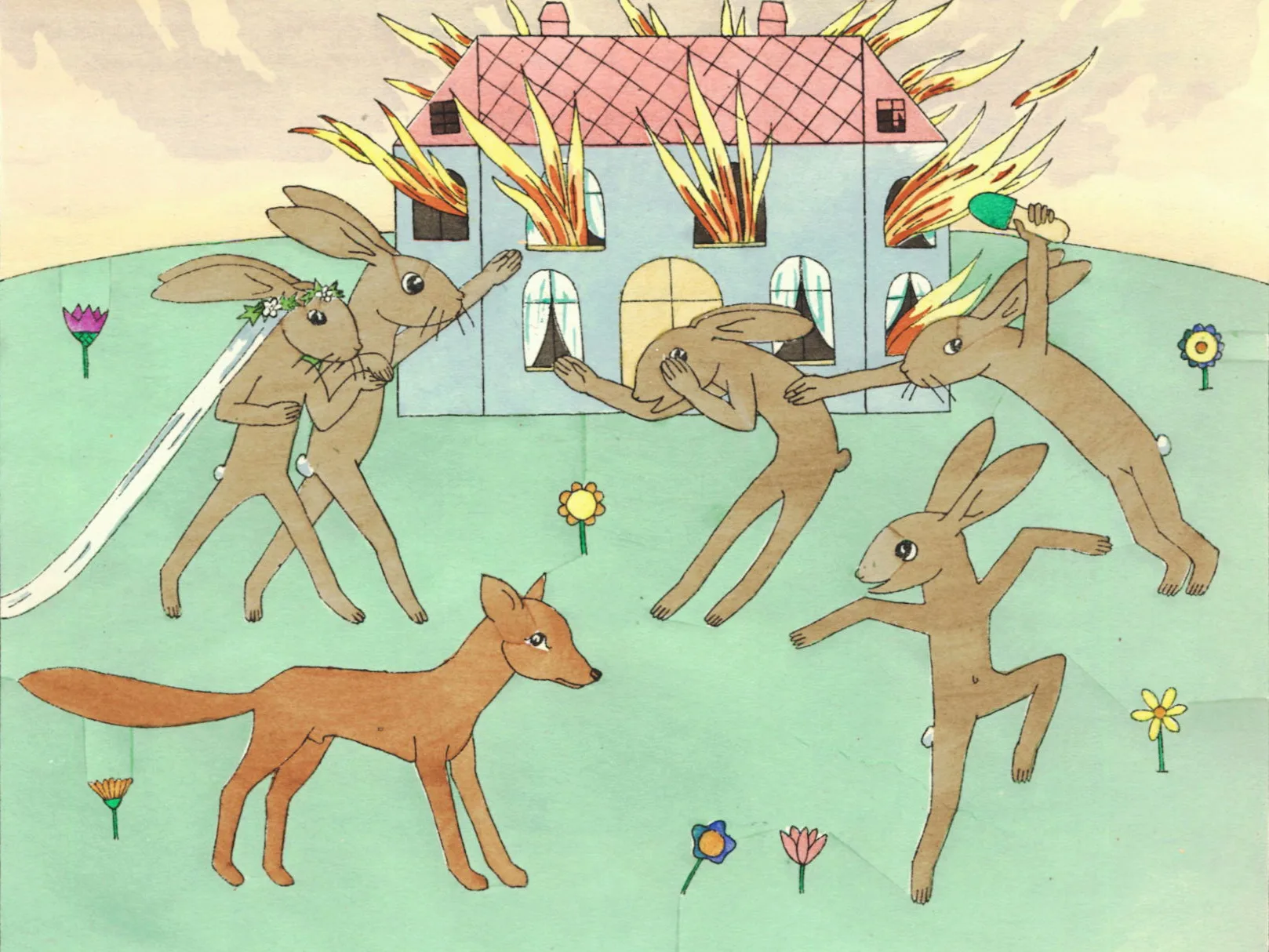
Hares and rabbits have been known to serve as messengers between the conscious world and those deeper warrens of the mind. In Tom Seidmann-Freud’s 1924 Buch Der Hasengeschichten (Book of Hare Stories), folk and fairy tales are collected from across the globe, chosen for their leporine heroes. The stories are often comic and bleak; their anthropomorphic animals live in worlds darkened by adulthood. Image sourced from the Public Domain Image Archive / Technische Universität Braunschweig See more at https://publicdomainreview.org/collection/tom-seidmann-freud-hare-tales/