I stood in the doorway. The room quieted. Everyone turned, a blur of faces. The teacher, standing at the chalkboard, smiled. She waved for me to enter.
Lined above the chalkboard were silhouettes like dark paper mirrors.
I stepped into the room (in yellow cursive underneath a few silhouettes, Jenny, Paul, Mary, William).
Maps of North Dakota, the US, and the world covered the walls, along with colorful photographs: a cloud shrouded mountain, a jade harbor in front of an old stone fort, a vast desert, a waterfall in ribbons of silver and white, thick rolls of bright hay in a field dotted with indigo blue ponds. On the board, in the lefthand corner, the teacher finished writing, I did not know it was impossible, so I did it.
I’m Mrs. Katz. Do you have a pass?
My father had talked to the principal for a few minutes before I began my first day. He twisted his oily leather gloves over and over, must’ve taken his hat off two or three times, unsure of what to do with it, ready to get out to the fields. Before leaving he gave me three dollars for lunch and an afterschool snack. We would meet outside the Crow Bar at 6:00 p.m.
Typed on a slip of paper were my name, birthdate, the Wildwood Motel’s address, room 24, their phone number, and that I was beginning the fifth grade. I had missed a few fall semesters because of travel and work, and I might’ve been eleven or twelve that year, one of those times when my father hoped for a big payday.
Hello, Manuel. For now, take the second seat. Mrs. Katz pointed to an empty desk, next to the windows filled prairie blue, a cottonwood that towered over the dirt playground swaying in the wind.
On the third or fourth day, someone knocked on the classroom door. A man said he needed to meet with me.
Of course, said Mrs. Katz. She held my shoulder and walked me across the room.
The hall was dark and quiet. The man stood near the classroom’s closed door. He wore a red tie, his glasses glinting from the light falling through the glass on the door. He folded his arms across his chest. His name was Mr. Johanson, he said, and then he asked me my name, where I lived, and my phone number.
I answered the first two, but told him you had to call the motel’s front office and leave a message. My father always says nothing can’t wait until he’s home from work.
Where did you live before?
Fargo.
And what school did you attend?
Oak Street, I said.
And it’s just you and your father here in Willingston?
My mother died, I said.
I see. Sorry to hear that, Manuel.
She had the influenza.
He asked me to count from 1-25. Then he had me say my ABCs.
Good, Manuel. He leaned forward.
One of the ceiling lights flickered. At the very end of the hall, through the glass exit doors, the sky had turned gray, and there was that metallic cold smell of snow on its way.
Mr. Johanson started down the hall. He said, Follow me.
Go do your homework—so damn important, go do it. My hands. A truckload of pipes. They’re killing me.
They were grayish blue, some of the fingertips were split, almost black, except for the blood just inside the cracked skin. My father spread his fingers as if he were about to grab another pipe, or clamp down on my shoulders and shake me until my neck hurt.
I’ll take out the fucking trash.
I hated when he talked like that—sometimes he could be a bastard. I knew unloading all those pipes wasn’t easy, especially in the freezing cold. We no longer met at the Crow Bar. I walked home to the three-room apartment my father had found in the back of a house on South Seventh Street.
I sat on the edge of my bed. The walls were lime green, and the gray linoleum was worn and cracked in spots that hurt my feet when I wasn’t wearing socks. I had stacked four apple crates against the wall by my bed: they were crammed with all kinds of books—adventure stories, mysteries, math books, fish encyclopedias—I had taken from the library’s free bin. I had a twin mattress on top of two pallets covered by a quilt my mother had made. I was always rereading my collection of National Geographics that were lined up in the top crate. The clock glowed 6:45 p.m.
There was a recent story about centenarians in Nova Scotia. In a photograph a man sat at a kitchen table, and the caption said: 100 years ago his mother gave birth to him in this kitchen. Behind the man, next to the stove, there was a clock, and I admired the shiny wood, a long gold pendulum caught in motion. The man looked happy stirring his tea. Sunlight fell through the kitchen window—I couldn’t see the numbers on the clock’s face. I didn’t know Nova Scotia from El Paso. I looked it up in a library atlas. There was something old, beyond time, I thought, looking at how the land was surrounded by so much ocean, like a whale breaking apart all those waves.
I opened my math book and considered the assignment. I had worked out some of the tables while walking home. I wrote down my name, my notebook balanced on my knee. Started the multiplication. I heard a knock at the front door. Paused. Heard a woman’s high voice, and then my father’s hoarse laughter. The door closed. My shoulders tensed. Talking. More laughter. Clinking ice. A jazz ballad on the radio. I stretched my neck, crossed out the numbers.
My father wasn’t always a bastard. He’d bring home hot dogs, slice them perfectly down the middle, and fry them in butter. He’d add a few eggs. I would slather mayo on the slices of white bread. He’d melt cheddar cheese on top. He had this trick of adding a tablespoon of water to the skillet, covering it with a plate, and in less than a minute the cheese would be bright orange and bubbling. My first bite—the yolk still soft. We’d drink tall glasses of ice water. Those sandwiches were the best.
There were times when I still called him papa. Slow quiet Sundays walking along the Missouri, his arm draped over my shoulder, the muddy current flowing next to us. When the fall had turned scorching, he took me to Plum Creek and we floated in a deep pool. His head tipped back, eyes closed, smiling.
My stomach grumbled. He must’ve forgotten dinner. Maybe they’d leave and I could make a peanut butter sandwich.
I heard a chair squeak, splitting wood, followed by his laughter. A thud against the floor. What sounded like a deep breath, almost wet. A truck roared down the street.
When I walked into the living room the woman was lying on the floor, her pale blue denim skirt above her thighs. She was wearing pink underwear with hearts dotting them. On the inside of her left thigh a dark tattoo of a bat, a bluebird, or maybe it was a fish. My father stood in the corner, his hands trembling at his sides, one of his front shirttails pulled out and wrinkled. His eyes dark stones, the whites streaked with fear, and his hair nicely combed back and glossy.
What did I do, Manolito?
I stepped closer. The chair was in pieces. When she fell back the glass she was holding must’ve cracked, and a large shard was in her neck. Blood stained her right shoulder and pooled on the edge of her curly blond hair. I could smell my father’s sweat, whiskey, mixing with something strong, earthy, iron-like.
Who is she?
From the bar.
I didn’t know what to say, what I could do. I started to recognize what my father had meant when he was yelling about accidents—spilling a glass of water, cutting my finger, a man at work who died. You can’t control them. You keep acting like they’ll never happen. You’ll know alright, he’d say, trying to explain my mother’s death. We had lived in Fargo, and they had great arguments because he wanted to go out to the oil fields. He went, my mother and I stayed in a motel, and then one October afternoon she passed away.
You’ll see, Manolito—you’ll have the consequences in your face, my father had screamed. And it won’t be fucking pretty.He was right. It wasn’t pretty at all. I was there for three days remembering my mother’s wet, red face, her closed eyes, her last sigh, before my father returned.
The woman on the floor was still looking towards the ceiling.
I knew I couldn’t stop time—this was an accident that would never end, one wave after another. I wondered what it would feel like to live in the same house for a hundred years. The floor looked sticky. The smell thicker. For some reason I told my father to get some towels. I bent down and took hold of her skirt. Her thighs were warm, the heat rising up to my hand. Who did she want to see that tattoo? For a moment, just before I let go of her skirt, the tattoo seemed to leap from her thigh, and it was no longer a bat or a bird. I saw a whale out in a wide stretch of sea breaking the surface, blue waves rising and crashing with white foam. I pulled the hem of her skirt down, let go, soft sound of denim touching skin. Last time I kissed my mother’s cheek. I heard the splash. Three months ago. Shivered with the cold sea.
My father was weeping, his breath jagged on my neck, and when I turned around he dropped the towels. His shoulders shook—I thought I heard his grinding bones. The clock ticked in the kitchen. I knew I’d have to hold him, or his shoulders might break from his body. How could I ever begin to keep him together?
I’ve returned to this memory often. So often in fact I can no longer tell what’s memory or imagination, and without that distinction maybe there’s no room for the truth. Or maybe that’s the truth. I have some jumbled details that I try to arrange into something like a pattern. The bare brown hills rolling to the horizon. My mother’s white blouse against the gray road. The short puffy sleeves tied with blue ribbons, and along her neckline embroidered red and yellow roses. I was sitting under some river birches at a picnic table on the edge of the motel’s parking lot. I had been writing when I felt her shadow, her hand on my shoulder. She took a ballpoint pen from her purse. Her dark hair was freshly brushed and feathered off her forehead. The roses blurred together. She was walking to the store. Remember, Manny, I’ll always love you she wrote on the edge of the paper. She handed me her pen. I remember her voice—insider her handwriting—whispering those words. As if she knew she would soon need to say goodbye.
It took some time to reach my father. I stayed with the owners of the motel. I’ve always imagined that on the second day a county sheriff or state trooper went out to the fields to find him. And then it took another day for him to return to Fargo.
Were there consequences after that woman died on our apartment floor? I didn’t learn her name, and I decided not to look it up. If I had, I wondered: what difference would it make? My father was jailed for a week. I stayed with a couple assigned to me by social services. Her death was ruled an accident. My father returned to work, became more withdrawn, drank with a greater fervor. We weren’t welcomed in our apartment. Luckily my father found us another. I had my room, set up my crates. My father slept on the couch. At night, through the wall, I heard him crying out in his dreams.
We never spoke of those days.
I never told him how my mother made me promise not to call for help. How in her fever she screamed for him. Her hair wet around her face—red, slick, twisted on that cold October day. Her nightgown soaked through. The peace in her last breath—her brow smooth, her legs no longer thrashing in the tangled sheets. My shame in not calling an ambulance. Then worse: I had to live with the fact that somehow I wasn’t infected.
My father wasn’t much for words—he threw himself into the days as if each was his last, then brought me to Willingston. I wished he would’ve told me why he loved my mother, how they met, why they stayed together. Anything.
The principal and Mrs. Katz would send notes from school. My father needed me to read them aloud. How I was in fights. Disruptive. Didn’t complete my homework. Silent. My father would speak with his leather strap, sometimes beating me until I almost passed out.
You’re better than those words, he would scream when he was done. What would your mother say?
I never told him about that day at school. It was so small, trivial, how could it even begin to matter in the bigger picture of what happened, his work, whatever loss he lived with. How Mr. Johanson, a speech pathologist, took me to a room, had me look at some cards with colorful objects and pronounce each one: red wagon, blue truck, star, grasshopper, cloud, prairie, river, clock. As if nouns were the most important thing in the world, when I already knew actions shaped my life. My father would’ve never believed that our last name made a difference, started my troubles at school. Our name was only a noun. My father wouldn’t have used that word—our name was only a thing. Nothing.
Curled up on my side, I’d shake in my bed, the welts rising on my shoulders like broken pieces of stone, glass, sharp waves. My shoulders on fire, my hands trembling still feeling the leather snap once, twice—snap after burning snap. Under the bottom of my bedroom door the light seeping through sparkled. My father’s shadow passed. If she could, I didn’t want my mother to say anything. I wished she could open the door, touch my face with her cool hand, and then I could believe everything would be okay, maybe say it aloud, maybe stop shaking. Accept her death.
You can go a long time without saying anything. That’s true of two people living together. You turn into a seashell, all that you have to say curves within, curves small, smaller, hard, harder, then seems to shatter. I only had to live with my father maybe five more years, all the time he needed to drink himself to death. I couldn’t hold him together because he found just what he needed to break apart.
Near the end he started talking more. We’d be sitting on the bench outside the Crow Bar, sparrows pecking in the dusty gutter, a passing oil train blowing its horn, his crooked and scarred hands clasped on his stomach. Before he went inside, and I walked home, he’d tell me about the dark green mountains that stood over his barrio, how they would sometimes mist like smoke on cold mornings. In the garden, a mango tree full of fruit shimmered red and yellow in the breeze. Butterflies. Ochre throated hummingbirds. Running with the bats in the twilight. Listening to the coquís sing from the trees. Across the dirt road, on the edge a cane field, a white ox was chained to a flamboyant tree. My father threw mangoes at its rump just to watch it raise its hoof, strike the earth, its belly powdered with red dust. He threw a mango high into the branches. The flamboyant blossoms fell like sparks of fire raining on the ox.
He was so old, Manolito. Pulled wagons for years. I wanted to keep him alive.
My father didn’t talk out of any sense of remorse. He had a pipe wrench in his hand when a strap broke. He said he fell to his knees, his hand buried in the dirt. He still held the wrench, covered up to his shoulder in the pipes that rolled against him, his ears ringing. His arm broke in two places. The weight crushed his hand, mangled his fingers, and the surgeons couldn’t save the last three. After a few months off and some physical therapy he found work. I don’t know how he learned to use his right hand again. That was the hand he draped around my shoulder as we walked, the hand that laid slices of cheese over our frying hot dogs and eggs, the hand that whipped his leather strap. And it was the hand that held a stubby pencil and drew my first whale. He called it La Ballena. The drawing was simple. He gave it dots along its back and a water spout like clouds rising in a thin line that spread out to meet thick clouds passing by in a deep blue sky. Simple. Yet in my mind I can’t seem to find. La Ballena. A man and a boy walking along some long-ago sea.
The more he talked the more he stared at his hands. Sometimes he would swipe his left hand like a machete along the darkened stubs of his right hand.
A crow in a tuxedo and a top hat, its face and bill a bright orange above us. The crow would flash on with a wide smile, the name Crow Bar over the top hat, and when it flashed off it was as if the crow spoke just before the neon sign went black and the red words Off-Sales blinked several times. Once the bar closed my father left with a bottle, and I’d find him in the early morning hours before dawn with his fingers spread on the table, a half full glass and the bottle between them, staring at some secret caught in the kitchen light glowing in amber.
I think he realized how far he had traveled—and for what. Work. Some money. Nothing. And my father really didn’t tell me any of these things. I try to remember what he said and all I have are the pictures. The small gray and black spots on the ox’s hide, the line of sweat and the rippling muscle along his shoulders, the rusted ring through his nose attached to the chain, how sore the scabs swarming with flies. A memory, I suppose, I’ll have until I die. Maybe somewhere near Fargo, maybe somewhere far away. A place where I’ll see my mother again. I’d like for her to know how long I’ve held on to what her handwriting whispered. Remember, Manny.
Fred Arroyo is the author of Alba and Other Songs, winner of the 3rd Gunpowder Press Alta California Chapbook Prize, and published in a bilingual edition (2024). His Sown in Earth: Essays of Memory and Belonging was shortlisted for 2021-2022 William Saroyan International Prize for Writing. He is also the author of Western Avenue and Other Fictions, and The Region of Lost Names. His writing has appeared in the anthologies Camino del Sol: Fifteen Years of Latina and Latino Writing and The Colors of Nature: Essays on Culture, Identity and the Natural World. Fred is currently working on a collection of short fictions, The Book of Manuels, and a collection of poems.
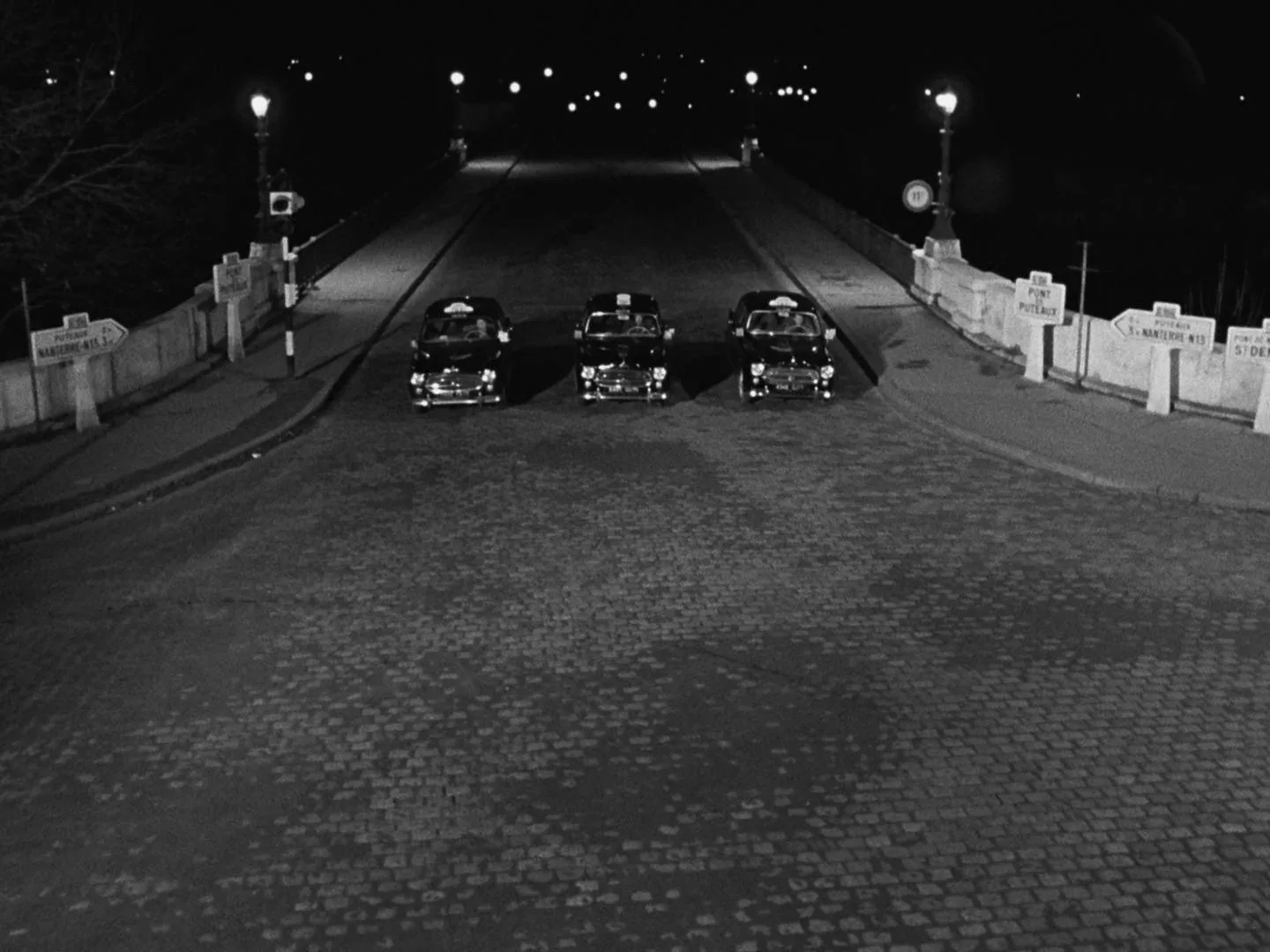
Stills from Witness in the City (1959), directed by Éduard Molinaro. The screenplay was written by Boileau-Narcejac, the pen name used by Pierre Boileau (28 April 1906 – 16 January 1989) and Pierre Ayraud, also known as Thomas Narcejac (3 July 1908 – 7 June 1998).