“I love it when you call me Big Poppa.”
The Notorious B.I.G.
My father began teaching at the Air Force Academy in the mid 1960s, soon after your father graduated from the school. I sometimes imagine a classroom encounter between the two men, these giants of our lives—my father six foot three and broad, yours six foot five with mitts like a bear, both born in 1940, in the middle of a world war, the Silent Generation; both hungry for leadership, but only one capable of achieving it.
In his classes, my father assigns articles from the New York Times detailing the atrocities in North Vietnam. When the academic year ends, Lieutenant Parssinen is fired from the Academy and sent elsewhere to finish his brief tour. Your father goes on to become a four-star general, second in command to Colin Powell during Operations Desert Shield and Desert Storm. You tell me this on our first date, when I keep losing my train of thought because of your beautiful face—the planes of your face, as I come to think of them; those cheekbones, concave and insouciant. I tell you your father is one of my heroes, then, for saving the place that I, an oil brat born and raised in Saudi Arabia’s Eastern Province, called home. There’s no one on this marble I’d rather be like, you say, and I envy you, because I fear the parts of me that are like my father, not the principled parts, but the reckless, reactive ones. The parts of me that seep beyond my borders and onto others.
On a recent visit to see family in Buffalo, my brother and I take Dad out to lunch at a local brew pub. We sit on the restaurant’s sprawling deck beneath an unseasonably powerful spring sun drinking frosty pints of pilsner while Dad tells us how his parents met in Oakland, his dad AWOL from the Coast Guard, his mom irresistible with her dark braids and Roman profile. When we get up to leave, my father rises toward his walker, large frame bent. My brother and I stand to either side of him—he recently fell while showering in the middle of the night—and watch as he sighs down into his seat, tries again, sits again. Finally, he is on his feet and moving, but we make it only halfway to the car before he demands to sit. This time he does not get up, and the restaurant manager calls emergency services. The EMTs, a young man and woman, wheel him to my car in the seat of his walker. They advise us to take him to the hospital and we oblige, driving across town to the VA, where Dad gets his healthcare for free thanks to his short time in the Air Force.
When we go on our first date, it is December 30th. Earlier that month, your wife filed for a dissolution of your marriage. Though I won’t file until March, I moved out of my family home in mid-November. You have not had sex with your wife in five years. I have tried to leave my husband on and off for eight. Because of this, we think we are ready for each other. I can’t believe this timing, we say. Like so much else about us, it feels fated—our dads and the Air Force Academy, our Reiki master siblings, how our grandfathers both attended USC. You grew up on military bases, and I grew up on Saudi oil compounds modeled on military bases. We both felt like we never quite belonged. A surprising number of actors are military brats, you tell me. Because of how often you move, you’re shapeshifters, chameleons, highly adaptable. You auditioned for Steppenwolf on a whim because a girlfriend did, only you got in and she didn’t, and she broke up with you soon after. After you break up with me, my therapist proposes that perhaps your ardency wasn’t love at all, but merely a terrific act.
At the VA hospital, the intake nurse makes small talk with my father: What branch did you serve in? Oh, the Chair Force! I’m an army guy myself. Then he asks my dad Which war? Korea? Dad says Desert Storm and I think it is the vascular dementia speaking, so gently I correct him: Vietnam, Dad. You were working for Aramco during Desert Storm. But he is adamant: Desert Storm. Saddam would send the SCUDs, and we would launch the Patriots, and shrapnel would fall all over Camp. It was just like…what’s the country Russia invaded? Ukraine. It was just like Ukraine.
My sister says that this is his standard answer now, that he was active duty in Saudi Arabia, and not an oil company employee hunkered in his closet with a company-issued gas mask, sending letters and Gary Larsen cartoons to his wife and children who had decamped to the States, to Bethesda, Maryland. At the time, while I tied a yellow ribbon around the tree in the front yard of our rental house, your father worked long hours at the Pentagon building a war strategy, both of us living somewhere off the Beltway, falling asleep worried about our fathers and the war unfolding across the ocean.
You tell me how, before the launch of Desert Storm was made public, your father drove home from the Pentagon to tell you and your sister in person. While CNN’s Charles Jaco narrated the war from a bunker in Tel Aviv and my father taped up the sliding glass doors of our company house in Dhahran, I hid in the coat closet of the Bethesda house, terrified.
I want you oiled and perfumed and ready for the act of love, you text me before our first date. When you arrive at my house, I am trembling. This is not a figure of speech. I am literally shaking with excitement. By this point we have already said I love you even though we have only had one lunch together, as colleagues. Before we ever met, the provost at our college selected you to evaluate my pre-tenure dossier, so you have read everything I’ve ever written. Short stories about the affair I had and the many times I tried to leave my husband, stories full of sex and shame and betrayal and weakness. Don’t make assumptions about the writer based on the story, I tell my students. Grant them the shield of fiction. Over and over, you tell me I’m unlike any woman you’ve ever been with, and I wonder if it is because to you, I am both myself and the women in my stories.
You are the first man in your family in generations not to serve in the Air Force. It is because of your disease, which gums up your lungs and gives you a persistent hacking cough. You are also the first male not to be named Henry, but you never talk about that. Your son becomes Henry V, which is the play you direct in the first season of our love. When you act in it as the narrator, I watch you, rapt. Your beautiful hands and resonant voice. That face. Even the cheap, ill-fitting suit bought on Amazon becomes perfect. In those early days you call me Gorgeous and I call you Mr. Chairman while fucking you on your office chair.
You tell your acting students to draw from the deep well of their shame in order to become transcendent on stage, because shame is the most powerful motivator. You say it so often that one of them parrots it back to me in my class, and I smile a secret smile, it’s as if you are there in the classroom with me. I smile because at that time, it seems to be one of those silly adages professors say to students in order to sound brilliant and deep; I don’t yet know that fear of shame is a major motivator of your life choices, and that you will one day grow ashamed of the flagrant emotions I draw out of you.
When we leave Saudi Arabia for Texas, my father can’t find a job for three years, and when he finally lands one, it’s only a matter of months before he gets sacked, on the eve of my sister’s departure for college. In his telling, he is the victim of their stupidity. He is the kind of man who says he likes to debate when what he really means is, he likes to argue; he is the kind of man who has problems with other men. This compulsion for conflict, this inability to hold his tongue even when his livelihood is on the line, means years of financial precarity for our family. Her senior year at college, my sister lived on yogurt and cereal, not wanting to ask mom for money, knowing there wasn’t much.
On the Buffalo visit when the EMTs are summoned to help my father, my sister and I visit nursing homes, just in case. At each one, when it comes time to discuss costs, the admissions person asks us if he will contribute anything from his savings. My sister shifts uncomfortably and replies with a nervous laugh that he doesn’t have any. At the end of his life, my father is living off a small social security check and his VA benefits. Your father, on the other hand, climbed the ranks with ease, a man at home with other men, good at following orders and always in control of himself. Soon he has many stars on his chest to prove his worth. When he retires from the Air Force, he becomes president of a national insurance company. He and your mother live in a mansion on Bainbridge Island. You tell me about a recurrent dream you have about that house, where you leave your family at the shore of Puget Sound and dive into the sea to swim with rainbow-colored whales. You say you think it is about meeting death.
When you and I discuss marriage in the first weeks of our courtship—when we discuss children and marriage and drive by a large red-shingled house we dream about buying together—you tell me about your trust fund. You tell me that if we are together, I’ll never have to worry about money again. I have worked since I was sixteen years old and never expected anyone to take care of me; I’m scrappy in the way of all kids operating without a safety net. But when I think of the millions of dollars that will one day be yours, I privately cry with relief.
You tell me how, when you first got to college in the mid-90s, you adopted a hip- hop persona, like the kids you went to high school with. You wore baggy jeans and white tank tops and had frosted tips and listened only to rap and hip hop, which is still the music you prefer, it’s always playing in your truck. I’ll admit, I love it, too, this music of my first school dances, with its Big Poppas and playas and hos and bitches. Yes, Daddy, reads the tank top in the photo that I teasingly text you.
As we leave the restaurant after our first date, you put your arm around me. Tucked under your shoulder like this, I feel your barrel-like rib cage, the one that houses your huge, troublesome lungs. Doctors speculate it is the sheer size of your lungs that has enabled you to live this long—long enough for a company to invent the miracle drug that returns your life to you. Your forties is the first decade when you are not told you are probably going to die. Despite the odds, you have made it to manhood, and maybe this is why at times you feel the need to overact the part: the deep voice which you confess you trained yourself into, the pickup truck, the playas and daddies bumping out of your speakers.
In your home office there is a print-up of a list your father sent you, What Every Man Should Know by Thirty, illustrated with a photo of Cillian Murphy in his Peaky Blinders cap. It includes advice that goes something like, If you’re having a bad day, go to work and get the job done anyway because nobody gives a shit about your feelings. Your father is a Republican, but you’re a Libertarian. Individualism is your god, and you believe fervently in the individual’s moral capacity for self-regulation—especially your own. In your view, it is the imposition of rules by an outside authority that activates man’s lizard brain, causing him to rebel. In other words, rules get broken because they exist. If they didn’t, and men were trusted to self-govern, all would be well. I don’t know why I write men here; why, to my mind, Libertarianism is an inherently male condition. I’m sure there are non-male people who hate rules and disavow the social fabric as necessary to human happiness. I just can’t picture them. I don’t know them. I only know you. You are my token Libertarian.
It is possible to see the germ of this thinking in your life experiences. You grew up in the shadow of the General, paragon of a certain kind of hyper-controlled masculinity, but also in thrall to your disease, your body always out of your control, until you, with pharmacological help, conquered it. I think of the five sexless years of your marriage, how committed you were to the role of Husband and Father, even if it meant a lifetime of loneliness. You act the Man to perfection, and the night of our first date, walking with your arm around me, I have never felt safer.
I don’t look to my father for advice; not anymore. Not since he and Mom divorced. Once she cast him out, my sister and I became the caretakers of his feelings. Needy and alone, he left behind my ninth-grade brother in Texas and moved to the East Coast, first living with my twenty-three year-old sister and her roommate, then moving to my college town, where he was always wanting to meet for coffee and talk for hours. I first saw my dad cry in the parking lot of Newark International Airport. When I told him I didn’t want to talk about the divorce with him, he sobbed with a force that frightened me.
My father is ruled by feeling, especially anger. When it spills beyond his boundaries, he needs many vessels to catch the overflow. The world judges such men harshly. They are childish and lack self-control; they cannot performwith the expected stoicism. He is an anxious man who is terrified of death.My sister likens Dad to a golden retriever, bounding around, demanding notice. We siblings remark the irony of him being born into the Silent Generation, whose men came of age in the aftermath of World War II only to be drafted into Vietnam, because our father can’t bear silence—when he’s not talking, he’s whistling, singing, or making up nonsense rhymes. One of his favorite pastimes is criticizing other people. Squatty body, low forehead, doesn’t know whether to wave or salute. These are a sampling of some of Dad’s favorite descriptors.
You and I have our first argument in a Mexican restaurant, about whether it is okay to need your lover, or if you should only want them. I have had a large neon yellow margarita, and I cry into our tortilla chips. Privately, I attribute this thinking to your Libertarianism: love as personal choice, rather than something mystical and beyond our control. I don’t understand your politics. How can the son of a four-star general wish to dismantle the state? How can a person who has lived with a chronic disease not believe in universal health care? How can your favorite song be Townes Van Zandt’s “If I Needed You,” if you don’t need anyone?
I don’t understand, and so I begin to pathologize. Not at first, but later, when we begin to break. You are the son of a four-star general, but you snuck out past curfew, drank, had a lot of sex from a young age because girls loved a general’s son, and they probably didn’t mind the tragic disease either, not with your pouty lips, those glacial blue bedroom eyes. You manage to get kicked out of Cal Arts for insubordination. Live fast and die young, because why not, if the die young part was already a certainty? I used to be a really angry guy, you tell me. Is anger the root of Libertarianism? Is it the party for kids with daddy issues?
When we make love, you bury your face in my armpit and inhale deeply, say you bet I’m as fertile as they come. In bed I am the Woman and you are the Man, though sometimes you ask me to choke and beat you—with fists, with a whip. Your most powerful fantasy is of us just wailing on each other. We fuck until we, slick with sweat and delirious, enter a trance state, where there’s only you and me and our bodies as we travel somewhere very deep. In those moments I love you more than I have loved anything, and I don’t give a shit about the difference between want and need.
When my mother visits, you take us to lunch and treat her like the mother of the bride. She has always liked a handsome man, and she is charmed by you. After lunch as we walk to our separate cars, I see that your front window has been smashed. Your tablet is gone, along with the leather journal where we wrote love letters back and forth, and the gold chain and pendant I gave you for your birthday. The chain belonged to my maternal grandfather, and the pendant my parents bought for me in Saudi, after the Gulf War ended, a golden shield inscribed with the words Operation Desert Storm, with tiny etchings of a tank and a fighter jet, my name engraved on the back along with the year, 1991.
I like to think that someone bought my pendant at a pawn shop and wears it over their heart, but I’m sure it’s been melted into gold bars, the kind they sell at Costco, where you buy me paper towels and hand soap and ant traps and once, a goose down comforter, to celebrate my tenure promotion. When your parents visit, you do not introduce me to them, saying that you don’t want them to think less of me, because you are still technically married and living with your wife and they are deeply Christian. But I suspect it’s because you do not want your father to think less of you.
The first time we agree to take a break, it is early spring and I have a panic attack on the side of a rural road and call you weeping. You try to tell me I don’t need you, that I’m strong, that I’ll be okay. When I tell you I feel crazy, you assure me in that resonant voice that I’m not. You speculate that maybe I think I need you so much because I don’t like myself. Later, when we are back together, you apologize, saying that you’re the one who doesn’t like yourself, and I want to crack my heart open and feed you all the love that is inside it.
In August when we break up for the last time, you tell me that I am too valuable for you to keep doing damage to us, like when you yelled at me the week before, sure I was going back to my husband, unable to hear the words coming out of my mouth: I love you, I love you, only you, more than anyone before. Not realizing that it is probably this love, its abundance and sincerity, that scares you the most.
Valuable, like I’m a watch or a necklace or a bullish stock. High-value woman: the language of incels. You tell me you can’t be with anyone right now, that you need to heal, and I believe you. For weeks afterwards, as we take walks and work out and fuck on the floor of my office, when I sit at your knees and cry from happiness, I believe you will come back to me.
After my mother leaves him, my father never loves again. In fact, as he often tells us kids, he is still in love with my mother, who dutifully visits him in the hospital after one of his many falls or surgeries. My mother and father had many happy years together, especially when they were young parents making a life together, when my mother’s own ardent love kept her from seeing his flaws. There are a lot of photos of them, arms around each other, laughing and smiling. You might view my father’s enduring love for my mother, long after the relationship was dead, as undisciplined, weak. I see it as beautiful, poignant, and tragic.
Whenever I visit my father, he speaks obsessively about the Gulf War years, when my mother got very sick, and he discouraged her from seeking treatment back in the States. Trusting her own instincts, she flew to Maryland and admitted herself to Johns Hopkins Hospital, where they discovered a brain infection and operated on her immediately. My father talks through these and other failures, flagellating himself, wanting forgiveness, seeking grace. He is a man in torment. This is the risk of too much feeling—that the past remains alive, and haunts you through regret. As a man, as a father, my dad has come up short by societal standards; even by my own measure. But as a human, he is achingly attuned to the movements of his heart.
In early November, after I send you a flirty email, you write me a single-line response, no salutation or signature: I want to be clear: I have a girlfriend now, I don’t want any confusion going forward. I can’t breathe. I call you and call you but you don’t pick up. I leave you a tearful message. Then I leave another one where I ask if you’ve cum on her face yet, or told her about your trust fund.
Ugly. I am ugly, you tell me the next day when we speak by phone. Such emotional incontinence disgusts you, I can hear it in your voice. You have survived a collapsed lung and conquered a deadly illness; you will not be drawn into unseemly and childish displays over matters of the heart. Perhaps your feelings for me were just another proving ground for self-denial, the wall you erected between us a moral triumph. Because it is impossible to enter the months-long fantasia we experienced without total surrender, and I think that scared you shitless.
The night of your email I call my brother, unable to catch my breath. He tells me to go outside and stand barefoot in the grass. He talks to me the whole time, voice steady and full of care. In the days that follow he does a remote healing on me and tells me my heart chakra is too open. Close that shit down, he says, and it’s true that my breastbone pops as if breaking apart every time I salute the sun in yoga, like all that feeling inside is trying to escape.
In the days following, I go to a Reiki master and ask for help with the pain. I tell her about us, my neediness and your avoidance, my heart like an open wound and yours well-guarded within its cavernous cage of bones. When I mention you have Cystic Fibrosis she nods as if that is the answer to everything. It’s a disease of the lungs, she says. People who have it are very protective of their hearts. I think of your poor posture, strange for a trained actor, the way you curve in on yourself. You don’t stand at proud attention, like your father must have for much of his life, and what is the opposite of pride?
Our breakup colonizes my body and mind. My heartbeat becomes irregular, and I have to wear a halter monitor, but the tests come back normal. At the doctor’s office I want to ask for a drug that will knock me out for as many years as it takes to forget. My therapist says that it couldn’t have been love because we’d only known each other a short time, and love takes time. Rather than face this possibility, I break up with her. I was engaged to my husband after three months, married after nine. That you and I spoke about children and cohabitating after three days did not alarm me.
I throw away the gifts and cards you gave me but cannot bring myself to discard the paper towels or comforter. The one because it is too wasteful, and the other because I need it, and so I think of you when I eat and sleep. People who love me instruct: Bury that complicated guy. He’s done, you have to let it go. He didn’t value you. You didn’t know him. Why let him live in your head rent-free? I remind myself about the panic attacks, how your pattern of avoidance made me so anxious my heart skipped beats. How you’re not just a Libertarian, but an Aquarian Libertarian, the most oppositional-defiant sign in the Zodiac.
Joke: What happens when you say I love you to an Aquarian Libertarian? He says Get off my lawn and then shoots you in the face.
I text a friend: The slogan of the Libertarian party is Become Ungovernable. How dumb is that???
Perhaps the heart, that rebel flesh, is a Libertarian, because God knows it doesn’t obey rules. We are always loving whom we should not. Maybe I wanted too much from you, daddy and lover and friend. Maybe you were acting all along, a bravura performance to deliver you safely beyond your hellish marriage. Maybe I was using you to bypass the grief of divorce because if I could just get another husband fast enough, I wouldn’t have to feel my family breaking apart. I wouldn’t have to figure out who I was on long silent weekends without my children or their father. Perhaps we weren’t fated, and I can choose to love someone new, as you have.
If you have any regrets about how things ended, I imagine you keep them locked down tight, far away from your vital organs. You aren’t on social media, but I can picture you as one of those well-muscled self-optimization influencers, the ones who wake and immediately begin disciplining body and mind in minimalist spaces devoid of other human beings, secular monks worshipping the god of self. Once, you got locked out of your house on a second-story balcony. Rather than text a neighbor or call out to a passerby for help, you dangled yourself over the edge and then dropped, smashing your wrist and ruining a tendon on the way down. That swollen, bandaged wrist has become, in memory, a symbol of your isolation. In it, I see an anti-social sickness, the kind that’s killing this country.
In some ways, age has gentled my father, slowed him enough to allow wisdom in. When I FaceTime him and my sister in the hospital, teary-eyed with anxiety over my ex-husband’s poor health, Dad gives advice that sounds distinctly fatherly: Tell him to get out of the house and move around, try to get out of his own thoughts.
The anger is still there, though. The ecstatic joy, too. The former when he talks about Trump, or the food at his nursing home. The latter when he’s listening to Miles or watching videos of his new granddaughter. My sister, his primary caregiver, makes room for it, as she did those decades ago in her New York apartment, when he slept on her La-Z-Boy chair. Back then, his demands were those of an immature parent incapable of standing on his own. Today, they are the requirements of an old man, and Tarja cares for him with the same dutiful grace.
A few months later, after a bruising year of falls and hospitalizations, my father dies. He suffers a massive stroke, after which he breathes for five more days but never opens his eyes again. It is the day after Thanksgiving. We have all converged on the VA Medical Center in Buffalo to sit vigil, but it is my sister who is with him at the end. She says when he breathed his final exhalation, tears fell down his cheeks. We wonder if this is just a response the body has in its final moments, but no; apparently, this is unique to Dad. It seems fitting that this expressive man would find a way to emote, to communicate with us one last time, even after being robbed of speech.
The hospital offers a small ceremony for the dead. They do not ask what kind of father or husband or airman he was. They offer it because once, he served his country, and now he is gone, and that is enough to deserve it. They drape Dad’s gurney in a flag, gather the staff on the hospice wing, then read a poem. Afterward, they play taps and we process behind him to the elevators, where we part ways for the last time, Dad descending to the morgue, while we emerge into the world as fatherless children.
In the weeks following his death, I think on the good that has come from my father’s emotionality, which for so long angered and shamed me. Whenever I dropped him back at his apartment, he always asked if I wanted to stay for a cup of coffee and shoot the breeze. Then, he would ask me questions and listen to my answers with careful attention, wanting to know my inner landscape, as he so desperately wanted to be known. He cultivated decades-long friendships, wrote hundreds of poems, kept a blog called The Harmonium, which was at surface level about music, but which was also about his mother, and George Floyd, and Hemet, California, where he grew up. One post is titled “Goodbye, Old White Men,” and ends with this line: So, get your shit together, men, and, whether you grow up or grow down…it will not make a hell of a lot of difference to the new ownership. Dad always rooted for the underdog, which made him a feminist and an anti-racist, among many other things. He taught me to love justice, and to speak courageously for what I believe in, as he did those decades ago at the Air Force Academy. He taught me a full-throated laugh and lightning-quick temper. He taught me through his open-heartedness a way of living that is fierce and full and sometimes wildly uncontrollable, but always honest.
Perhaps this is how I came to love you with such abandon. Because in that total submission, there is ecstasy and vulnerability, trust and truth. Most of all, there is hope. Hope in the chance to be made new by another soul. For that chance, I will throw myself on the fire again and again.
Death has freed me from the anger I felt toward my dad. That freedom leaves room for me to see the person more fully. Not as a man or father, but as a human being. He was always reaching for other people, talking to them, seeking connection and community. Even if he, because of his own battles, couldn’t always maintain those relationships, he knew that love and friendship, those embodiments of our shared humanity, were worth the reach, and the risk.
At night beneath the goose down comforter, I dream of our wedding. Your parents are there, and your sister. We are in the backyard of their home on Bainbridge Island, and the sunset paints the bay in sherbet colors as we say our vows. I am barefoot in a simple lace dress. The planes of your face catch the shadows and light. Then we walk to the end of a small pier, family members in tow, our sisters and mothers, my brother, our fathers, who are somehow not stooped with age but towering as they were when they walked the halls of the Academy. Together we dive into the water, which is clear as glass and full of glittering sea life, including the rainbow-hued whales of your dreams. Unlike in your dream, though, you are not alone. Effortlessly, we dance for hours, and I wake happy.
Keija Parssinen is the author of the novels The Ruins of Us and The Unraveling of Mercy Louis, both published by HarperCollins. Her work has appeared in The New York Review of Books Daily, the Atlantic Online, The Southern Review, Gulf Coast, Puerto del Sol, and in numerous anthologies, and has been supported by fellowships from the Truman Capote Trust, Yaddo, MacDowell, Hedgebrook, and Ragdale, among others. A graduate of Princeton University and the Iowa Writers’ Workshop, she is currently an Associate Professor of English and Creative Writing at Kenyon College.
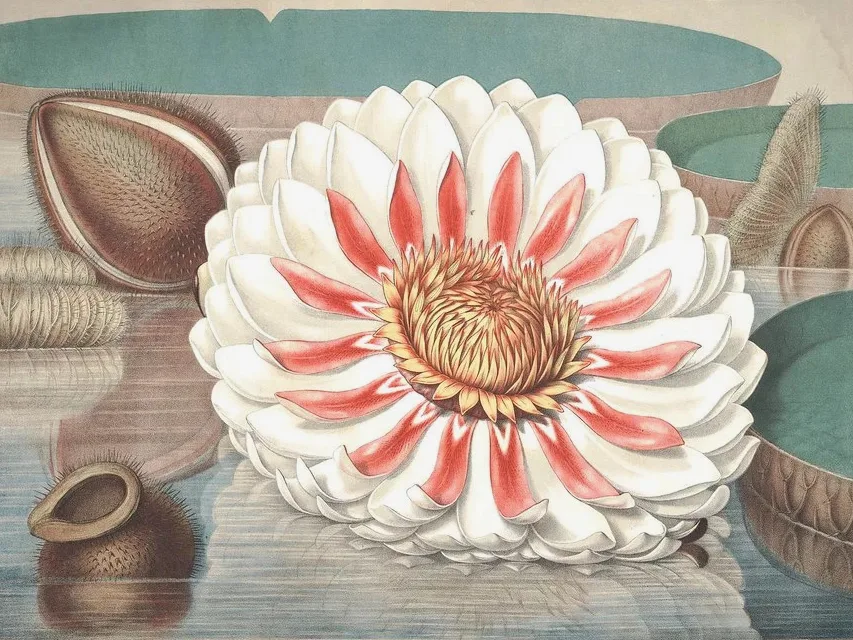
These color lithographs are to be found in Victoria Regia, or, The Great Water Lily of America: With a Brief Account of its Discovery and Introduction into Cultivation (1854), a work by amateur botanist John Fisk Allen which documents his attempts to propagate the Amazon’s Victoria regia (now called Victoria amazonica) in the more northerly climes of his hometown of Salem, Massachusetts. See more at https://publicdomainreview.org/collection/william-sharp-s-chromolithographs-of-the-great-water-lily-1854/