We had been running late for our friend’s wedding in Nikko after several wrong turns led us along a narrow road hugging the base of a mountain, my wife navigating our car with increasing indifference to the edge that overlooked a valley of rice fields. A truck driver in a bigger hurry than us coming from the opposite direction plowed right through us.
I remember lying on a dirt path cutting through the rice fields, covered in pain and having no idea how I was suddenly out of the car. My last thought was wondering where my wife was.
There was a sensation like a pool of water growing beneath me. I drifted between reality and the beyond, until I felt a hand close around mine. I couldn’t feel heat from the skin surrounding that hand, but I knew at once it was my wife’s. I squeezed her hand.
“Anna.”
The odd way my voice carried in the air – as though through ripples of water – forced my eyes open.
Before me was the impassioned scene of a car flipped upside down and on fire beside that narrow road, the truck gone. Several cars were stopped near the wreckage, people on their cell phones. The sound of sirens flirted with the air.
But I was away from it, and Anna was pulling me across the rice fields.
“You feel it, don’t you?” Her voice was little better than mine, distorted and unnatural, but I nearly wept with relief to know she was all right.
“Feel what?”
I followed her all the same, realizing with growing alarm that I couldn’t feel my feet hitting the ground anymore. It was such a natural series of responses for my body to contemplate – the muscles of my legs complaining, the bones and nerves assaulted by their continual push against the ground – that the sudden absence made my head spin.
“Anna, I can’t feel the ground.”
“Keep going,” she said, her head turned away from me toward a house I saw looming in the distance. “We need shelter.”
“From what?”
In place of an answer, my mind spiraled into panic as I came to the stunning realization I wasn’t inhaling anymore. My chest wasn’t rising and falling; I felt no need to make it do so. Though I could hear the wind and the growing sound of sirens, my skin detected absolutely nothing, either. Not the cold drying out the air as we settled into the winter months, nor, for that matter, the heat clawing around the destroyed car at our backs.
“Anna?”
Her grip tightened, but I felt no pain from it. Not even a hint of any pressure had been applied to the joints – only my eyes dutifully informing me she had done so.
Then, I felt the pull. As though a vortex had opened up above me, I was being torn upward.
“Anna, I feel it!”
At last, she turned to me, and the look of sheer terror on her face was enough that I began to fight against the pull.
“Please, you can’t go yet, Sora. I can’t go on yet. Please don’t leave me here alone.”
Alone?
Though the pull was beginning to feel more urgent, more impatient at my refusals, the idea that obeying its call and leaving Anna alone was enough that I snapped all of my attention away from it, back to her.
“I won’t go,” I said.
The pull remained, but it had grown considerably fainter. Anna watched whatever was happening to me, her eyes finding some semblance of calm again after my words, and she pulled me to the house.
Based on the holes plaguing the roof, the two rusted cars drowning in weeds beside the house, and the layers of dust on the windowsills, it was clear no one had lived in it for years.
“Here,” Anna said.
There was no front door.
“This is hardly safe,” I said. “We’re trespassing.”
She dropped my hand and took several steps toward the looming shadows within.
“No one will know we’re here.”
Anna, in her beautiful dress of light blue she’d only just picked out for the wedding, glowed as she went into the darkened home. Though I wanted to run from such a house of neglect, I followed her.
The living room we walked into was a diorama of garbage, with mountains of trash lining the walls cut through by rivers of black mold. One look into the kitchen, at the insects picking through what remained of rotting food left out on a table, and I knew the place reeked. For once, I was glad my sense of smell had also fallen victim to the car accident.
With my hands free, I could finally glance down at myself to see why I couldn’t feel the ground. In the terrible lighting inside the home, I realized my feet were casting a small shadow on the ground.
“Are we…dead?”
Anna, who had been wandering the house as though looking for a lost ring, stopped and turned to face me. It was nearly unnoticeable, but staring at her feet, she was indeed hovering just above the cracked and peeling floor.
“Yes, and we need to stay here. We’ll be safe here.”
I watched her float around the room – like we’re in water, I thought. The air had become our water.
“How do you know that?”
“I don’t.” She continued floating around, distracted, her eyes everywhere but me. “I’m just hoping.”
“What are you looking for? I can help.”
She wandered toward the stairs, which were missing a few steps I followed.
“I just want to see if the pull feels any weaker anywhere in this house.”
“You feel it, too, then.”
“Of course. As soon as I saw my mangled body beside the burning car, I knew I was dead. The pull came right after that.”
She simply floated through the piles of trash lining every room on the second floor. It seemed unfathomable that one house could contain so much putrid clutter. The mysterious stains on the walls of varying shades of gray and green and the incessant sound of water leaking somewhere were signs that we needed to leave. Yet Anna seemed intent on staying.
“And why can’t we…go on?”
“We can’t,” she simply said.
After ten years of marriage, I knew well enough that she didn’t want to talk about it anymore. Thus, I followed her like a shadow throughout the house in search of a place with a weaker pull on us while I inwardly tried to guess at her hesitation.
We settled on the bathtub on the first floor, housed in what was likely an extension that jutted out into an overgrown yard littered with plastic wrappers from convenience store bread and bottles.
While the bathtub had taken on a life of its own, covered in grime from years of neglect, the pull to whatever lay beyond was weak enough there that I could almost ignore it when we were within its parameters. It was awkward for us floating there, though, and just picturing it in my mind’s eye, I couldn’t help but laugh at the absurdity of it all.
“If I had told you this morning that we’d end up hovering in someone’s forgotten bathtub, I would’ve assumed you’d lost your mind.”
Anna simply nodded at the little joke, her mind clearly preoccupied with what troubled her. It was easy enough for me to tell she was upset, at least. The deep way her brow furrowed, even in death, and the storm that always seemed to cloud her eyes in times of distress were all still there.
Of course, I thought to myself, it would make sense she’d be upset we were dead. I would have felt more upset, too (and maybe I would later), if not for Anna being there with me. We were in unknown waters, but at least we were together.
“Well,” I said, “at least I know you can’t possibly be worried about us being late for the wedding anymore.”
As soon as I said it, I wished I could suck it back into whatever comprised my form. Peering down again at my arms, hints of light peeking through the soot-covered window caused parts of my arm to sparkle. I expected Anna to rail against me for making light of death, but she simply nodded, biting her tongue with what couldn’t possibly be teeth anymore. Yet how much she looked just like herself, even in this new form. I was still me, too. I felt like we had a lot to be grateful for, though it bothered me Anna still seemed upset.
“Please,” I said into the confounding silence, “if you could just tell me what’s bothering you. I think we’re going to be in here a while, so if you could just tell me.”
“No.” Anna shook her head with increasing fervor, her hair whipping behind her without coming undone from the pretty half-up style she’d worked it into earlier that morning. “No, no, no, I can’t tell you. You’ll hate me forever.”
“I doubt that,” I said, and I felt no hint of the muscles tightening in my throat to force my voice into a level of calm. It simply was. “But I can wait until you’re ready. I’ll stop bothering you.”
She took my hand into hers again and kissed the back of it.
“You’re never bothering me.”
It was difficult to tell the passing of time, but I think a good estimate was watching the rate of decay in the wooden beams over our head in that little bathroom addition. I watched and vaguely assumed every piece of the wood falling to the ground as dust would mean at least a year had gone by, though I’m by no means an expert on such things. Still, I would venture to guess a good decade passed.
Of course, not all of that time was spent simply floating above the decrepit bathtub. When we felt brave enough, our grip on handling the relentless pull firm enough, we would take turns venturing around in search of where we were exactly and how we might make it home again. We could only tolerate perhaps a day at a time away from the bathtub, though, and it felt like the pull was only growing worse as time ground on. Or perhaps we were simply growing weaker to its call.
Several times, I broached the subject of us simply moving on, but Anna would hear nothing of it. Something was keeping her on earth. Though we had no children, no pets to worry over, Anna insisted we stay.
And then, one fine spring morning, a man wandered through the house.
Wearing what I assumed was an industrial mask and heavy-duty gloves, we watched him navigate his way through the trash that had all congealed together into a kind of sludge, kicking at some every now and then and watching the spray of dust and toxic particles waft into the air.
Since our coming into the house, no one but us had gone anywhere near it. Not even wild animals seemed interested, and the insects had all left once the food was wasted. It felt altogether refreshing to see a person of flesh and blood wander the house, and so I told Anna I wanted to follow him around as he inspected everything.
“Please don’t be gone long,” Anna said, her hair as perfectly kept as the morning she’d done it all those years before. “I don’t want to be left alone while he’s here.”
I couldn’t help but laugh. “Anna, I doubt he can even see you.”
“The living…they frighten me. She shuddered and hugged her sides.
While I had taken to the afterlife with a kind of jovial curiosity, Anna existed in a state of near paranoia that something worse was going to happen to us. She clung to me as she never had in life. Rather than finding it irritating, I found a sense of protection grow within me as I’d never felt before.
And so, I was interested to see this living man in our home, but I was also wary of him. I wanted to know what he was doing and when he would leave.
The man in the mask kicked his way through the living room, I a few paces behind him. If he saw me, he never acknowledged it. He was perhaps 40, with a smattering of gray among the black hair neatly trimmed atop his head. I could see the sweat trickling down his neck, the way his chest heaved as he pushed over a stubborn pile of rusted cooking ware in the kitchen. I loved watching him leap back and gag when he opened the fridge, imagining what he could be smelling.
All in all, he seemed rather harmless, and I took a liking to him.
“He’s gone,” I said to Anna a few hours later. “I don’t think he likes it here, and I doubt he’ll return.”
Anna would only shake her head, still holding her sides as I held her in my arms.
The man returned what I guessed was a few days later. This time, however, he wasn’t alone. Armed with a group of people all wearing masks and gloves, each carrying a trash bag, they dutifully marched into the house and began attacking the trash.
The noise when a pile of trash in the hallway came crashing down broke us out of our serene embrace, and I lifted my head from atop Anna’s to better hear. It sounded like they were trying to break the entire house down.
“Let me go see what they’re doing.”
“They’re going to push us out.” Anna’s voice was small in my arms. “I can’t go.”
Rather than ask her, for the thousandth time, what she meant, I simply nodded and said, “I know.”
I left her in the bathroom and watched the group of six people, some as old as my grandmother, begin sorting the trash. The three younger men piled the large appliances in the overgrown yard, dutifully putting tags on each for the local trash-collection company to pick up later. Two old women were in the kitchen wearing white plastic gloves and surgical masks as they sorted the trash into metals, plastics and burnable material. Every grimy window was open to allow a cool breeze through the house.
These two women immediately caught my attention – not for how methodical they were sorting someone else’s trash, but for the glow they had around their bodies that the younger four did not possess.
I wandered closer to them and marveled at the faint orange light they emitted. It spoke of years well lived and time that had nearly sanded their bodies down to skin and bones. And yet they laughed as they worked, bantering about the latest TV show or antics one of their dogs had gotten up to.
“I think Pochi won’t go near me when I get home I smell so bad from this house,” one of the women, sporting a green bandana to pull her brittle hair back, chortled to the other. “It’s like it’s coming up from the floors.”
“That dog is so old, I doubt he’ll notice any difference at all,” the other said with a laugh and used the weight from her upper body, such as it was, to push down rotten food deeper into a plastic garbage bag. Her hair, probably dyed black, was pulled up into a tight bun at the top of her head.
“Aren’t all the young people supposed to move to Tokyo?” the one in the green bandana said.
I floated along toward the open refrigerator that was now empty and saw out the open window that the two youngest men were hauling a thick TV set onto the lawn now.
This, I thought in complete wonder, is what living is like.
After so long in that abandoned house, I had completely forgotten.
“Ren said it’s cheaper here for him, and he only needs to go into the office once a month, his boss said.”
“And you must be happy he’s closer to home.”
The two women continued conversing as they worked, oblivious to my existence. I wandered to the one in the bandana and watched my hand go cleanly through her shoulder blade, but there was no reaction. I was little more than a boulder in a river, condemned to observe the flow but never move.
The six people continued to clear the house of garbage until the sun began to touch the horizon. Not one of them noticed me; no one seemed particularly bothered. I’d always assumed someone would feel us in that house, but it was like we didn’t exist. I didn’t like that, and I wanted them to leave.
Beyond the need to protect Anna, I hated being so abruptly reminded of what I was missing now that I was dead. I hated seeing them laugh and talk to one another, interact with everything around them with ease, and when they grew tired of the house, they could simply leave.
As soon as they were out of the house, I went back to Anna’s side in the bathtub, too wrapped up in reporting to her to note there was no sound outside of a car engine starting, nor any hint of anyone actually leaving. Safely in my arms again, I told her about the piles of trash so easily cast out and the way the older women seemed to glow.
“Their time may be ending soon,” Anna said. “That’s all I can think of.”
“We should find a new home.”
“No, we can’t go. The call is too great.”
“We can’t stay here – someone wants to live here.”
“We have to,” she said, her form trembling in my arms.
“Anna, we have no choice. I can’t be around them any longer. I can’t…I can’t bear to see them.”
Rather than ask what I meant, as I had dreaded I might have to explain, Anna simply buried her face into the folds of my still-pristine dress shirt and said, “I know.”
“Please, let’s-”
The lulling sounds of someone chanting in the living room stopped my voice cold in the air. While I couldn’t make out the words, the effect it had on us was undeniable – the pull grew exponentially with every nonsensical word.
“Wait here!” I cried, and I ripped my way through the walls until I was in the living room.
A priest from a shrine in flowing white stood in the living room waving something around and chanting while the two old women and four younger people knelt behind him, their heads bowed even as sweat dripped from their brows onto the floor.
It was nothing short of cruel, the living parading their sheer vitality around me all day, then using a priest to force us out. I had wanted to leave anyway, and yet they were treating us like intruders.
“Stop it!” I screamed. “Stop!”
The chanting sliced through my pleas. No one turned to me.
The pull grew.
I frantically clawed my way back to Anna, who had crumpled to her knees in the bathroom, holding her sides, her eyes squeezed shut from the effort it took to simply stay there.
“No, no I can’t go.”
For how frantic I felt, her voice was remarkably calm. Final.
Throwing my arms around her, I kissed her cheeks, though I felt nothing.
“We have to go,” I said. The pull was so strong I could barely think through my words. “It’ll be all right.”
She suddenly looked at me with a lifetime’s worth of agony trapped in her eyes, and I nearly pushed away from her, from such misery. We couldn’t both be miserable. One of us was to be the anchor to the other.
“It’s my fault!” she cried.
“What is?”
“The car accident, our deaths.”
“No, no, it was that damned truck driver’s fault.”
“No, I saw him, Sora. I saw him, and I didn’t swerve. I saw him barreling at us, and I thought he was just being a bully, and we were in a hurry, so I didn’t swerve. I thought he’d stop. It’s my fault!”
She lowered her head as though too ashamed to look at me, but I simply lowered myself down until my face was beneath hers, so I could look up into her lovely eyes. It was quite the feat, I have to say. Maybe it would be the last great thing I did before I was entirely forgotten.
“It’s all right.” I smiled as best I could, even as the pull was like a roar of wind in my ears. “This time with you, it’s been wonderful.”
“Here? In this awful house?”
“It’s an awful house,” I agreed, “but you were here.”
“I’m so sorry.” Her voice sounded choked with tears that would never come. “You should have had a fuller life.”
My final thoughts turned to the seven people in the house, at the older people who had managed to avoid death for so long. Envy swelled within, but I swallowed it back.
My final moments needed to be focused on Anna; not on what I didn’t have.
“It’s all right,” I told her again.
A hole in the air above us tore itself into being, and bright, orange light cascaded down from it, drowning us.
As the pull dragged us into the source of the light, now in an array of colors I couldn’t begin to name, I cast aside my regrets and bitterness toward a life ended and held onto Anna, delighting instead in the fact she was holding onto me, too.
Sarah Hozumi is a writer who has lived near Tokyo for about 17 years and has loved almost every moment of it. She had a short, dark fantasy story published with Literally Stories and a short romantasy story published with Flame Tree Press in April this year, and she was a finalist for the 2025 Baen Fantasy Adventure Award. To read the short stories she’s had published, and to read her blog mostly about all things Japan, please visit sarahhozumi.com. You can also follow her on Facebook at sarahjhozumi and Instagram at @author.sarah.hozumi.
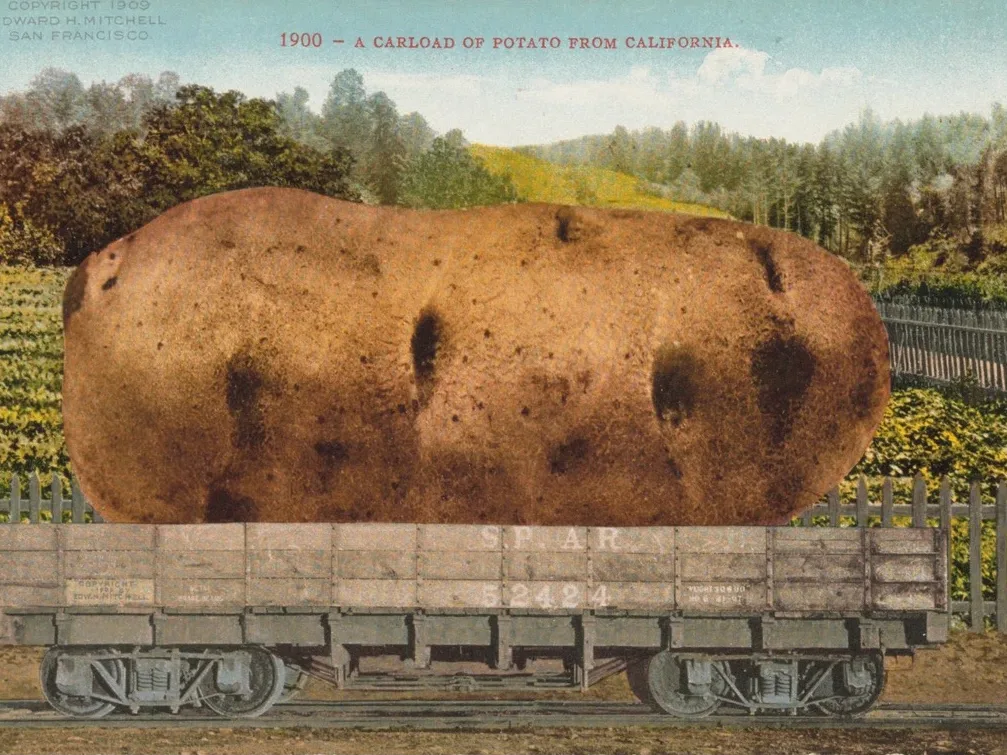
Postcards of Giant Produce (1888-1909) sent as hints of the bounty of California farms. For more details, see https://publicdomainreview.org/collection/giant-produce-postcards/