The need to defend yourself is what occurs to me as I sit in this hospital room, looking at blank paper, breathing to my mother’s suction machine. She doesn’t know or believe what’s happening to her. She is too nervous and afraid to collate information. She doesn’t want to be touched and doesn’t want to be left alone.
Her universe is going dark. She is fumbling in the chaos. She wants to go home.
The imposition of order, or the solicitation of it. The distinction is important, but it melts away once you are close to the wire.
The significance of the word. My mother doesn’t or can’t say very much. The only clues I have are the changes in her face, and they aren’t enough to convince me that I know what’s going on behind them. The old Indian scriptures were written in Sanskrit, a very concise yet immense language. Thousands of poetic and analytical pages which try to speak adequately of spirit, reality, ultimacies. There is a reverence in these pages, a reverence that runs throughout the Indian tradition, for the word as the best expression of whatever is beyond words. And the sound of the word: what Bengali poet Tagore calls the music of the infinite.
There are few sounds like that here. Water bubbles through machines, people walk the halls attached to bottles of yellow liquid. One woman in a pink robe looks thinner every day, but she can still pace the corridor and talk to everyone she meets, as if to make up for what she’ll lose later.
My mother belongs to the Church of the Living Word. Living. Today, two of her born again sisters came to visit. One read from the New Testament, sections on what miracles can be accomplished by faith. The other offered me a bath in the Lord’s light. She said she is just an ordinary person who’s been filled by the Lord’s love and forgiveness. She’s been saved. I am a project to be saved as well.
I move into the hall outside my mother’s room and read a review of Knife in the Head. Praise the Lord.
My mother has cancer. She’s been ill for six years. She’s 53, the same as her own mother, when she died of the same disease. My great-grandmother was 33 when she died, cause unknown. My age. On my last birthday, my mother could barely wish me a happy one. It was on my birthday, six years ago, that she was diagnosed and sent to the hospital for a mastectomy. Neither of us forgets that.
“Neti, neti.” Not this, not that. Somewhere in the Upanisads, amid all the eloquent Sanskrit, these two words occur. By the time the reader comes upon them, not all, though much, has been said about the ultimate realities. More indeed will always remain to be said. The continued, considered use of the word refines the senses, brings one closer to these realities, and sharpens one’s awareness of a distance that can never be bridged by rational processes alone. So, not this, not that. Life, death, the heart of the matter. It’s easier to narrow the range of possibilities than to make positive assertions. Less presumptive, perhaps. Sitting by this bed, responding to my mother’s hopeless requests to be made comfortable, I have so little to go on. To say anything is absurd. To say nothing, to have nothing to say, is too difficult.
She wakes up again, briefly. The church people have left. What’s happening, she asks. We share the same questions, at least.
The need for order, to see cycles, phases, symmetry. To come up against the gaps where these concepts do not apply, and what? If one exhausts the interpretive categories, the intuitive ways of going, one can hope for a spark, or be surprised by one.
Two years ago, my father related an incident to me over the phone. A large crow had come into the house through the fireplace chimney. It made a circuit of the living room, then flew into the dining room, adjacent to the kitchen. Before he could open the glass doors to let it out, the distraught bird unburdened itself several times on the sheer blue drapes covering the doors. My mother was frozen in the kitchen, lunch on the table. All she could say was “If it pecks me on the head, I’ll have to go to the hospital.” Her head was bald at the time. It seems safe to say, when I put this together with other things she has said and done in the last six years, that everything has been seen as an indication of her tenuous hold on life. Everything was a threat to her delicate balance. No actual reference to cancer was tolerated, though. Her friendships were made and broken on this deference to her sensibilities. She cried often, something she has always done to protect herself.
She began to expand into unfinished parts of the house. The basement was turned into a paneled, carpeted room, good for big parties and dancing the Tarantella. Lots of echoes. The garage was turned into a sunroom with rattan furniture, more paneling, and rugs. Oranges and browns, colors to assure herself she’d be alive in the Fall. Then outside the garage, an extension of the roof, indoor-outdoor carpets, cast iron railings, an old-fashioned lantern in the corner. The spruce trees out there have grown very full and tall. She talked about cutting them down. They were planted 15 years ago, when she was more confident. Now they made her feel dwarfed.
I look at her now and she’s dwarfed by everyone. She looks like an old baby. She’s smiled once in the week I’ve been with her. That was when she introduced me to her minister. She looked right at me but I didn’t return the smile and don’t think, now, that I’ll have another opportunity. I regret how her face retreated then, hurt.
She’s been eating less every day, becoming more impatient. She pushes my father away, but wants me to spend the nights with her. Once she thanked me for that. Me, wordless again.
“A Bird in the House,” Margaret Laurence’s story. A bird in the house means death, it says. I wonder if my mother knew about that idea the day the crow came down the chimney. If she did, she would have believed it. If she did, it would have been behind her campaign to expose any dark, concrete corner to the light.
But then the house was finished and she wasn’t getting any better. Her church affiliation changed suddenly from Roman Catholic to born-again Christian. From saints and statues and pilgrimages to total immersion in Jesus. Paraphernalia is unnecessary when Jesus is everything. When everything worth saying has been said in the only book worth reading.
Once she joined the Living Worders, things changed. Friendships were based on religion and detachment from icons. She began to talk about her illness. She appeared on the minister’s TV show, The Truth. She announced her decision to discontinue medical treatments, to leave herself in the hands of Jesus. Other people with cancer called her for advice.
When she spoke to me by phone, she was sometimes flippant. Once, just after I’d talked with her doctor about the dire consequences of refusing further treatment, she called to tell me about a party she’d given for my paternal grandmother’s 80th birthday. Pretty good for somebody who’s supposed to be dying, huh, she said. The minister had, by then, told her she had already been healed and would live a long life.
Now, in spite of her impatience and irritability, she is able to hug this minister and promise to put in a good word for him in heaven.
My father comes into the room. He has been working all night and comes here directly from the bakery. In his hand is a box of cookies for the night nurses. He worries about my mother at night and wants her to have all the attention she needs. A cookie can do almost anything, he tells me, delivering it like an old and revered bit of philosophy. I worry about his connection to reality. He still talks about taking her home once she gets her appetite back. Maybe we can prop her up, he says, get her going again. We can do it, he says, and the way he says it makes me feel like the last of the hard nosed cynics.
This is not the time or place for a spark, of anything. The more I think, the more I am in a bog. I wish I could talk to her but I came here too late for that. Just a month ago, my father said, she was beautiful. Talking, walking around, eating. Now, he said….
She’s asleep again. The nurses are beginning to come in more often with injections for pain. The suction tube was removed a few hours ago, and her breathing is beginning to sound liquid. My father is afraid and calls for the doctor. That’s the way people sound when they’re close to the end, he tells my father. They clasp hands and my father cries. I can’t believe it, he says.
It’s getting late, 11:30 PM. My father goes into the lounge and stretches out on a couch. A contingent from the church has arrived, and promises to let him know if she wakes up. He wants her to ask for him. I stand in the doorway, looking in. My mother’s youngest sister has just come and gone, my grandmother is on the way out. My grandmother is very vocal about her feelings, wailing out into the hall. There is too much noise, too many people. One of the church members for whom my mother had a special fondness runs his fingers through her hair and sings to her. I take myself to the lounge to sit.
Someone comes shortly to rouse my father from the couch. I follow them back to the room. We are in time to catch her last slow breath. I watch her face for a long time and know I’ll never forget it or want to.
It’s almost midnight. Monday, my father’s day off, the day they always spent shopping and doing the town. She almost made it through the whole day. She even made this convenient, my father says. She waited for my day off.
Two days later there is the funeral. She is put in a mausoleum, and there is another ceremony. The minister makes a few remarks. Many of you out there, he says, are too lost, too proud to give yourselves to Jesus, but not Rosemary, he says about my mother. She has a hope and she is with Jesus. Where will you be, he says, when you’re in her place?
There is food waiting at the house afterwards, prepared by church people. All I can do is rejoice, they keep saying. My father sits with the minister. They talk about my mother, about the wonderful thing she did going on TV and sharing her experience. Later, my father tells me he’s going to get a videotape of the show so that whenever he wants to see her he can just turn on the set and watch.
The words spoken here are thick. They clog the senses. The last thing my mother said was “hurry, hurry.” I don’t know who she was talking to or what she meant. She died, I know that, but the word is like dust. It can’t be grabbed and turned and examined. She died, she’s over, she’s come to an end. No embellishments.
In the Upanisads, the ultimate is not a god to whom all must submit or be forever lost. Any person can be revered on the basis of what she carries around inside of her. Everyone has the seeds of their own perfection in themselves, though some have more awareness of the possibilities than others.
What’s happening, my mother wanted to know. What did I do?
Neti, neti. Not this, not that.
Sarah Louise lives in northern Colorado by way of New York, Canada, and New Mexico. Her stories and poetry have been published in Quarry, The Fiddlehead, Prism International, Contemporary Verse II, Descant, The Canadian Forum, Canadian Woman Studies, The Cimarron Review, Vestal Review, Sixfold Poetry Summer 2018, Epiphany, and Defunkt.
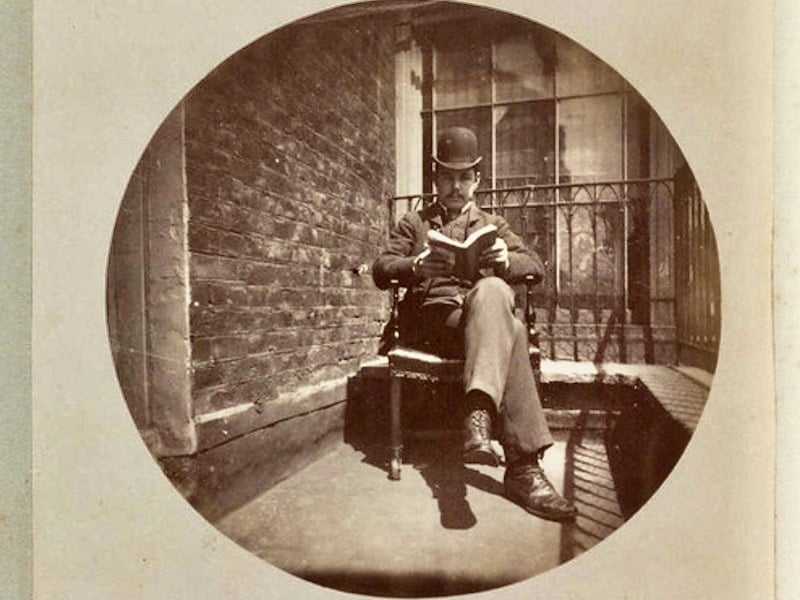
Photographs of northern Norway in 1881 by Charles Rabot (1856 -1944) From Public Domain Review